Malachite with Cerussite from Yanga Koubenza Quarry

SKU: B_36_0031

The specimen features dark green malachite, which serves as a backdrop for contrasting crystals. Colorless cerussite crystals and clusters of azurite are visible on the surface and inside natural cavities. Main Features: three-color paragenesis; high luster of cerussite; mossy habit of malachite; deep blue of azurite. Condition: Good.
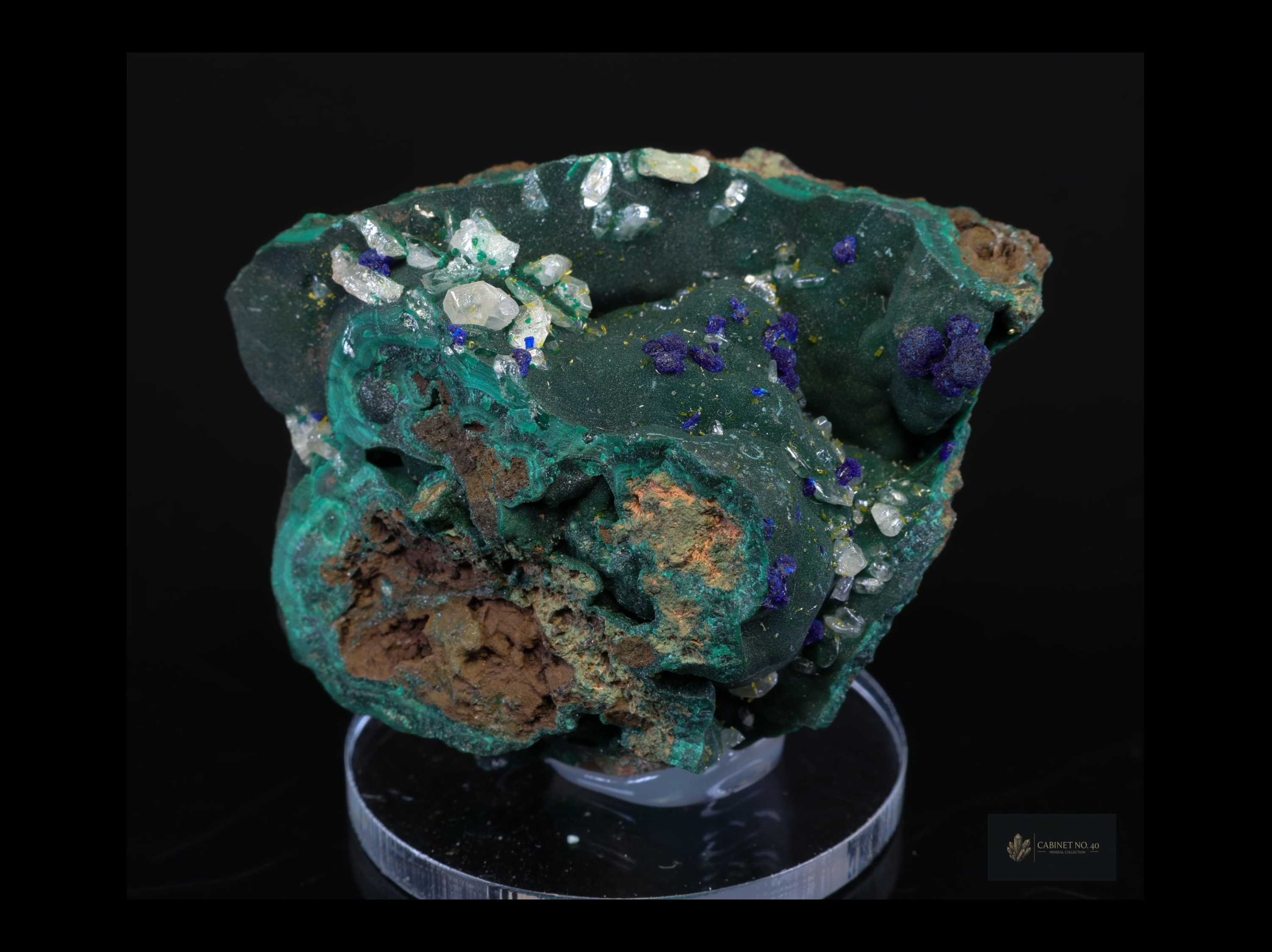
Malachite with Cerussite from Yanga Koubenza Quarry

Price: 32 EUR (139 PLN)

Availability: In stock

Location: Yanga Koubenza quarries, Mfouati, Mfouati District, Bouenza Department, Republic of the Congo

Size: 39 x 23 x 30 mm

Weight: 35 g

Chemical formula: Cu₂CO₃(OH)₂

Mohs hardness: 3.5-4

Characteristics Malachite is a secondary copper mineral, often found in the oxidation zones of copper ore deposits. Typical malachite specimens are characterized by radiating, fibrous, or botryoidal aggregates; well-formed crystals are rarer. Its color is always green, ranging from light green to dark, almost blackish-green, which is its most recognizable feature. It often forms concretions with concentric bands of varying color intensity, giving it a decorative appearance. Physical Properties Malachite's hardness on the Mohs scale is 3.5-4, making it a relatively soft mineral. It has a specific gravity of about 3.6. Malachite's luster varies from vitreous on crystal surfaces, to silky in fibrous varieties, to dull in massive forms. It is an opaque mineral, although thin layers can be translucent. It exhibits perfect cleavage along {201} and poor cleavage along {010}. Colors and Varieties Malachite occurs exclusively in shades of green, from light green, through emerald, to very dark, almost blackish-green. Color variations often result from differences in structure and impurity content. Some specimens show characteristic banding, creating patterns resembling agates, which is prized in jewelry and sculpture. History and Name The name malachite comes from the Greek word "malache," meaning mallow, referring to the green color of the plant's leaves. This mineral was known and used in antiquity, for example, in Egypt for making jewelry, amulets, and as a pigment. Its discovery is not attributed to a specific person or date, as it has been used for thousands of years. Uses Malachite is a valued ornamental and gemstone, used for producing cabochons, beads, sculptures, and inlays. Due to its color and patterns, it is popular in decorative arts. Historically, it was also used as a pigment for paints, although its use for this purpose is now limited.

Diagnostic features

Identification Malachite is easily recognizable due to its characteristic, intense green color and its often radiating, fibrous, or botryoidal forms. The streak of malachite is light green, which is a diagnostic feature. It is a relatively soft mineral and can be scratched with a knife. Distinguishing from Similar Minerals Malachite can be confused with other green copper minerals, such as dioptase or chrysocolla. However, dioptase has a higher hardness (5 on the Mohs scale) and usually forms well-developed, transparent crystals. Chrysocolla is generally softer and has a more waxy luster, and its color is often more bluish-green. Malachite also differs from them in its reaction with acids, in which it dissolves, releasing carbon dioxide. Crystal Forms Malachite rarely forms well-developed, single crystals. It most often occurs as radiating, fibrous, botryoidal, mammillary, or crust-like aggregates. Crystals, if present, are usually acicular or columnar, with a monoclinic crystal system.

Formation environment

Genesis Malachite is a secondary mineral, formed in the oxidation zones of copper ore deposits. It forms as a result of the weathering of primary copper minerals, such as chalcopyrite or bornite, in the presence of carbon dioxide and water. It occurs in sedimentary, metamorphic, and igneous rocks where copper deposits are present. Mineral Associations Malachite often co-occurs with other secondary copper minerals, such as azurite (often forming concretions with it), cuprite, chrysocolla, tenorite, as well as calcite, gypsum, and limonite. Localities Known malachite deposits are found worldwide. Important localities include: Democratic Republic of Congo (Congo), Zambia, Russia (Urals), Australia (Broken Hill), United States (Arizona), Namibia (Tsumeb), France, and Chile.

For the collector

Quality Criteria The most prized malachite specimens are those with an intense, vibrant green color, distinct banding (if present), and well-formed habits, especially radiating or botryoidal aggregates. Large, aesthetic specimens with well-preserved surfaces are particularly sought after. Purity and absence of mechanical damage also contribute to collectible value. Popular Localities Among the most esteemed malachite localities are the deposits in the Democratic Republic of Congo, known for large and impressive specimens, often with a radiating structure. The Russian Urals are also famous for high-quality malachite, historically used for artistic objects. Other important localities include Namibia (Tsumeb) and Arizona in the USA, where specimens with beautiful color and structure are found.

See mineralogical reference for Malachite in the Knowledge Base →

View product →