Malachite
Chemical formula: Cu<sup>2+</sup><sub>2</sub>CO<sub>3</sub>(OH)<sub>2</sub>
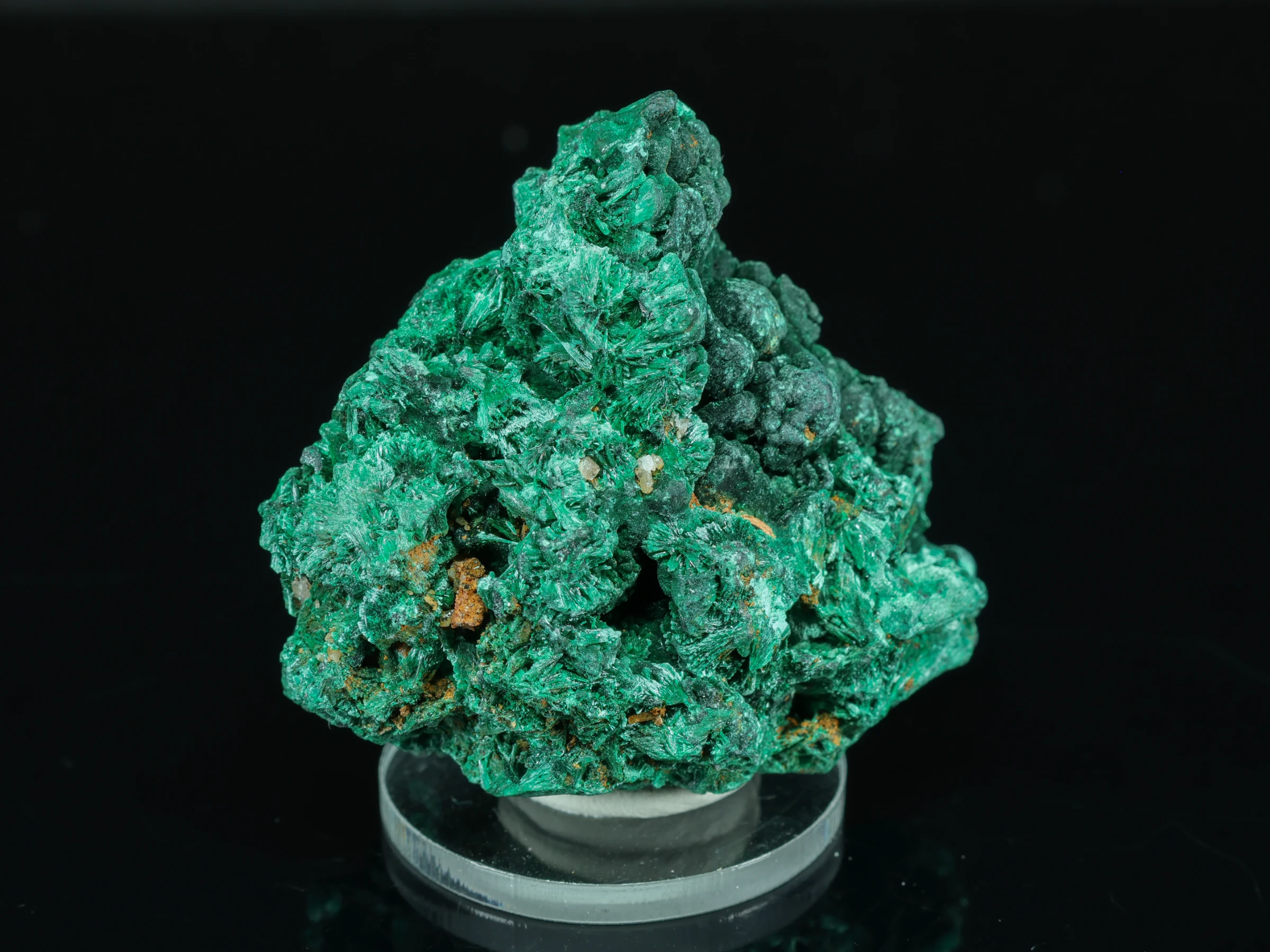
Malachite is a common carbonate mineral, a hydrated copper carbonate with a characteristic intense green color.
Properties
- Mohs hardness
- 3.5-4
- Luster
- Szklisty, jedwabisty, matowy
- Streak
- Light green
- Density
- 3.6
- Cleavage
- Perfect on <mi>{_201}</mi>, fair on {010}.
- Fracture
- Muszlowy do nierównego
- Transparency
- Opaque
- Crystal system
- Monoclinic
Diagnostic features
## Identification Malachite is easily recognizable due to its characteristic, intense green color and its often radiating, fibrous, or botryoidal forms. The streak of malachite is light green, which is a diagnostic feature. It is a relatively soft mineral and can be scratched with a knife. ## Distinguishing from Similar Minerals Malachite can be confused with other green copper minerals, such as dioptase or chrysocolla. However, dioptase has a higher hardness (5 on the Mohs scale) and usually forms well-developed, transparent crystals. Chrysocolla is generally softer and has a more waxy luster, and its color is often more bluish-green. Malachite also differs from them in its reaction with acids, in which it dissolves, releasing carbon dioxide. ## Crystal Forms Malachite rarely forms well-developed, single crystals. It most often occurs as radiating, fibrous, botryoidal, mammillary, or crust-like aggregates. Crystals, if present, are usually acicular or columnar, with a monoclinic crystal system.
Geological environment
## Genesis Malachite is a secondary mineral, formed in the oxidation zones of copper ore deposits. It forms as a result of the weathering of primary copper minerals, such as chalcopyrite or bornite, in the presence of carbon dioxide and water. It occurs in sedimentary, metamorphic, and igneous rocks where copper deposits are present. ## Mineral Associations Malachite often co-occurs with other secondary copper minerals, such as azurite (often forming concretions with it), cuprite, chrysocolla, tenorite, as well as calcite, gypsum, and limonite. ## Localities Known malachite deposits are found worldwide. Important localities include: Democratic Republic of Congo (Congo), Zambia, Russia (Urals), Australia (Broken Hill), United States (Arizona), Namibia (Tsumeb), France, and Chile.
Rarity
Very Common
For collectors
## Quality Criteria The most prized malachite specimens are those with an intense, vibrant green color, distinct banding (if present), and well-formed habits, especially radiating or botryoidal aggregates. Large, aesthetic specimens with well-preserved surfaces are particularly sought after. Purity and absence of mechanical damage also contribute to collectible value. ## Popular Localities Among the most esteemed malachite localities are the deposits in the Democratic Republic of Congo, known for large and impressive specimens, often with a radiating structure. The Russian Urals are also famous for high-quality malachite, historically used for artistic objects. Other important localities include Namibia (Tsumeb) and Arizona in the USA, where specimens with beautiful color and structure are found.
Care and storage
## Cleaning Malachite is a relatively soft mineral, so it should be cleaned gently. It is best to use a soft cloth or brush and lukewarm water. Avoid strong streams of water, which can damage delicate fibrous structures. ## What to Avoid Malachite is sensitive to acids, ammonia, and other strong chemicals, which can cause it to dissolve or dull its surface. Prolonged exposure to direct sunlight should also be avoided, as it can lead to color fading. High temperatures and sudden temperature changes can also be harmful. ## Storage Malachite specimens are best stored in a dry place, away from direct sunlight and heat sources. It is advisable to place them in separate boxes or soft pouches to prevent scratching by harder minerals.