SKU: S_00020
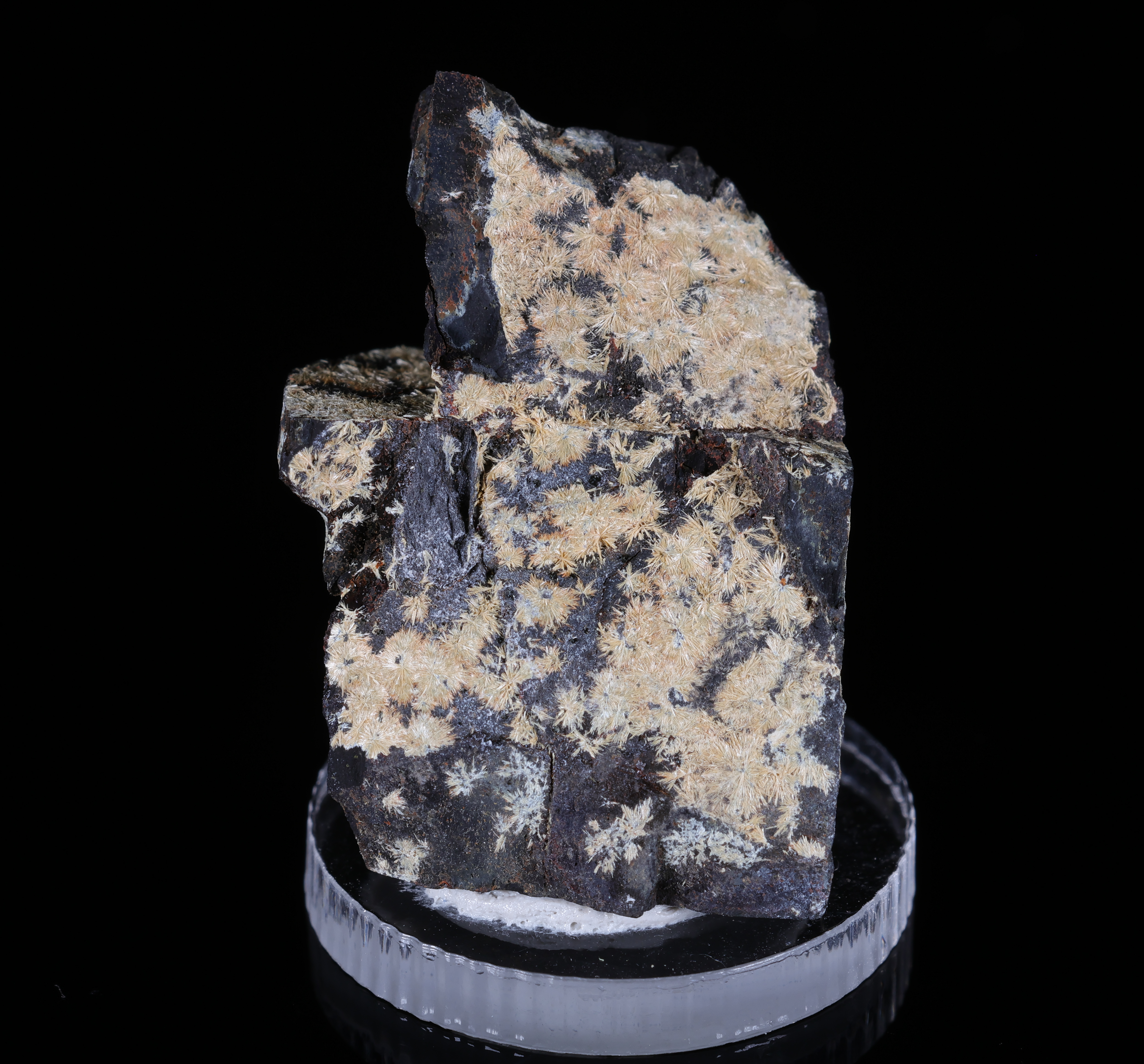
A specimen of the rare ferristrunzite, originating from its type locality - Blaton in Belgium. Numerous radiating clusters of needle-like crystals with a light straw-yellow color have formed on a dark, strongly contrasting matrix. The crystals create characteristic, dense rosettes that display excellent and distinct morphology under magnification. Main Features: rare phosphate mineral; Type Locality; radiating, needle-like clusters; high contrast with dark matrix. Condition: Very good. The crystals of ferristrunzite are inherently extremely delicate, however, this specimen has preserved in excellent condition.
Price: 25 EUR (109 PLN)
Availability: In stock
Location: Mont-des-Groseillers, Blaton, Bernissart, Hainaut, Belgium
Size: 25 x 15 x 20 mm
Weight: 6.2 g
Chemical formula: Fe²⁺Mn²⁺₂Fe³⁺₂(PO₄)₄(OH)₂·8H₂O
Crystal system: Trójskośny
Mohs hardness: 4
Characteristics Ferristrunzite is an iron phosphate mineral, usually forming small, fibrous or acicular crystals, often gathered into radial or spherical aggregates. Its color ranges from light yellow to creamy white, sometimes taking on buff to very light brown hues. The crystals are usually small, but their clusters can form striking, fluffy shapes. Physical Properties The hardness of ferristrunzite on the Mohs scale is 4. This mineral exhibits a vitreous to silky luster. It is transparent to translucent. The specific gravity is 2.38. It has probable cleavage in one direction. Colors and Varieties Ferristrunzite occurs in shades of light yellow, creamy white, as well as buff and light brown. No specific commercial or color varieties of this mineral are known. History and Name The mineral was discovered and described in 1986. The name "ferristrunzite" refers to its chemical composition, indicating the presence of iron (ferri-) and alluding to strunzite, with which it is isostructural. Strunzite was named after the German mineralogist Hugo Strunz. Applications Ferristrunzite has no industrial applications. It is a mineral of purely collectible and scientific significance, valued by collectors of rare phosphates.
Identification Ferristrunzite can be identified by its characteristic appearance - fibrous or acicular crystals forming radial or spherical aggregates. The color from light yellow to creamy white is also a diagnostic feature. A hardness of 4 on the Mohs scale and a vitreous to silky luster aid in identification. Distinguishing from similar minerals Ferristrunzite can be confused with strunzite, with which it is isostructural. The main difference is the dominant iron cation (Fe³⁺) in ferristrunzite, while in strunzite, Fe²⁺ dominates. However, these differences are difficult to ascertain without chemical analysis. Other iron phosphates may also be visually similar, so studying mineral associations and the environment of occurrence is crucial. Crystal forms Ferristrunzite typically forms small, acicular or fibrous crystals. They often occur as radial or spherical aggregates, which can resemble fluffy balls or fans.
Genesis Ferristrunzite is a secondary mineral, forming in the oxidation zones of phosphate deposits, often in pegmatites, where other iron phosphates occur. It forms as a result of hydrothermal processes or weathering, in environments rich in iron, phosphates, and water. Mineral associations Ferristrunzite often co-occurs with other phosphate minerals, such as strunzite, rockbridgeite, beraunite, dufrenite, goethite, as well as with quartz and clay minerals. Localities Known localities of ferristrunzite include: the Hagendorf-Süd mine in Bavaria (Germany), the Palermo No. 1 mine in New Hampshire (USA), the Big Chief mine in South Dakota (USA), and some localities in Portugal and Brazil.
Quality criteria The most prized ferristrunzite specimens are those that exhibit well-formed, radial or spherical aggregates of fibrous crystals with an intense, uniform light yellow or creamy white color. Large, aesthetic crystal clusters, free from mechanical damage and impurities, are particularly sought after. Specimens with clearly visible associations with other rare phosphates also increase their collectible value. Popular localities The most prized specimens usually come from classic localities, such as the Hagendorf-Süd mine in Germany, known for its well-formed and aesthetic phosphate specimens, and pegmatite mines in the USA, such as Palermo No. 1.
See mineralogical reference for Ferristrunzite in the Knowledge Base →