Ferristrunzite
Chemical formula: Fe<sup>3+</sup>Fe<sup>3+</sup><sub>2</sub>(PO<sub>4</sub>)<sub>2</sub>(OH)<sub>3</sub>·5H<sub>2</sub>O
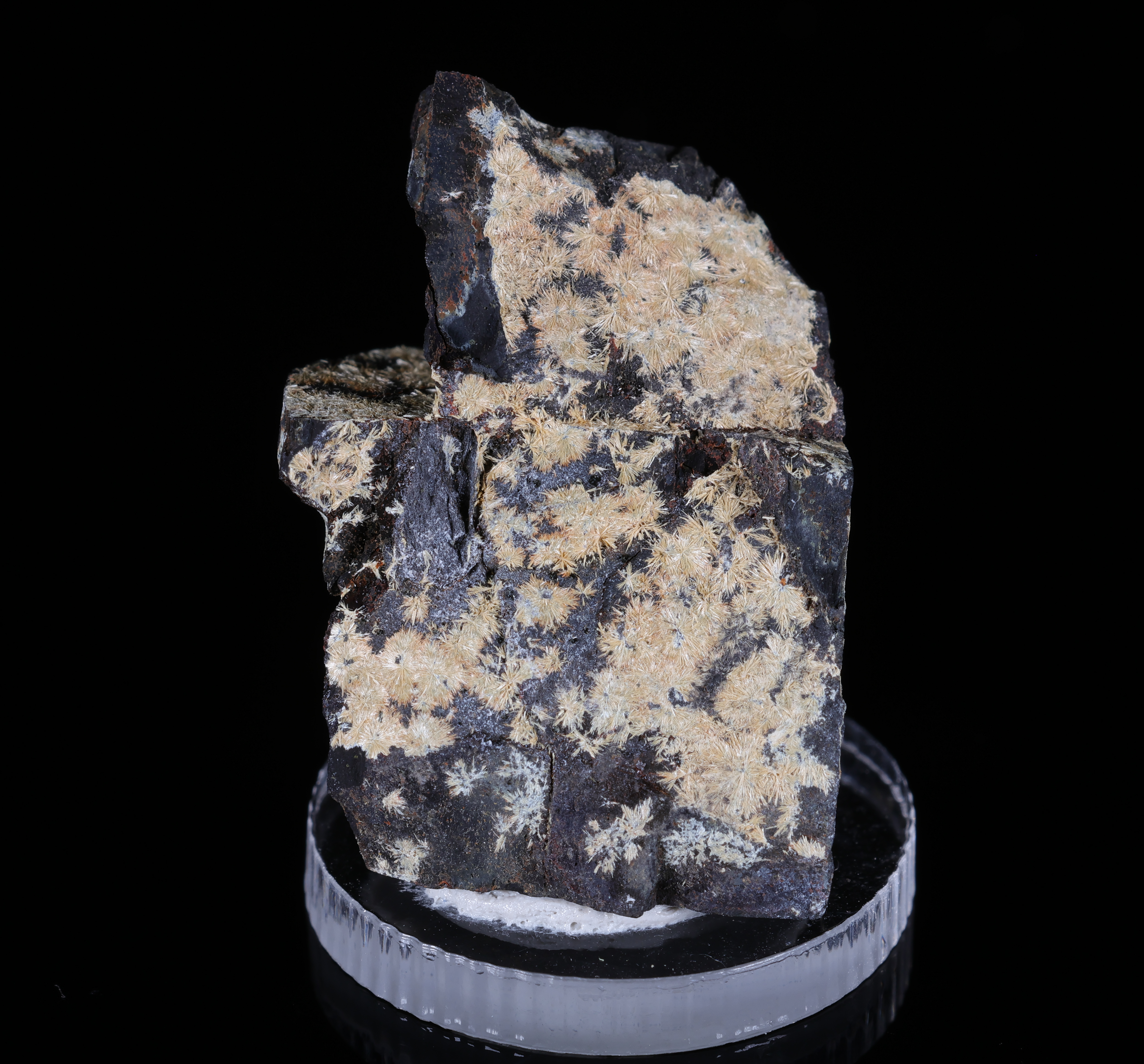
Ferristrunzite is a rare iron phosphate mineral, characterized by fibrous aggregates of light yellow to creamy white color.
Properties
- Mohs hardness
- 4
- Luster
- Szklisty do jedwabistego
- Streak
- very pale yellow
- Density
- 2.38
- Cleavage
- One, probable, parallel X-Z
- Fracture
- Brak danych
- Transparency
- Transparent,Translucent
- Crystal system
- Triclinic
Diagnostic features
## Identification Ferristrunzite can be identified by its characteristic appearance - fibrous or acicular crystals forming radial or spherical aggregates. The color from light yellow to creamy white is also a diagnostic feature. A hardness of 4 on the Mohs scale and a vitreous to silky luster aid in identification. ## Distinguishing from similar minerals Ferristrunzite can be confused with strunzite, with which it is isostructural. The main difference is the dominant iron cation (Fe³⁺) in ferristrunzite, while in strunzite, Fe²⁺ dominates. However, these differences are difficult to ascertain without chemical analysis. Other iron phosphates may also be visually similar, so studying mineral associations and the environment of occurrence is crucial. ## Crystal forms Ferristrunzite typically forms small, acicular or fibrous crystals. They often occur as radial or spherical aggregates, which can resemble fluffy balls or fans.
Geological environment
## Genesis Ferristrunzite is a secondary mineral, forming in the oxidation zones of phosphate deposits, often in pegmatites, where other iron phosphates occur. It forms as a result of hydrothermal processes or weathering, in environments rich in iron, phosphates, and water. ## Mineral associations Ferristrunzite often co-occurs with other phosphate minerals, such as strunzite, rockbridgeite, beraunite, dufrenite, goethite, as well as with quartz and clay minerals. ## Localities Known localities of ferristrunzite include: the Hagendorf-Süd mine in Bavaria (Germany), the Palermo No. 1 mine in New Hampshire (USA), the Big Chief mine in South Dakota (USA), and some localities in Portugal and Brazil.
Rarity
Very Rare
For collectors
## Quality criteria The most prized ferristrunzite specimens are those that exhibit well-formed, radial or spherical aggregates of fibrous crystals with an intense, uniform light yellow or creamy white color. Large, aesthetic crystal clusters, free from mechanical damage and impurities, are particularly sought after. Specimens with clearly visible associations with other rare phosphates also increase their collectible value. ## Popular localities The most prized specimens usually come from classic localities, such as the Hagendorf-Süd mine in Germany, known for its well-formed and aesthetic phosphate specimens, and pegmatite mines in the USA, such as Palermo No. 1.
Care and storage
## Cleaning Ferristrunzite is a relatively soft mineral, therefore it requires gentle cleaning. It is best to use a soft brush or paintbrush to remove dust. For heavier dirt, lukewarm distilled water can be used, avoiding prolonged soaking. ## What to avoid Avoid using aggressive chemicals, such as acids or strong detergents, which can damage the mineral's surface. Ferristrunzite is sensitive to high temperatures and direct sunlight, which can lead to color changes or structural damage. Due to the water content in its structure, sudden changes in humidity should be avoided. ## Storage Ferristrunzite specimens are best stored in enclosed display cases or boxes, away from dust, direct sunlight, and heat sources. It is advisable to maintain a stable temperature and moderate humidity. Delicate fibrous specimens should be protected from mechanical damage.