SKU: P_26-4_6
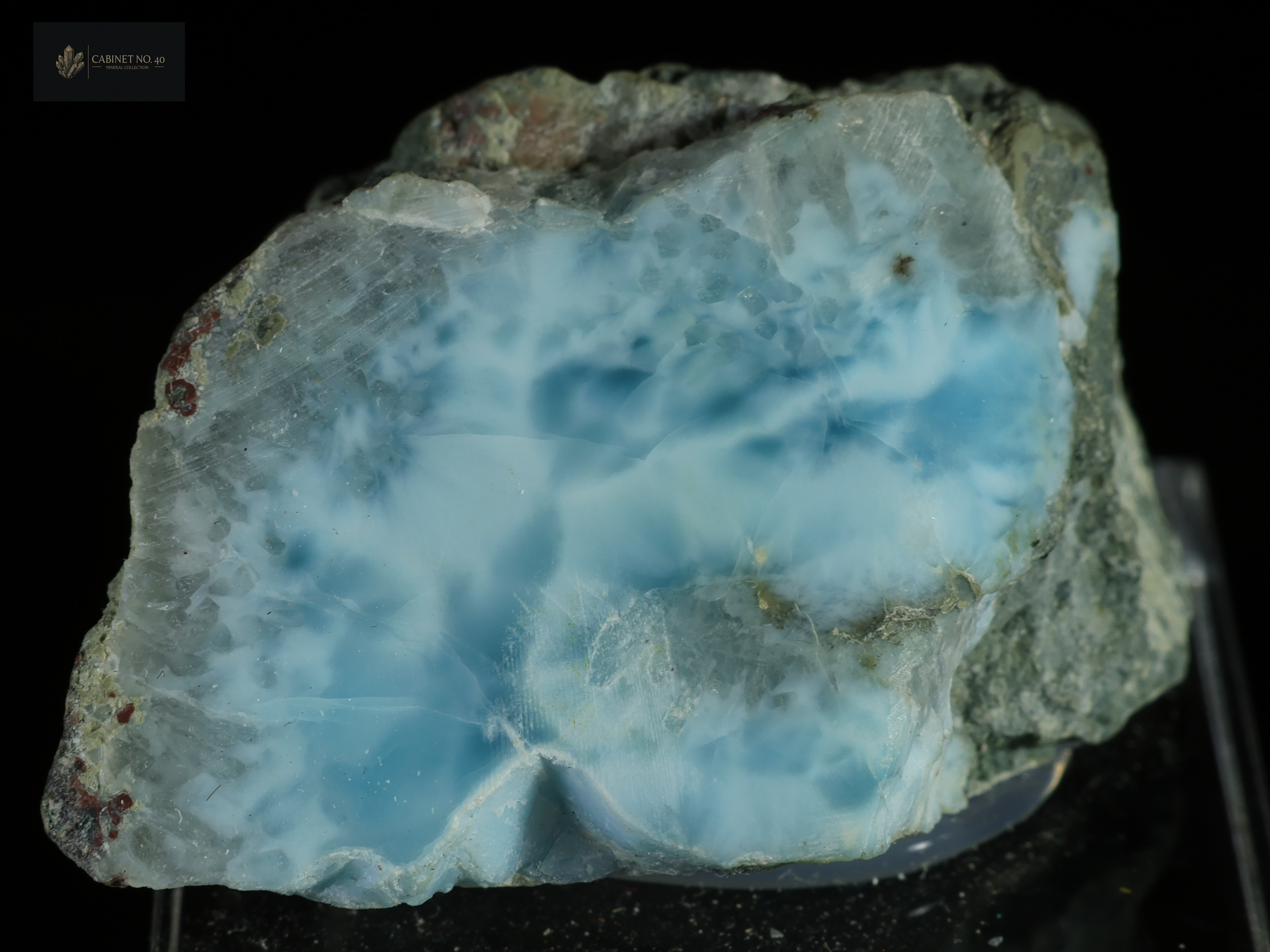
The specimen is characterized by an intense blue coloration, typical for this variety. The mineral exhibits beautiful, layered formation with visible, soft tonal transitions. Larimar is embedded in the host rock, which attests to its naturalness and original geological context.
Price: 43 EUR (189 PLN)
Availability: In stock
Location: Larimar Mines, Los Checheses, Sierra de Baoruco, Barahona Province, Dominican Republic
Size: 30 x 32 x 18 mm
Weight: 200 g
Chemical formula: NaCa₂Si₃O₈(OH)
Crystal system: Triclinic
Mohs hardness: 4.5–5.0
Characteristics Larimar is a blue variety of pectolite, a mineral from the silicate group. It typically occurs in compact masses, often with a fibrous or radial structure. It is characterized by shades of blue, from light, almost white, to intense turquoise, sometimes with a greenish tint. White or gray bands and spots are often observed, forming patterns resembling clouds or sea waves. This mineral is translucent to opaque, and its polished surface exhibits a silky luster. Physical Properties Larimar has a Mohs hardness of 5, making it a relatively soft mineral. It has a specific gravity of approximately 2.74. Larimar's luster is vitreous to silky, especially on fracture surfaces or after polishing. The mineral is transparent to translucent. Colors and Varieties Larimar occurs in various shades of blue, from very light, almost white, through sky blue, to deep turquoise. The coloration is often uneven, with white or gray streaks and spots. The intensity of the color depends on the copper content. Blue pectolite from the Dominican Republic is known exclusively by the trade name larimar. History and Name Larimar was discovered in 1916 in the Dominican Republic, but its official market introduction did not occur until 1974. The name "Larimar" was given by Miguel Méndez, who combined his daughter's name, Lara, with the Spanish word "mar" meaning sea, referring to its blue color. Uses Larimar is a valued ornamental and gemstone. It is used to produce cabochons, beads, carvings, and other jewelry components. Due to its color and patterns, it is popular in jewelry, especially in tourist regions.
Identification Larimar can be identified by its characteristic blue color, often with white or gray patterns. It usually occurs in compact masses with a fibrous or radial structure. When polished, it exhibits a vitreous to silky luster. Its hardness is 5 on the Mohs scale, meaning it can be scratched by a steel blade. Distinguishing from Similar Minerals Larimar is sometimes confused with turquoise, chrysocolla, or chalcedony. It differs from turquoise by its typically milkier, bluer hue and characteristic white patterns. Chrysocolla often has a more greenish tint and is slightly softer. Chalcedony, although it can occur in similar colors, usually does not have such distinct fibrous structures and patterns as larimar. Crystal Forms Larimar most commonly occurs as compact, fibrous, or radial aggregates. More rarely, it forms small, acicular crystals in fissures.
Genesis Larimar forms in cracks and cavities in volcanic rocks, mainly basalts, as a result of hydrothermal processes. Water rich in silica and calcium, flowing through the rocks, deposits minerals in open spaces. The blue coloration is due to the presence of copper in the mineral's structure. Mineral Associations Larimar often co-occurs with other secondary minerals such as calcite, hematite, natrolite, and other zeolites. It can also be found in association with native copper. Localities The only known locality for gem-quality larimar is the Baoruco area in the Barahona province on the southwestern coast of the Dominican Republic.
Quality Criteria The most prized specimens of larimar are characterized by an intense, uniform blue color, without visible impurities or cracks. Specimens with distinct, aesthetic patterns resembling waves or clouds are also highly valued. Transparency and luster also affect the stone's value. Large, well-colored specimens are more desirable. Market Prices Larimar prices vary and depend on quality, size, and color intensity. Small, poorly colored pieces can cost a dozen dollars, while large, high-quality specimens with intense color and interesting patterns fetch prices from tens to hundreds of dollars per gram or carat, especially in the form of polished cabochons or jewelry components. Popular Localities The only commercially significant source of larimar is the Dominican Republic, specifically the Los Chupaderos area in the Baoruco mountains. All specimens available on the market originate from there.
See mineralogical reference for Larimar in the Knowledge Base →