SKU: 0249_3-RS
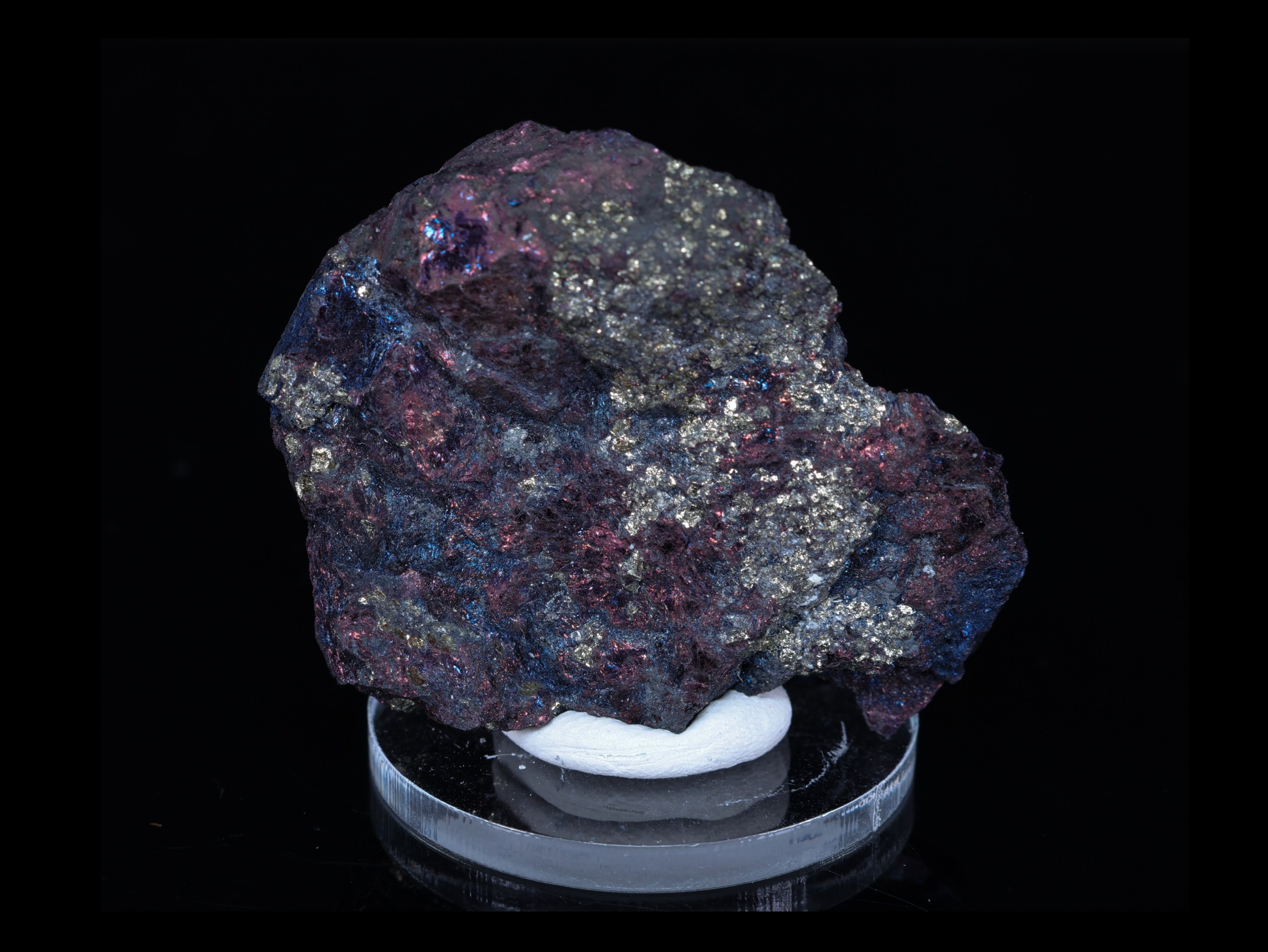
An interesting specimen consisting of a combination of massive covellite with finely crystalline pyrite. A characteristic feature of this specimen is the strong, natural iridescence of the covellite, shimmering in shades of deep blue and intense violet. Main Features: intense blue-violet iridescence; presence of golden pyrite; ex coll. K.Urbanik. Condition: Very good - natural iridescent surfaces are well preserved and distinct on most of the specimen.
Price: 23 EUR (99 PLN)
Availability: In stock
Location: Bor-Majdanpek, Serbia
Size: 36 x 16 x 35 mm
Weight: 35.1 g
Chemical formula: CuS / FeS₂
Crystal system: Hexagonal (covellin), Isometric (pyrite)
Mohs hardness: 1.5–2 / 6–6.5
Mineral group: Pyrite Group
Rarity: Uncommon
Characteristics Covellite is a sulfide mineral, whose typical specimens are characterized by an indigo-blue color, often transitioning to shades of black. Iridescence often occurs on the mineral's surface, creating purple, deep red, and brassy-yellow reflections, which gives it a unique appearance. It can form platy, tabular, or prismatic crystals, as well as massive, granular, or reniform aggregates. Physical Properties Covellite is characterized by a low Mohs hardness of 1.5-2, which makes it a soft mineral. It has perfect cleavage along the {0001} plane. Its density is 4.6 g/cm³. The luster of covellite is submetallic, and the streak is lead-gray to black, often with a metallic luster. Colors and Varieties The dominant color of covellite is indigo-blue, transitioning to blue-black. Iridescence is often observed on it, manifesting as purple, red, and yellow discolorations on the mineral's surface, which is its characteristic feature. No specific commercial varieties are distinguished. History and Name The mineral's name comes from the Italian mineralogist Niccolò Covelli, who first described this mineral in 1832. Its discovery took place in a mine on Vesuvius in Italy. Uses Covellite is an important copper ore, although less common than chalcopyrite or chalcocite. Due to its intense color and iridescence, it is valued by mineral collectors.
Identification Covellite can be identified by its characteristic indigo-blue color, often with a metallic luster and iridescence. Low hardness (1.5-2 on the Mohs scale) and perfect cleavage are also diagnostic features. A lead-gray to black streak is another indicator. Distinguishing from Similar Minerals Covellite can be confused with other copper sulfides, such as chalcocite, but its intense blue color and strong iridescence are usually distinguishing. Chalcocite typically has a darker, more gray color and lacks iridescence. Bornite, although also iridescent, has a more brownish-red color before oxidation. Crystal Forms Covellite most often occurs as platy, tabular, or prismatic crystals. It can also form massive, granular, reniform, or earthy aggregates. It often forms coatings and incrustations.
Genesis Covellite is a secondary mineral, forming in zones of copper ore enrichment, where oxidation and redistribution of primary copper sulfides occur. It can also form under hydrothermal conditions, at low temperatures, as a product of metasomatism. Mineral Associations Covellite often co-occurs with other copper minerals, such as chalcocite, bornite, chalcopyrite, pyrite, enargite, tetrahedrite, and with copper oxide and carbonate minerals, such as malachite and azurite. Localities Known covellite localities include: Butte, Montana (USA), Bristol, Connecticut (USA), mines in Chile, Peru, Mexico, as well as in Germany (Mansfeld), Italy (Vesuvius), and Russia (Urals).
Quality Criteria The most prized covellite specimens are those with an intense, uniform indigo-blue color, with clear and rich iridescence, creating purple, red, and yellow reflections. Well-formed crystals, especially platy or tabular ones, are also highly sought after. The size of the specimen and the absence of mechanical damage also affect its collector's value. Popular Localities Particularly prized covellite specimens come from Butte, Montana (USA), where beautiful, iridescent crystals occur. Other important localities include mines in Chile and Peru, known for large and impressive aggregates.
See mineralogical reference for Covellite in the Knowledge Base →