Covellite
Chemical formula: Cu<sup>1+</sup>S
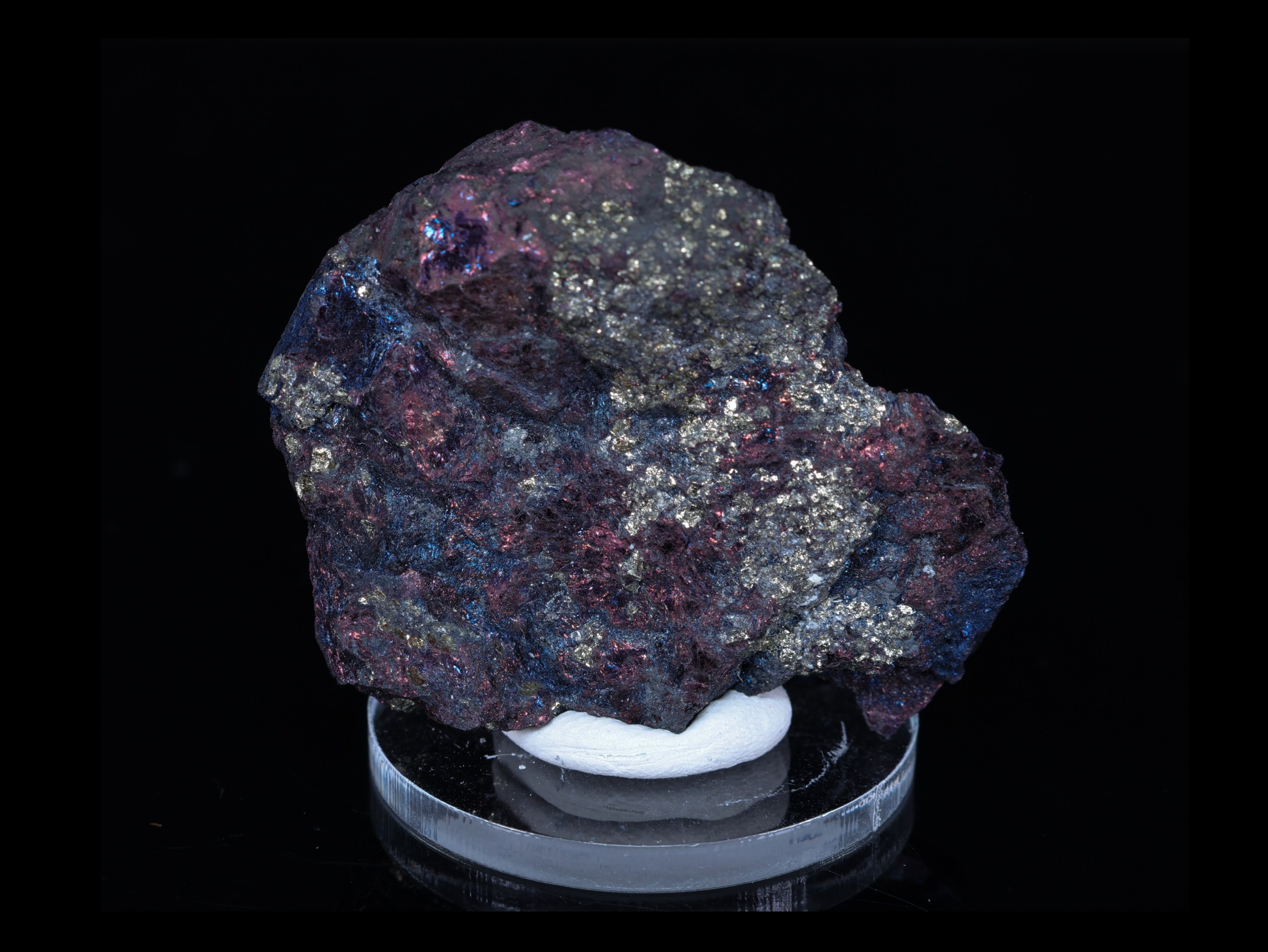
Covellite is a copper sulfide, known for its characteristic indigo-blue color and often occurring iridescence.
Properties
- Mohs hardness
- 1.5-2
- Luster
- Sub-Metallic
- Streak
- Shiny metallic, lead-grey to black
- Density
- 4.6
- Cleavage
- Perfect on {0001}.
- Fracture
- Muszlowy
- Transparency
- Opaque
- Crystal system
- Hexagonal
Diagnostic features
## Identification Covellite can be identified by its characteristic indigo-blue color, often with a metallic luster and iridescence. Low hardness (1.5-2 on the Mohs scale) and perfect cleavage are also diagnostic features. A lead-gray to black streak is another indicator. ## Distinguishing from Similar Minerals Covellite can be confused with other copper sulfides, such as chalcocite, but its intense blue color and strong iridescence are usually distinguishing. Chalcocite typically has a darker, more gray color and lacks iridescence. Bornite, although also iridescent, has a more brownish-red color before oxidation. ## Crystal Forms Covellite most often occurs as platy, tabular, or prismatic crystals. It can also form massive, granular, reniform, or earthy aggregates. It often forms coatings and incrustations.
Geological environment
## Genesis Covellite is a secondary mineral, forming in zones of copper ore enrichment, where oxidation and redistribution of primary copper sulfides occur. It can also form under hydrothermal conditions, at low temperatures, as a product of metasomatism. ## Mineral Associations Covellite often co-occurs with other copper minerals, such as chalcocite, bornite, chalcopyrite, pyrite, enargite, tetrahedrite, and with copper oxide and carbonate minerals, such as malachite and azurite. ## Localities Known covellite localities include: Butte, Montana (USA), Bristol, Connecticut (USA), mines in Chile, Peru, Mexico, as well as in Germany (Mansfeld), Italy (Vesuvius), and Russia (Urals).
Rarity
Very Common
For collectors
## Quality Criteria The most prized covellite specimens are those with an intense, uniform indigo-blue color, with clear and rich iridescence, creating purple, red, and yellow reflections. Well-formed crystals, especially platy or tabular ones, are also highly sought after. The size of the specimen and the absence of mechanical damage also affect its collector's value. ## Popular Localities Particularly prized covellite specimens come from Butte, Montana (USA), where beautiful, iridescent crystals occur. Other important localities include mines in Chile and Peru, known for large and impressive aggregates.
Care and storage
## Cleaning Covellite is a soft mineral, so it should be handled with care. For cleaning, it is best to use a soft brush and lukewarm water. It can also be gently wiped with a damp cloth. ## What to Avoid Avoid using strong chemicals, acids, and detergents, which can damage the mineral's surface. Due to its low hardness, covellite is susceptible to scratches, so it should be protected from contact with harder minerals. Also avoid prolonged exposure to direct sunlight, which can affect the intensity of its color. ## Storage Covellite is best stored in closed display cases or boxes, away from dust and moisture. It is advisable to place it separately from other minerals to prevent scratches. Specimens with intense iridescence should be displayed in a place with appropriate lighting to highlight their aesthetic qualities.