SKU: SY-0152_4-BR
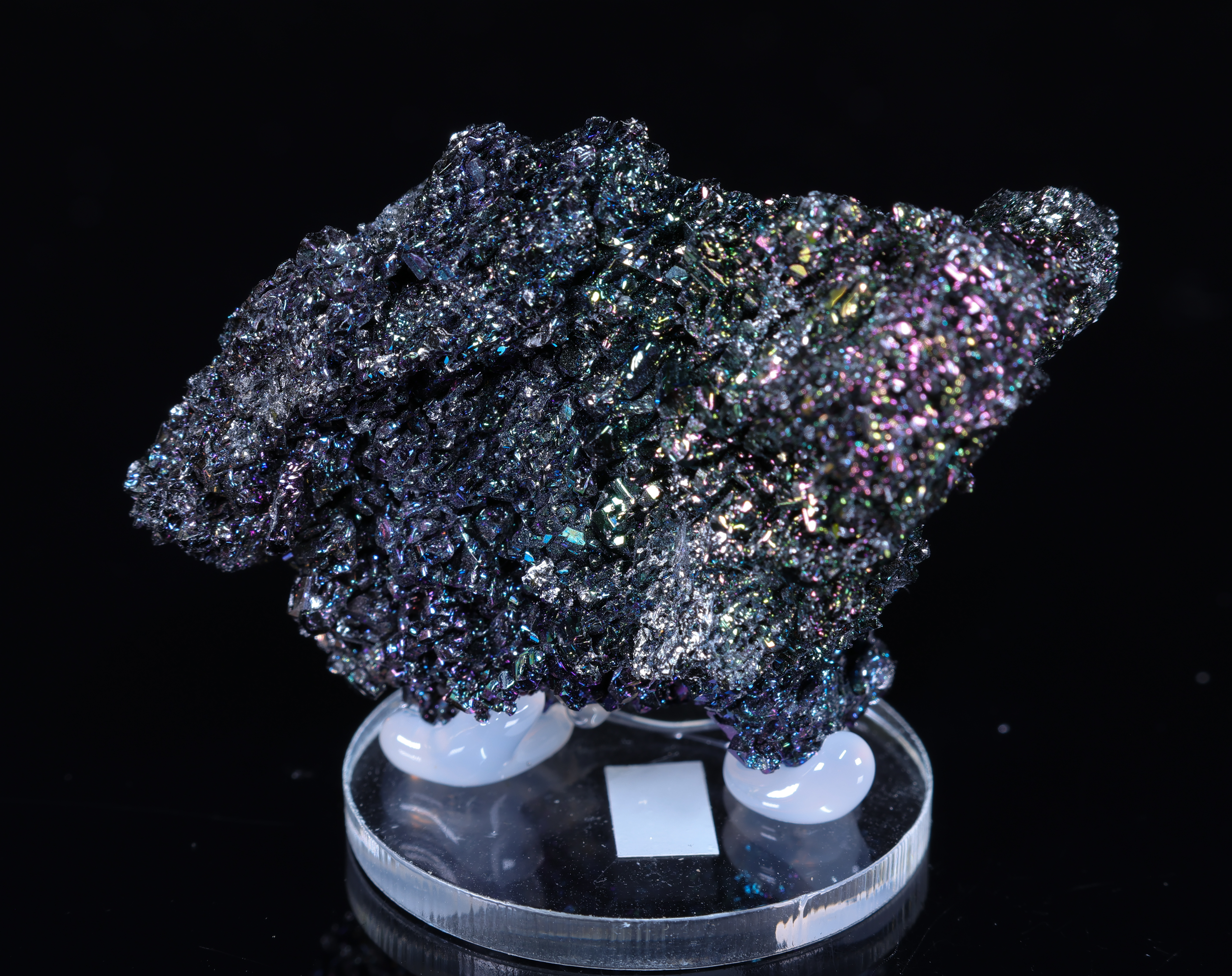
An aesthetic specimen of carborundum, which is synthetic silicon carbide (SiC). This material, although produced in industrial and laboratory processes, remains consistently popular among novice collectors due to its unique visual qualities. The specimen is characterized by a dense accumulation of sharp, platy crystals with a strong metallic luster. The main highlight of the specimen is its spectacular, multicolored iridescence. Main Features: multicolored iridescence; strong metallic luster; sharp, platy crystals; synthetic material (silicon carbide); high decorative value. Condition: Very good.
Price: 7 EUR (29 PLN)
Availability: In stock
Location: -, Brazil
Size: 50 x 40 x 25 mm
Weight: 18 g
Chemical formula: SiC
Crystal system: hexagonal / rhombohedral
Mohs hardness: 9–9,5
Mineral group: Corundum Group
Rarity: Rare
Characteristics Carborundum, or silicon carbide (SiC), is a chemical compound of silicon and carbon, which occurs extremely rarely in nature as the mineral moissanite. For the most part, it is a synthetic product, manufactured on an industrial scale. It is characterized by very high hardness, second only to diamond, which makes it an excellent abrasive material. Visually, synthetic carborundum often takes the form of small, sharp-edged crystals with a metallic or submetallic luster, often with iridescent, rainbow-like coatings on the surface, which are a result of oxidation. Physical Properties Carborundum is distinguished by its exceptional hardness, reaching 9-9.5 on the Mohs scale. It has high density, and its luster is usually metallic to submetallic. It is a brittle material, with a conchoidal or uneven fracture. It is also very resistant to high temperatures and most chemical agents. Colors and Varieties Synthetic carborundum occurs in various colors, depending on impurities and production conditions. The most common shades are black, gray, greenish, blue, and also brown. Often, an iridescence effect, or rainbow coloration, is observed on the surface of the crystals, which is particularly valued in collector's specimens. History and Name The name "carborundum" is a trade name and comes from the combination of the words "carbon" and "corundum," reflecting its chemical composition and hardness similar to corundum. This compound was first synthesized by Edward Goodrich Acheson in 1891, who was looking for a method to produce artificial diamonds. He discovered that silicon carbide has abrasive and refractory properties, which initiated its industrial production. Applications Due to its extreme hardness, carborundum is widely used as an abrasive material for the production of sandpaper, grinding wheels, polishing pastes, and in cutting tools. It is also used in the refractory industry for the production of high-temperature resistant materials, such as crucibles and furnace components. In electronics, it is used in the production of semiconductors, LED diodes, and high-power transistors, due to its semiconductor properties and ability to operate at high temperatures.
Identification Synthetic carborundum is easily recognizable by its characteristic, often iridescent surface, metallic luster, and exceptional hardness. It often occurs as sharp-edged, tabular or prismatic crystals. Distinguishing from Similar Minerals It can be confused with some minerals with a metallic luster, such as hematite or magnetite, but its hardness and often occurring iridescence are diagnostic features. Natural moissanite is very rare and usually requires specialized tests to distinguish it from synthetic carborundum. Crystal Forms Synthetic carborundum often forms well-developed crystals with tabular, prismatic, or isometric habits. Aggregates are usually granular or massive.
Genesis Carborundum is a synthetic mineral, industrially produced in Acheson furnaces at temperatures exceeding 2000°C. The natural counterpart, moissanite, occurs extremely rarely in igneous rocks, meteorites, and as inclusions in diamonds. Mineral Associations As a synthetic mineral, carborundum does not occur in natural mineral associations. In the case of natural moissanite, it can co-occur with diamond, graphite, and other igneous rock minerals. Localities As a synthetic product, carborundum is manufactured in many industrial plants worldwide. Natural moissanite has been found in meteorites, kimberlites, and some metamorphic rocks, but its occurrence is very limited and there are no significant collector localities.
Quality Criteria The most valued specimens of synthetic carborundum are those with well-formed crystals, intense iridescence, and large sizes. Purity and lack of mechanical damage also affect collector value. Market Prices The prices of synthetic carborundum are relatively low due to its mass production. Collector's specimens with beautiful iridescence can fetch prices from a few to several dozen Polish zlotys, depending on size and aesthetics. Popular Localities There are no popular localities for carborundum, as it is a synthetic material. Collector's specimens usually come from laboratories and production facilities.
See mineralogical reference for Carborundum in the Knowledge Base →