Carborundum
Chemical formula: SiC
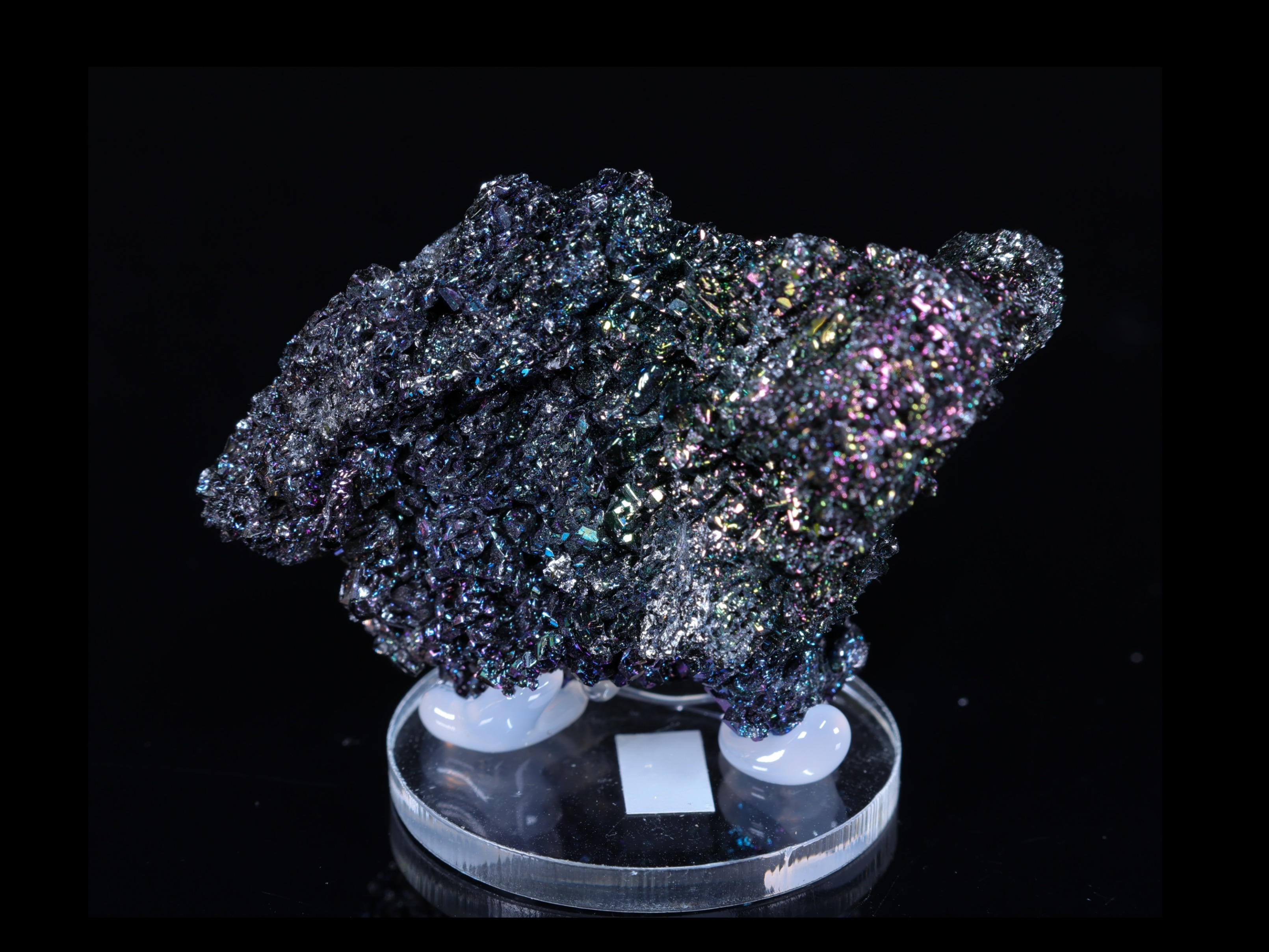
Carborundum is synthetic silicon carbide, valued for its exceptional hardness and chemical resistance, primarily used as an abrasive and refractory material.
Properties
- Mohs hardness
- 9-9.5
- Luster
- Metaliczny do półmetalicznego
- Streak
- Zielonkawo-czarna
- Density
- 3.21
- Cleavage
- Brak
- Fracture
- Muszlowy do nierównego
- Transparency
- Nieprzezroczysty
- Crystal system
- Heksagonalny
Diagnostic features
## Identification Synthetic carborundum is easily recognizable by its characteristic, often iridescent surface, metallic luster, and exceptional hardness. It often occurs as sharp-edged, tabular or prismatic crystals. ## Distinguishing from Similar Minerals It can be confused with some minerals with a metallic luster, such as hematite or magnetite, but its hardness and often occurring iridescence are diagnostic features. Natural moissanite is very rare and usually requires specialized tests to distinguish it from synthetic carborundum. ## Crystal Forms Synthetic carborundum often forms well-developed crystals with tabular, prismatic, or isometric habits. Aggregates are usually granular or massive.
Geological environment
## Genesis Carborundum is a synthetic mineral, industrially produced in Acheson furnaces at temperatures exceeding 2000°C. The natural counterpart, moissanite, occurs extremely rarely in igneous rocks, meteorites, and as inclusions in diamonds. ## Mineral Associations As a synthetic mineral, carborundum does not occur in natural mineral associations. In the case of natural moissanite, it can co-occur with diamond, graphite, and other igneous rock minerals. ## Localities As a synthetic product, carborundum is manufactured in many industrial plants worldwide. Natural moissanite has been found in meteorites, kimberlites, and some metamorphic rocks, but its occurrence is very limited and there are no significant collector localities.
Rarity
Common
For collectors
## Quality Criteria The most valued specimens of synthetic carborundum are those with well-formed crystals, intense iridescence, and large sizes. Purity and lack of mechanical damage also affect collector value. ## Market Prices The prices of synthetic carborundum are relatively low due to its mass production. Collector's specimens with beautiful iridescence can fetch prices from a few to several dozen Polish zlotys, depending on size and aesthetics. ## Popular Localities There are no popular localities for carborundum, as it is a synthetic material. Collector's specimens usually come from laboratories and production facilities.
Care and storage
## Cleaning Carborundum specimens can be gently cleaned with soap and water, using a soft brush. Strong scrubbing should be avoided, especially for specimens with delicate iridescent coatings. ## What to Avoid Carborundum is a very chemically and thermally resistant material, however, prolonged contact with strong acids and bases should be avoided, as they can damage the surface or coatings. It is not sensitive to sunlight. ## Storage Carborundum should be stored in a dry place, away from other, less hard minerals, to avoid scratching them. Due to its hardness, it can scratch other specimens in the collection.