Intensely Pink Cobaltocalcite from Congo

SKU: W-0139_3-CD

An exceptionally vivid specimen rich in cobaltocalcite with an intense, deep pink color. The surface of the specimen features small, contrasting green clusters of the rare kolwezite. The whole forms a dense coating set on a light matrix. Main Features: saturated color; presence of rare kolwezite; strong color contrast; classic location. Condition: Very good.
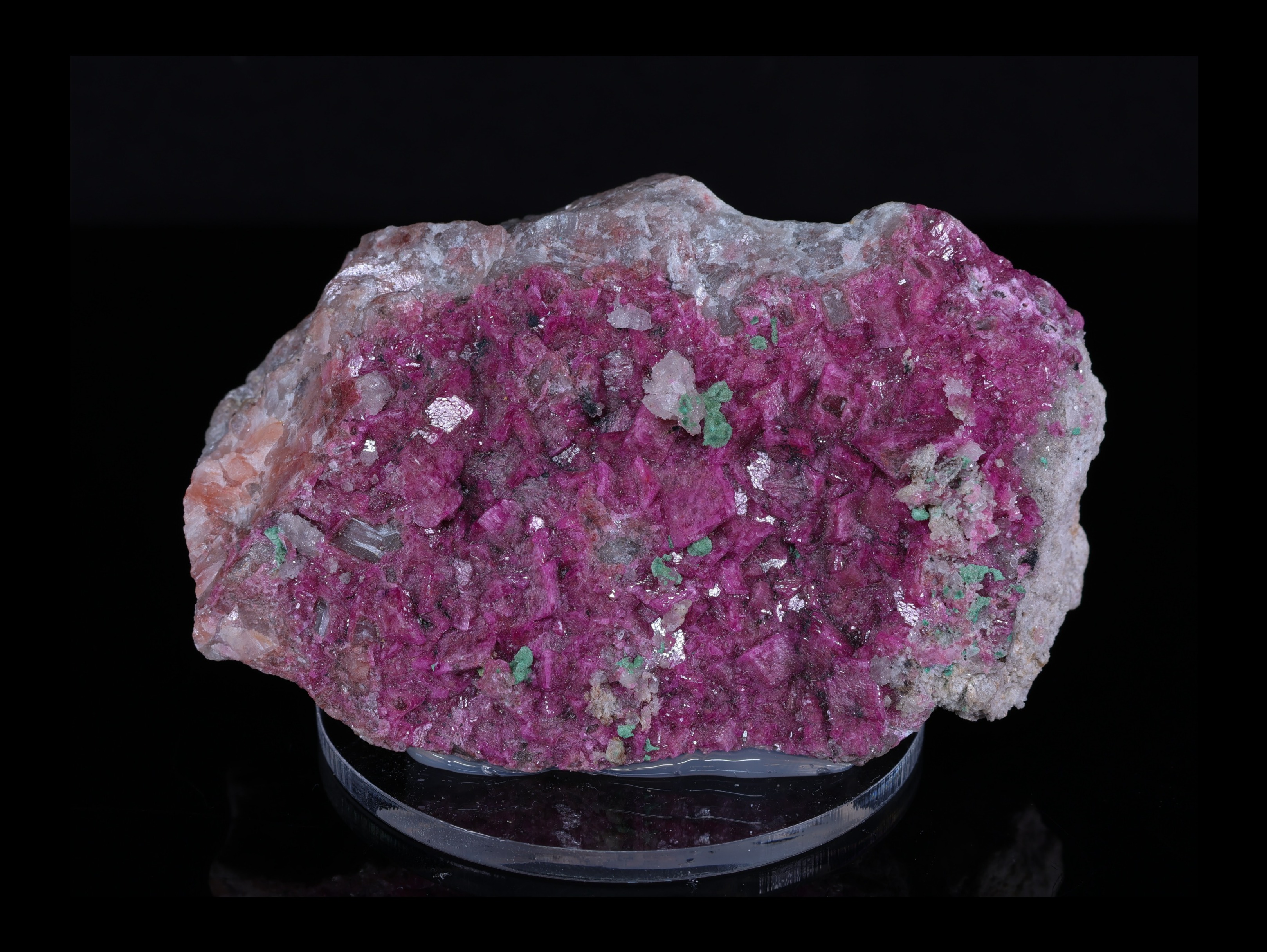
Intensely Pink Cobaltocalcite from Congo

Price: 41 EUR (179 PLN)

Availability: In stock

Location: Katanga, Congo

Size: 74 x 29 x 45 mm

Weight: 101 g

Chemical formula: CaCO₃:Co, ZnCO₃:Co

Crystal system: trigonal

Mohs hardness: 3

Mineral group: Calcite Group

Rarity: Uncommon

Characteristics Cobaltocalcite is a variety of calcite, characterized by an intense pink, red, or purple color, resulting from the presence of cobalt ions in the crystal structure. It typically forms spherical, reniform, or botryoidal aggregates, often with a radial internal structure. Less frequently, it occurs as well-formed crystals, which retain the typical rhombohedral or scalenohedral habit of calcite. The surface of the aggregates can be dull or slightly vitreous. Physical Properties Cobaltocalcite has a Mohs hardness of 3, making it a relatively soft mineral. The luster is vitreous to pearly, especially on fracture surfaces. The mineral is transparent to translucent. The specific gravity usually ranges from 2.71-2.72 g/cm³. Colors and Varieties The predominant color of cobaltocalcite is pink, from delicate rose to intense fuchsia, as well as red and purple. The intensity of the color depends on the concentration of cobalt. No distinct commercial varieties are distinguished beyond the name cobaltocalcite, which itself is a variety of calcite. History and Name The name "cobaltocalcite" refers to the chemical composition of the mineral, indicating the presence of cobalt in calcite. It is a descriptive name used in mineralogy for this specific, cobalt-colored variety of calcite. Applications Cobaltocalcite has no industrial applications. It is a prized collector's mineral due to its rarity and attractive color.

Diagnostic features

Identification Cobaltocalcite can be identified primarily by its characteristic pink to red color and the typical Mohs hardness of calcite (3). It often occurs in reniform or botryoidal aggregates. It reacts with hydrochloric acid, releasing carbon dioxide, which is a diagnostic feature of calcite. Distinguishing from Similar Minerals It can be confused with rhodochrosite, which can also be pink, but rhodochrosite is usually harder (3.5-4 on the Mohs scale) and has different cleavage. It also differs from rose quartz, which is much harder (7 on the Mohs scale). Crystal Forms Cobaltocalcite most often occurs as massive, reniform, botryoidal, or radial aggregates. Less frequently, it forms rhombohedral or scalenohedral crystals, typical of calcite.

Formation environment

Genesis Cobaltocalcite forms in low-temperature, hydrothermal ore veins, often in the oxidation zones of cobalt deposits. It forms by precipitation from solutions rich in carbonates and cobalt ions, which replace calcium ions in the calcite structure. Mineral Associations It co-occurs with other oxidation zone minerals, such as malachite, azurite, erythrite, as well as quartz, barite, and other carbonates. Localities Known localities for cobaltocalcite include deposits in Bou Azzer, Morocco, where beautiful, intensely pink specimens are found. Other localities include areas in the Democratic Republic of Congo, Germany (e.g., Schneeberg), and the United Kingdom.

For the collector

Quality Criteria The most prized specimens are those with intense, uniform color, without discoloration or damage. Large, well-formed botryoidal aggregates or crystals with a distinct habit are highly valued. Transparency and luster also contribute to the attractiveness of the specimen. Popular Localities The most sought-after specimens come from Bou Azzer, Morocco, which is famous for its exceptionally beautiful and intensely colored cobaltocalcites. Specimens from the Democratic Republic of Congo are also highly regarded.

See mineralogical reference for Cobaltocalcite in the Knowledge Base →

View product →