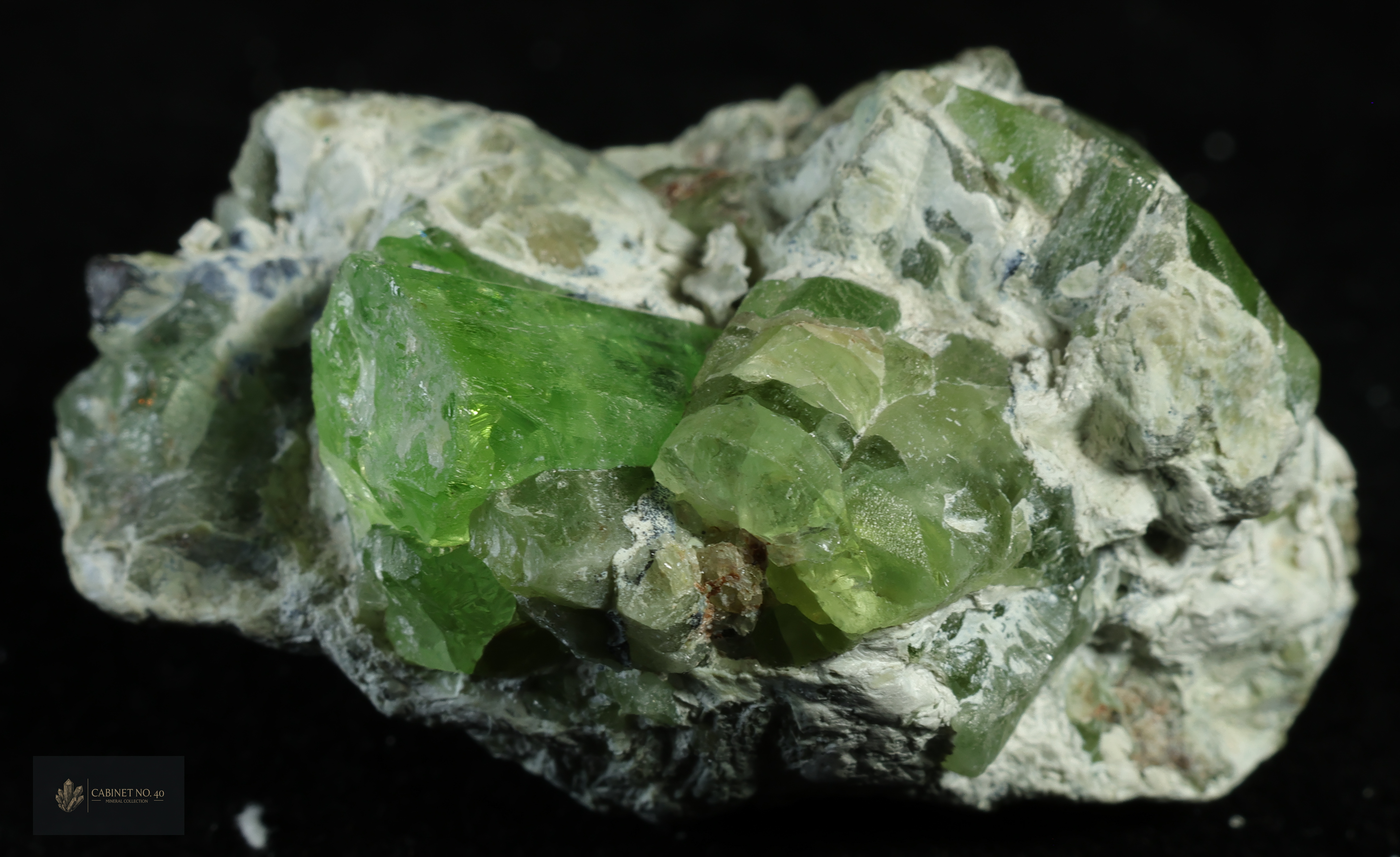
SKU: B_26_0036
A specimen of peridot, distinguished by its intense, juicy green color. The focal point of the specimen is a distinctly defined crystal, set against a contrasting light matrix. Main Features: intense green color; distinct main crystal; light matrix. Condition: Good - the main crystal has well-preserved walls.
Price: 41 EUR (179 PLN)
Availability: In stock
Location: Sapat Gali, Naran, Kaghan Valley, Mansehra District, Khyber Pakhtunkhwa Province, Pakistan
Size: 39 x 27 x 21 mm
Weight: 30.6 g
Chemical formula: (Mg,Fe)₂SiO₄
Crystal system: Orthorhombic
Mohs hardness: 6.8
Mineral group: Olivine Group
Characteristics Olivine is the name of a mineral group, the most well-known members of which are forsterite and fayalite. These minerals form a solid solution, and their chemical composition varies from pure forsterite (magnesium-rich) to pure fayalite (iron-rich). A typical olivine specimen has a color ranging from yellowish-green to olive-green, often with visible, fine grains or crystals. It usually occurs as granular aggregates, less frequently as well-formed crystals. Physical Properties The hardness of olivine on the Mohs scale is 6.5-7, making it a relatively hard mineral. It has a vitreous luster, and its transparency ranges from transparent to translucent. The density of olivine depends on its composition and ranges from 3.2-4.3 g/cm³. This mineral has poor cleavage and a conchoidal fracture. Colors and Varieties The most typical color of olivine is green, from light yellowish-green to dark olive-green. This color results from the presence of iron in the mineral's structure. The gem-quality variety, characterized by intense green, is called peridot. Depending on the magnesium to iron ratio, the color can vary, also including brown or yellow hues. History and Name The name "olivine" comes from its characteristic olive-green color. This mineral was known in antiquity, and its gem variety – peridot – was valued in Egypt. The name "peridot" likely has Greek roots, from the word "peridona," meaning "giving abundance." Applications Olivine is primarily used as a gemstone (peridot) in jewelry. Due to its high-temperature resistance, it is also used in the metallurgical industry as a refractory material. Furthermore, due to its high magnesium and iron content, it is sometimes used as a fertilizer additive.
Identification Olivine can be identified by its characteristic green color, vitreous luster, and conchoidal fracture. It often occurs as granular aggregates in igneous rocks. Its hardness (6.5-7 on the Mohs scale) allows it to scratch glass. Distinguishing from Similar Minerals Olivine is sometimes confused with garnet, epidote, or dioptase, which also occur in green shades. It differs from garnet by the lack of distinct cleavage and a different crystallization habit. It differs from epidote by the absence of epidote's characteristic prismatic habit. Dioptase is much softer and has a more intense, emerald green color. Crystal Forms Olivine most commonly occurs as granular aggregates, forming small, irregular grains in rocks. Well-formed, short-prismatic or tabular crystals with an orthorhombic habit are less common.
Genesis Olivine is a mineral typical of ultramafic and mafic igneous rocks, such as peridotites, basalts, and gabbros. It forms at high temperatures and pressures in the Earth's mantle and is then brought to the surface by volcanic processes. It can also occur in metamorphic rocks, formed by the alteration of magnesium- and iron-rich rocks, and in meteorites. Mineral Associations Olivine often co-occurs with other minerals typical of igneous rocks, such as pyroxenes (e.g., augite), plagioclase, chromite, magnetite, and ilmenite. In metamorphic rocks, it can be associated with serpentine and talc. Localities Significant deposits of olivine, including the gem variety – peridot, are found in many places around the world. The most important include: Zabargad Island (Egypt), Arizona (USA), Pakistan, China, Vietnam, Australia, Brazil, and Norway. In Poland, olivine occurs in the basalts of Lower Silesia.
Quality Criteria For olivine collectors, the intensity and purity of color are most important – the more vivid, olive-green the color, the more valuable the specimen. Transparency and lack of inclusions are also important. Large, well-formed crystals are rare and highly prized. Specimens with visible inclusions of chromite or other minerals can also be interesting due to their scientific value. Market Prices The prices of olivine, especially the peridot variety, vary and depend on the quality, size, and origin of the specimen. Small, rough olivine grains are relatively inexpensive. High-quality, faceted peridots with intense color can fetch prices from tens to hundreds of dollars per carat, depending on size and clarity. Popular Localities The most prized peridot specimens come from Zabargad Island in Egypt, known for historical sources of this gem. Other popular and valued localities include the San Carlos Reservation in Arizona (USA), where large, clear crystals are found, and regions of Pakistan and China, which supply high-quality gem material.
See mineralogical reference for Olivine / Peridot in the Knowledge Base →