SKU: S-0062_3-SK
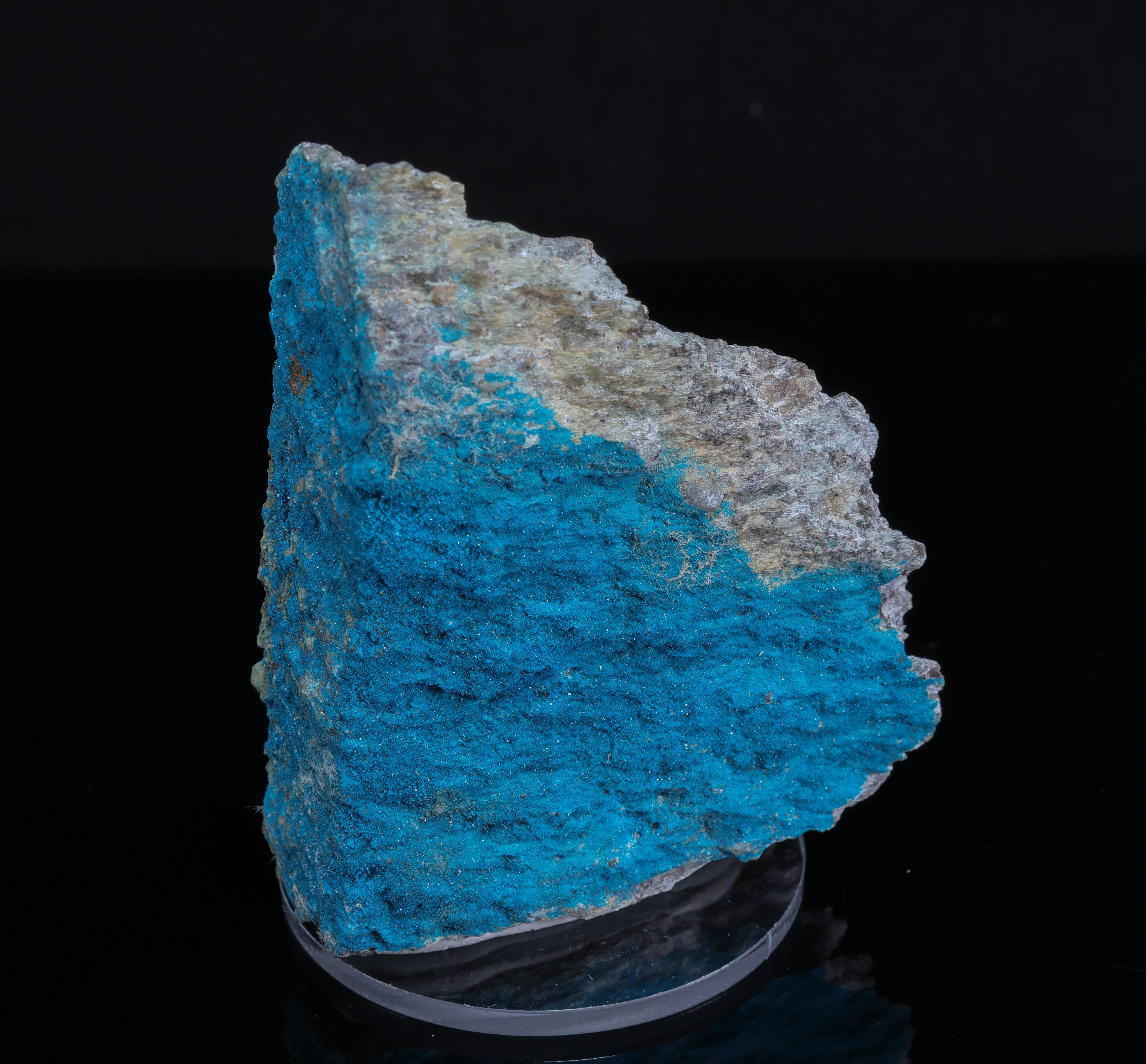
The specimen represents a rare copper sulfate, originating from the classic European locality of Ľubietová in Slovakia. This mineral forms an intensely blue, microcrystalline crust on the surface of the rock with a distinct, porous texture. The crust of langite is dense, covering a significant portion of the frontal wall of the specimen. Main Features: intense blue color; rich, microcrystalline crust of langite; clear contrast with the matrix; classic European locality. Condition: Very good.
Price: 39 EUR (169 PLN)
Availability: In stock
Location: Podlipa Mine, Lubietova, Banska Bystrica Region, Slovakia
Size: 79 x 65 x 19 mm
Weight: 101.2 g
Chemical formula: Cu₄(SO₄)(OH)₆·H₂O
Crystal system: rhombic
Mohs hardness: 2,5–3
Mineral group: Langite Group
Rarity: Uncommon
Characteristics Langite is a hydrated copper sulfate with hydroxyl groups, forming as a secondary mineral in the oxidation zones of copper deposits. It typically occurs as fine, acicular or tabular crystals, often forming coatings, radial aggregates, or spherulites. Its color ranges from intense blue to greenish-blue, which is characteristic of many copper minerals. Physical Properties This mineral is characterized by a Mohs hardness of 2.5-3, making it relatively soft. The luster of langite is vitreous. It is a translucent mineral. The density of langite is approximately 3.48 g/cm³. Colors and Varieties Langite primarily occurs in shades of blue and greenish-blue. The color is associated with the presence of copper in the mineral's structure. No specific commercial or color varieties are distinguished. History and Name Langite was discovered and described in 1864. The mineral's name comes from its discovery locality – the Långban mine in Sweden, although other sources state that the name comes from the Austrian mineralogist Victor von Lang. Applications Langite has no industrial applications due to its rarity and small quantities. It is a mineral valued mainly by collectors for its color and crystal forms.
Identification Langite can be identified by its characteristic blue or greenish-blue color, vitreous luster, and typical crystal forms, such as acicular or tabular crystals. Low hardness (2.5-3 on the Mohs scale) is also a diagnostic feature. Distinguishing from Similar Minerals Langite can be confused with other secondary copper minerals of similar color, such as chalcanthite, brochantite, or azurite. It differs from chalcanthite by its insolubility in water. From brochantite and azurite, it differs in chemical composition and crystallographic system, which requires laboratory tests for unambiguous identification. Brochantite has a higher hardness. Crystal Forms Langite forms monoclinic crystals with acicular, tabular, or prismatic habits. It often occurs in radial aggregates, spherulitic forms, or as coatings and incrustations on other minerals.
Genesis Langite is a secondary mineral, forming in the oxidation zones of copper deposits, where sulfate-rich solutions react with copper minerals. It forms at relatively low temperatures, often in the presence of pyrite or other sulfides, which provide sulfate ions. Mineral Associations It co-occurs with other secondary copper minerals, such as brochantite, chalcanthite, azurite, malachite, cuprite, and with iron minerals like goethite or limonite. Localities Known langite localities include mines in Cornwall (England), mines in the Broken Hill region (Australia), as well as in Chile, Germany, Italy, and the United States (e.g., Arizona).
Quality Criteria The most prized langite specimens are those with well-formed, distinct crystals, of intense, uniform blue or greenish-blue color. Large crystalline aggregates or aesthetic coatings on the host rock also increase collectible value. Popular Localities Specimens from historical mines in Cornwall (England) and from certain localities in Chile and the United States, where aesthetic and well-formed crystals are found, are particularly sought after.
See mineralogical reference for Langite in the Knowledge Base →