Langite
Chemical formula: Cu<sup>2+</sup><sub>4</sub>S<sup>6+</sup>O<sub>4</sub>(OH)<sub>6</sub>(H<sub>2</sub>O)·H<sub>2</sub>O
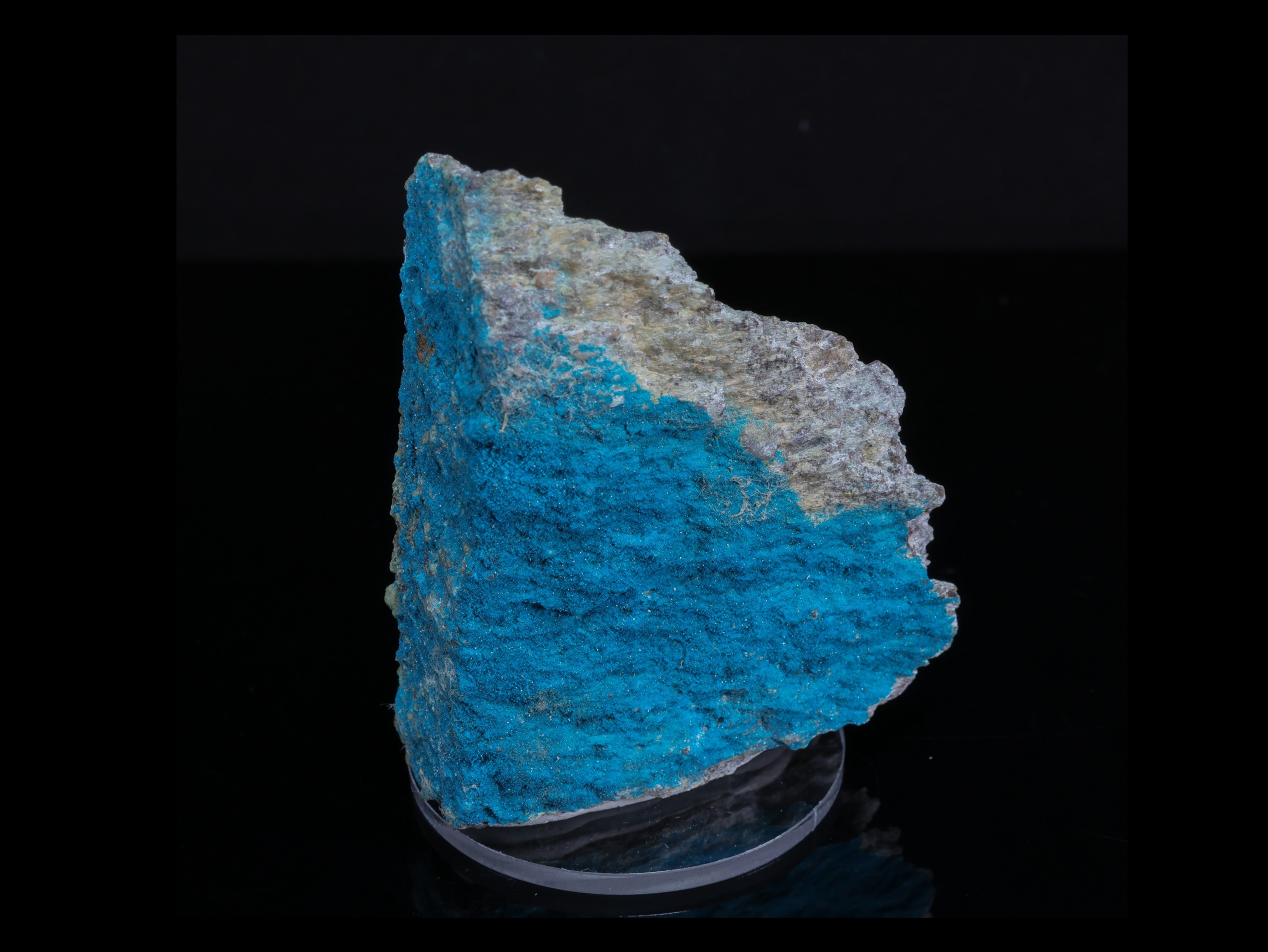
Langite is a rare, secondary copper mineral, which is a hydrated copper sulfate with hydroxyl groups, characterized by an intense blue or greenish-blue color.
Properties
- Mohs hardness
- 2.5-3
- Luster
- Vitreous
- Streak
- Jasnoniebieska
- Density
- 3.48
- Cleavage
- On {001} and {010}.
- Fracture
- Nierówny
- Transparency
- Translucent
- Crystal system
- Monoclinic
Diagnostic features
## Identification Langite can be identified by its characteristic blue or greenish-blue color, vitreous luster, and typical crystal forms, such as acicular or tabular crystals. Low hardness (2.5-3 on the Mohs scale) is also a diagnostic feature. ## Distinguishing from Similar Minerals Langite can be confused with other secondary copper minerals of similar color, such as chalcanthite, brochantite, or azurite. It differs from chalcanthite by its insolubility in water. From brochantite and azurite, it differs in chemical composition and crystallographic system, which requires laboratory tests for unambiguous identification. Brochantite has a higher hardness. ## Crystal Forms Langite forms monoclinic crystals with acicular, tabular, or prismatic habits. It often occurs in radial aggregates, spherulitic forms, or as coatings and incrustations on other minerals.
Geological environment
## Genesis Langite is a secondary mineral, forming in the oxidation zones of copper deposits, where sulfate-rich solutions react with copper minerals. It forms at relatively low temperatures, often in the presence of pyrite or other sulfides, which provide sulfate ions. ## Mineral Associations It co-occurs with other secondary copper minerals, such as brochantite, chalcanthite, azurite, malachite, cuprite, and with iron minerals like goethite or limonite. ## Localities Known langite localities include mines in Cornwall (England), mines in the Broken Hill region (Australia), as well as in Chile, Germany, Italy, and the United States (e.g., Arizona).
Rarity
Common
For collectors
## Quality Criteria The most prized langite specimens are those with well-formed, distinct crystals, of intense, uniform blue or greenish-blue color. Large crystalline aggregates or aesthetic coatings on the host rock also increase collectible value. ## Popular Localities Specimens from historical mines in Cornwall (England) and from certain localities in Chile and the United States, where aesthetic and well-formed crystals are found, are particularly sought after.
Care and storage
## Cleaning Due to its relatively low hardness and the presence of copper, langite should be cleaned carefully. It is recommended to use a soft brush and distilled water. Avoid strong rubbing. ## What to Avoid Avoid contact with acids, which can damage the mineral. Prolonged exposure to direct sunlight may lead to slight fading of the color. High temperatures are also not advisable. The mineral is sensitive to moisture, so it should be stored in a dry environment. ## Storage Langite specimens are best stored in closed display cases or boxes, away from dust and fluctuating environmental conditions. It is advisable to place a moisture absorber in the container to prevent its accumulation.