SKU: S_00012
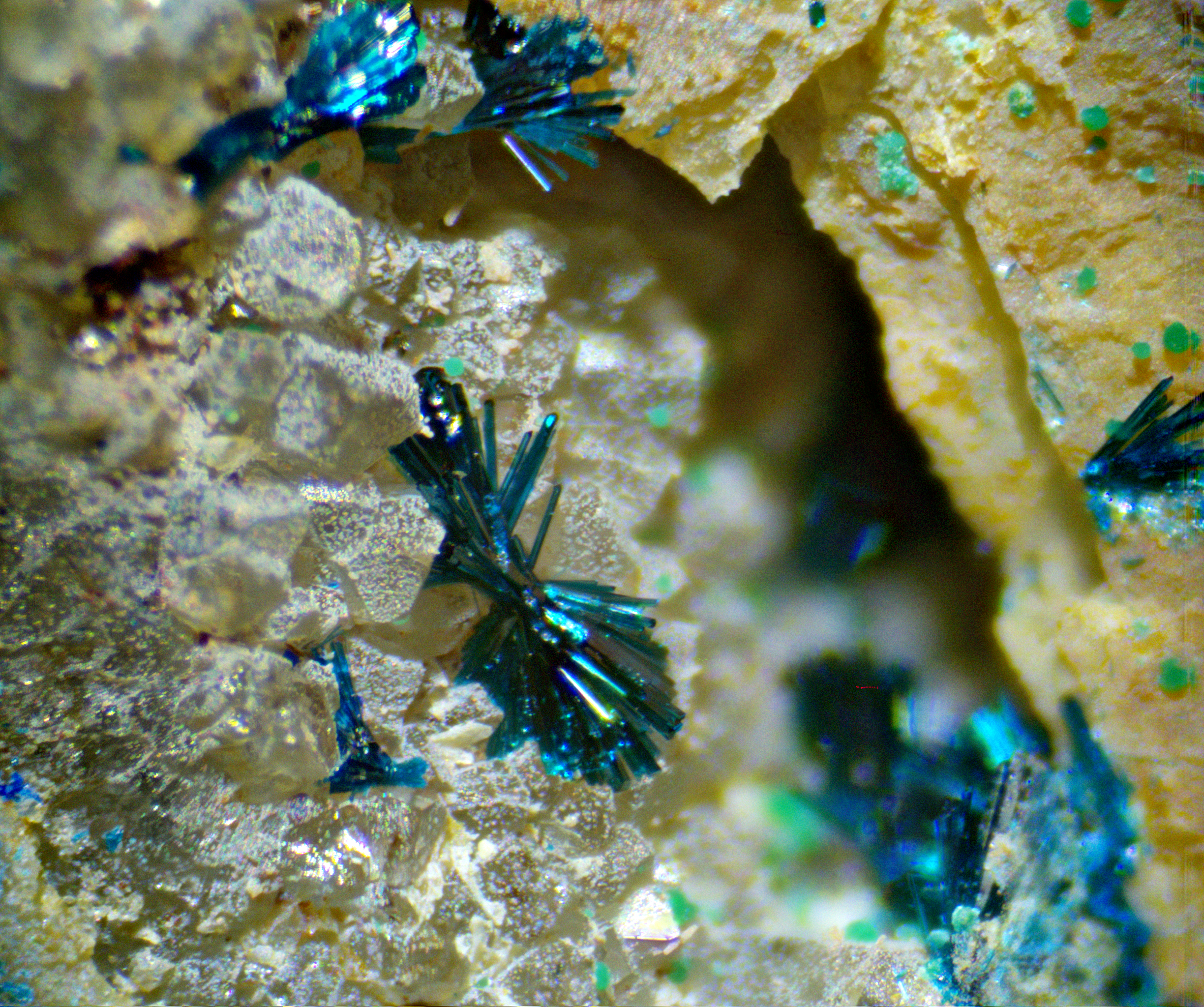
An exceptionally aesthetic specimen of rare copper arsenate, originating from the legendary Clara Mine. The mineral forms characteristic, dark-navy aggregates which, under the microscope, reveal an intense color and strong luster. Main Features: rare clinochlore; classic locality; intense navy color; radiating rosettes of crystals; excellent material for microscope/macro photography. Condition: Very good - the crystals are well-protected, intact, and have retained their natural, high luster on the faces.
Price: 48 EUR (209 PLN)
Availability: In stock
Location: Clara Mine, Germany
Size: 22 x 28 x 15 mm
Weight: 200 g
Chemical formula: Cu₃(AsO₄)(OH)₃
Crystal system: Monoclinic
Mohs hardness: 2.5-3
Characteristics Clinoclase is a copper arsenate mineral that typically forms small, acicular or tabular crystals, often arranged in radial or fan-shaped aggregates. Its color ranges from blue, through greenish-blue, to dark greenish-black, and in transmitted light, it is blue-green. Clinoclase crystals are usually small, but their intense color and characteristic habit make them recognizable. Physical Properties Clinoclase has a Mohs hardness of 2.5-3, making it a relatively soft mineral. It is characterized by a vitreous luster. It is transparent to translucent. Its density is 4.38 g/cm³. It has perfect cleavage along the {001} plane. Colors and Varieties The color of clinoclase is variable, from blue, through blue-green, to dark greenish-black. In transmitted light, it takes on a blue-green hue. No specific commercial or color varieties are distinguished. History and Name The mineral was described in 1830. The name "clinoclase" comes from the Greek words "klinein" (to lean) and "klan" (to break), which refers to its oblique cleavage. Uses Clinoclase has no industrial applications. It is a mineral valued mainly by collectors due to its rarity, aesthetics, and intense color.
Identification Clinoclase can be identified by its characteristic blue-green color, vitreous luster, and typical acicular or tabular crystals, often forming radial aggregates. Its relatively low hardness (2.5-3 on the Mohs scale) is also a diagnostic feature. Distinguishing from Similar Minerals Clinoclase can be confused with other copper minerals of similar color, such as azurite or malachite. It is distinguished from azurite by its lack of reaction with hydrochloric acid and different crystallographic system. It differs from malachite by the absence of a banded structure and different hardness. From olivenite, which is also a copper arsenate, clinoclase is distinguished by the streak color (blue-green for clinoclase, green for olivenite) and crystallographic system. Crystal Forms Clinoclase most often occurs as acicular, tabular, or prismatic crystals. It often forms radial, fan-shaped, or spherulitic aggregates. Crystals are usually small but well-formed.
Genesis Clinoclase is a secondary mineral that forms in the oxidation zones of copper deposits containing arsenic. It forms as a result of the reaction of hydrothermal solutions with copper and arsenic minerals under low-temperature conditions. Mineral Associations Clinoclase often co-occurs with other secondary copper minerals, such as azurite, malachite, olivenite, chalcophyllite, adamite, as well as with quartz and limonite. Localities Known clinoclase localities include: Wheal Gorland mine in Cornwall (England), Majuba Hill mine in Nevada (USA), Tsumeb in Namibia, Cap Garonne in France, and the Schneeberg area in Saxony (Germany).
Quality Criteria The most prized clinoclase specimens are those with well-formed, intensely colored crystals, forming aesthetic aggregates. The size of the crystals and their transparency are also important. Specimens on matrix, without mechanical damage, are more desirable. Popular Localities Valued clinoclase specimens come from historical localities such as the Wheal Gorland mine in Cornwall (England) and Tsumeb in Namibia. Specimens from these locations often feature exceptional color and crystal form.
See mineralogical reference for Clinoclase in the Knowledge Base →