Clinoclase
Chemical formula: Cu<sup>2+</sup><sub>3</sub>As<sup>5+</sup>O<sub>4</sub>(OH)<sub>3</sub>
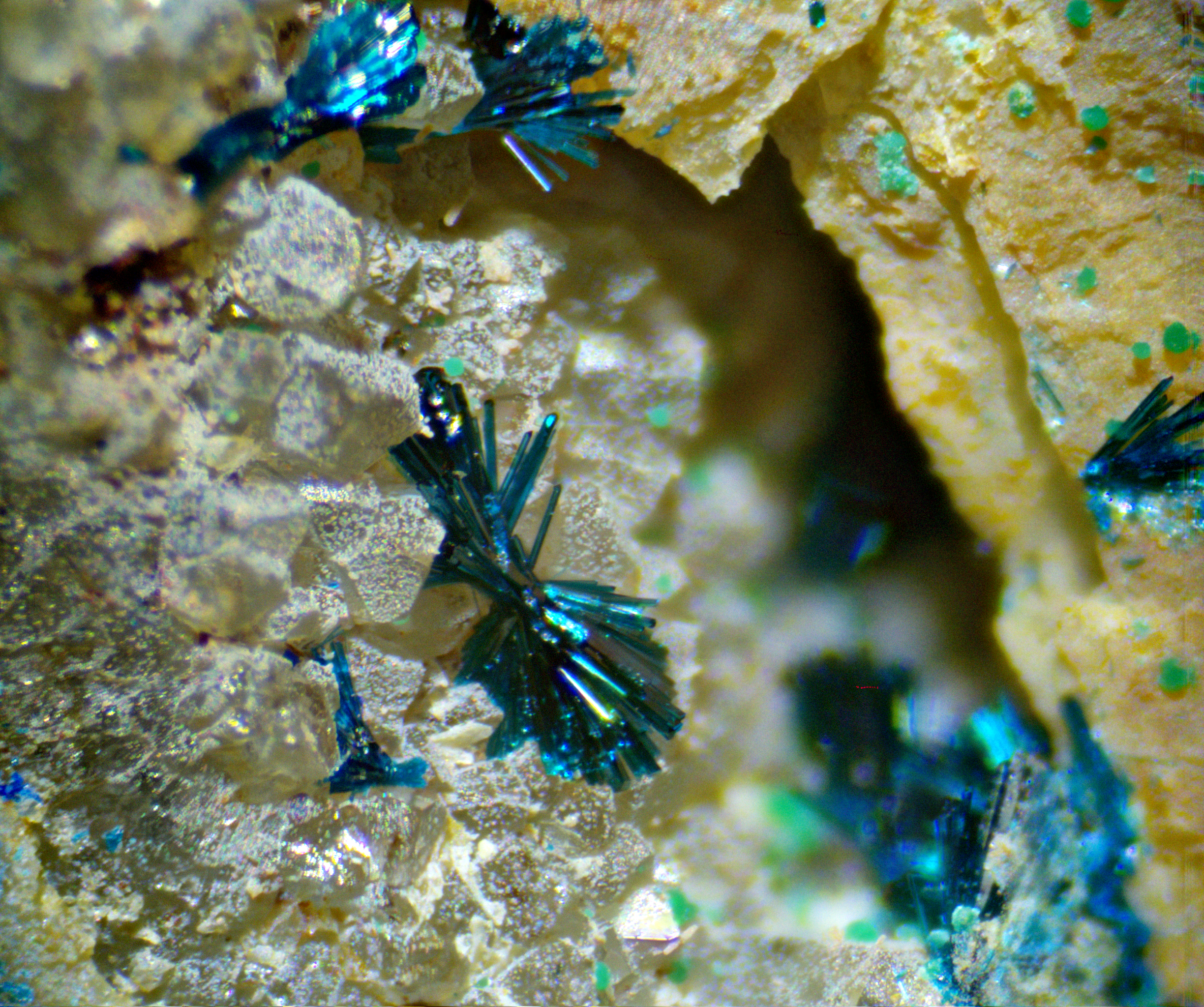
Clinoclase is a rare copper mineral, a hydroxyl arsenate, characterized by an intense blue-green color and vitreous luster.
Properties
- Mohs hardness
- 2.5-3
- Luster
- Vitreous
- Streak
- Bluish green
- Density
- 4.38
- Cleavage
- On {001}, perfect.
- Transparency
- Transparent,Translucent
- Crystal system
- Monoclinic
Diagnostic features
## Identification Clinoclase can be identified by its characteristic blue-green color, vitreous luster, and typical acicular or tabular crystals, often forming radial aggregates. Its relatively low hardness (2.5-3 on the Mohs scale) is also a diagnostic feature. ## Distinguishing from Similar Minerals Clinoclase can be confused with other copper minerals of similar color, such as azurite or malachite. It is distinguished from azurite by its lack of reaction with hydrochloric acid and different crystallographic system. It differs from malachite by the absence of a banded structure and different hardness. From olivenite, which is also a copper arsenate, clinoclase is distinguished by the streak color (blue-green for clinoclase, green for olivenite) and crystallographic system. ## Crystal Forms Clinoclase most often occurs as acicular, tabular, or prismatic crystals. It often forms radial, fan-shaped, or spherulitic aggregates. Crystals are usually small but well-formed.
Geological environment
## Genesis Clinoclase is a secondary mineral that forms in the oxidation zones of copper deposits containing arsenic. It forms as a result of the reaction of hydrothermal solutions with copper and arsenic minerals under low-temperature conditions. ## Mineral Associations Clinoclase often co-occurs with other secondary copper minerals, such as azurite, malachite, olivenite, chalcophyllite, adamite, as well as with quartz and limonite. ## Localities Known clinoclase localities include: Wheal Gorland mine in Cornwall (England), Majuba Hill mine in Nevada (USA), Tsumeb in Namibia, Cap Garonne in France, and the Schneeberg area in Saxony (Germany).
Rarity
Uncommon
For collectors
## Quality Criteria The most prized clinoclase specimens are those with well-formed, intensely colored crystals, forming aesthetic aggregates. The size of the crystals and their transparency are also important. Specimens on matrix, without mechanical damage, are more desirable. ## Popular Localities Valued clinoclase specimens come from historical localities such as the Wheal Gorland mine in Cornwall (England) and Tsumeb in Namibia. Specimens from these locations often feature exceptional color and crystal form.
Care and storage
## Cleaning Clinoclase is a relatively soft mineral, so it requires gentle cleaning. It is best to use a soft brush and lukewarm water. Distilled water can also be used to avoid hard water deposits. ## What to Avoid Avoid using any chemical cleaning agents that could damage the mineral's surface. Clinoclase is sensitive to high temperatures and prolonged exposure to sunlight, which can lead to color fading. Due to its copper content, this mineral can react with acids. It should also be protected from moisture to prevent possible chemical reactions. ## Storage Clinoclase should be stored in a dry place, away from direct sunlight and heat sources. It is best to place it in a closed display case or box to protect it from dust and mechanical damage. Due to its softness, avoid contact with harder minerals that could scratch it.