SKU: K-0223_5-IN
An exceptionally aesthetic specimen of Cavansite, characterized by the presence of several radiating, spherical aggregates of stunning color. The crystals are set on a light, fine-grained matrix covered with Stilbite, creating an almost perfect color contrast. An additional advantage of the specimen is the larger, transparent crystals of Stilbite in the central part. Main Features: intense electric blue color; spherical rosettes of crystals; clear contrast with the substrate; association with Stilbite; ex coll. K.Urbanik. Condition: Very good - the main concentrations of Cavansite are complete, intact, and stably set.
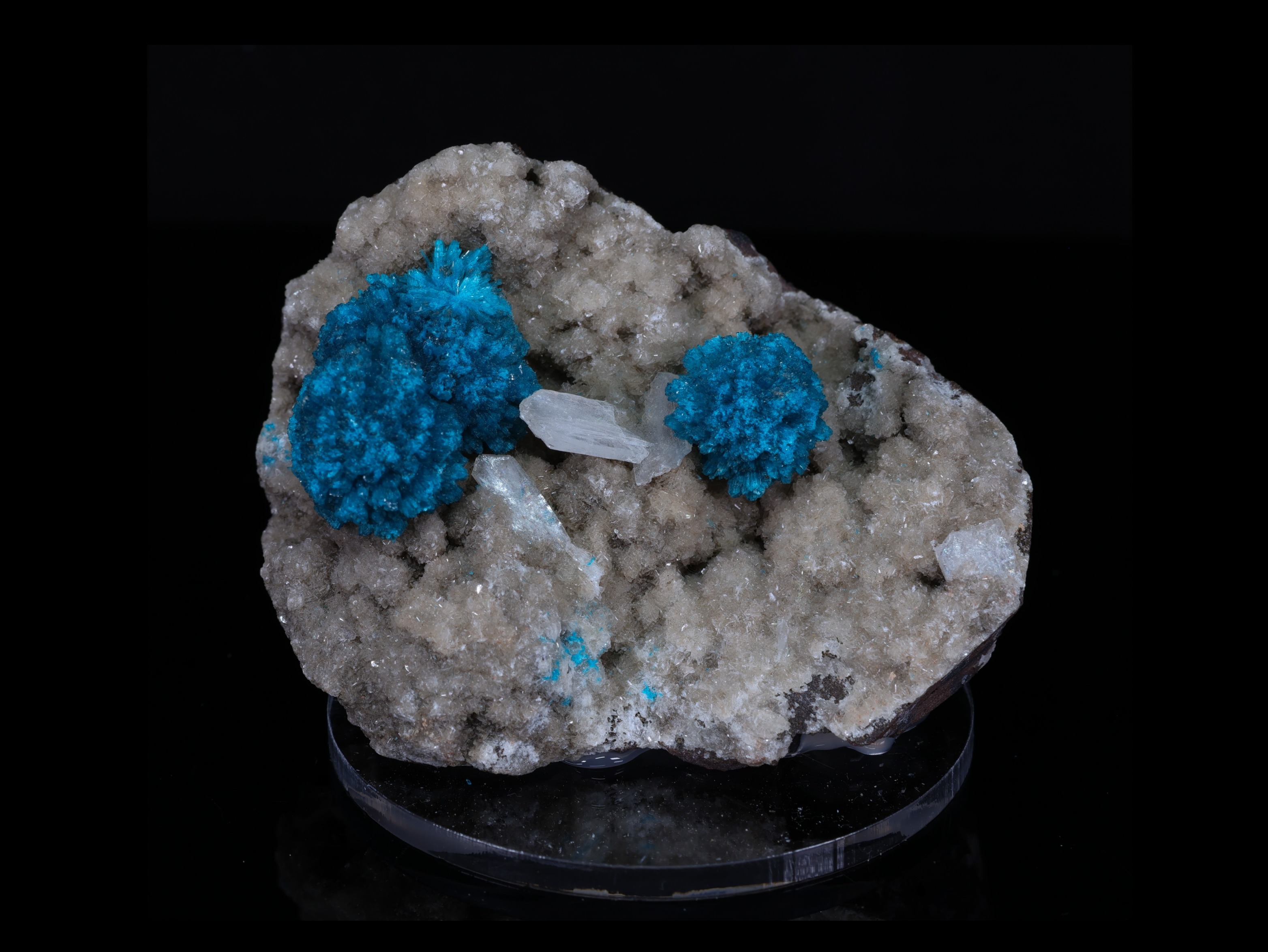
Price: 283 EUR (1229 PLN)
Availability: In stock
Location: Wagholi Quarry, Pune, Maharashtra, India
Size: 69 x 48 x 30 mm
Weight: 57 g
Chemical formula: Ca(VO)(Si₄O₁₀)·4H₂O
Crystal system: monoclinic
Mohs hardness: 3–4
Mineral group: Cavansite Group
Rarity: Very Rare
Characteristics Cavansite is a mineral characterized by its distinctive, intensely blue or greenish-blue coloration. It often occurs as radial or spherical aggregates of small, acicular crystals, forming striking shapes resembling fluffy balls or fans. Cavansite crystals are usually small, but their aggregates can reach several centimeters in size. This mineral often precipitates on a substrate of zeolites, such as stilbite or heulandite, or on calcite, creating contrasting and aesthetic specimens. Physical Properties Cavansite has a Mohs hardness of 3-4, which means it is a relatively soft mineral. It has a vitreous luster and its transparency is described as transparent. The specific gravity of cavansite is 2.21. This mineral exhibits good cleavage along the {010} plane. Colors and Varieties The typical color of cavansite is intense blue, often described as azure or sapphire. It can also take on greenish-blue hues. This color is a result of the presence of vanadium in the mineral's structure. Cavansite has no known commercial or color varieties, but the intensity and shade of blue can vary depending on the specific deposit. History and Name Cavansite was discovered in 1967. Its name comes from its chemical composition, being an acronym for the elements that comprise it: Calcium, Vanadium, and Silicon. This name reflects the unique combination of these elements in the mineral's structure. Uses Cavansite is primarily a collector's mineral. Its attractive appearance, intense color, and rarity make it prized by mineral enthusiasts. It has no industrial applications due to its rarity and softness.
Identification Cavansite can be recognized primarily by its characteristic, intensely blue color and radial or spherical aggregates of acicular crystals. It often occurs in association with white zeolites, creating a distinct contrast. Its vitreous luster and transparency are also helpful in identification. Distinguishing from Similar Minerals Cavansite is sometimes confused with pentagonite, which has an identical chemical composition but crystallizes in a different system (orthorhombic). Differences in crystal form are subtle and often require detailed analysis. Other blue minerals, such as azurite, usually have different hardness, density, and often different crystal habits. Azurite is also much harder and has a darker, more navy blue color. Crystal Forms Cavansite most often forms radial or spherical aggregates of small, acicular crystals. These crystals are usually elongated and form spherical clusters, often described as "ball-like" or "flower-like" forms. Single, well-formed crystals are less common.
Genesis Cavansite is a secondary mineral, forming in low-temperature hydrothermal environments, often in fractures and cavities in volcanic rocks, especially basalts. It forms as a result of hydrothermal processes where solutions rich in calcium, vanadium, and silicon react in the presence of water. Mineral Associations Cavansite often co-occurs with other secondary minerals, such as zeolites (e.g., stilbite, heulandite, apophyllite), calcite, quartz, and chalcedony. These associated minerals often form the substrate on which spectacular cavansite aggregates are deposited. Localities The most important and well-known occurrences of cavansite are in India, especially in the Deccan region, in the states of Maharashtra and Gujarat. Specimens from these localities are prized for their intense color and well-formed shapes. Other, less significant occurrences have been reported in the United States (Oregon) and New Zealand.
Quality Criteria The most prized cavansite specimens are characterized by an intense, deep blue color. The size and perfection of the radial or spherical crystal aggregates are also important. Specimens with well-formed, undamaged "balls" of cavansite on an aesthetic matrix, e.g., of white zeolites, are the most sought after. The absence of mechanical damage and impurities also affects collectible value. Popular Localities The most prized cavansite specimens come from India, especially from the Pune region in Maharashtra. These localities are famous for producing large and aesthetic specimens of exceptional color.
See mineralogical reference for Cavansite in the Knowledge Base →