Cavansite
Chemical formula: CaV<sup>4+</sup>OSi<sub>4</sub>O<sub>10</sub>·4H<sub>2</sub>O
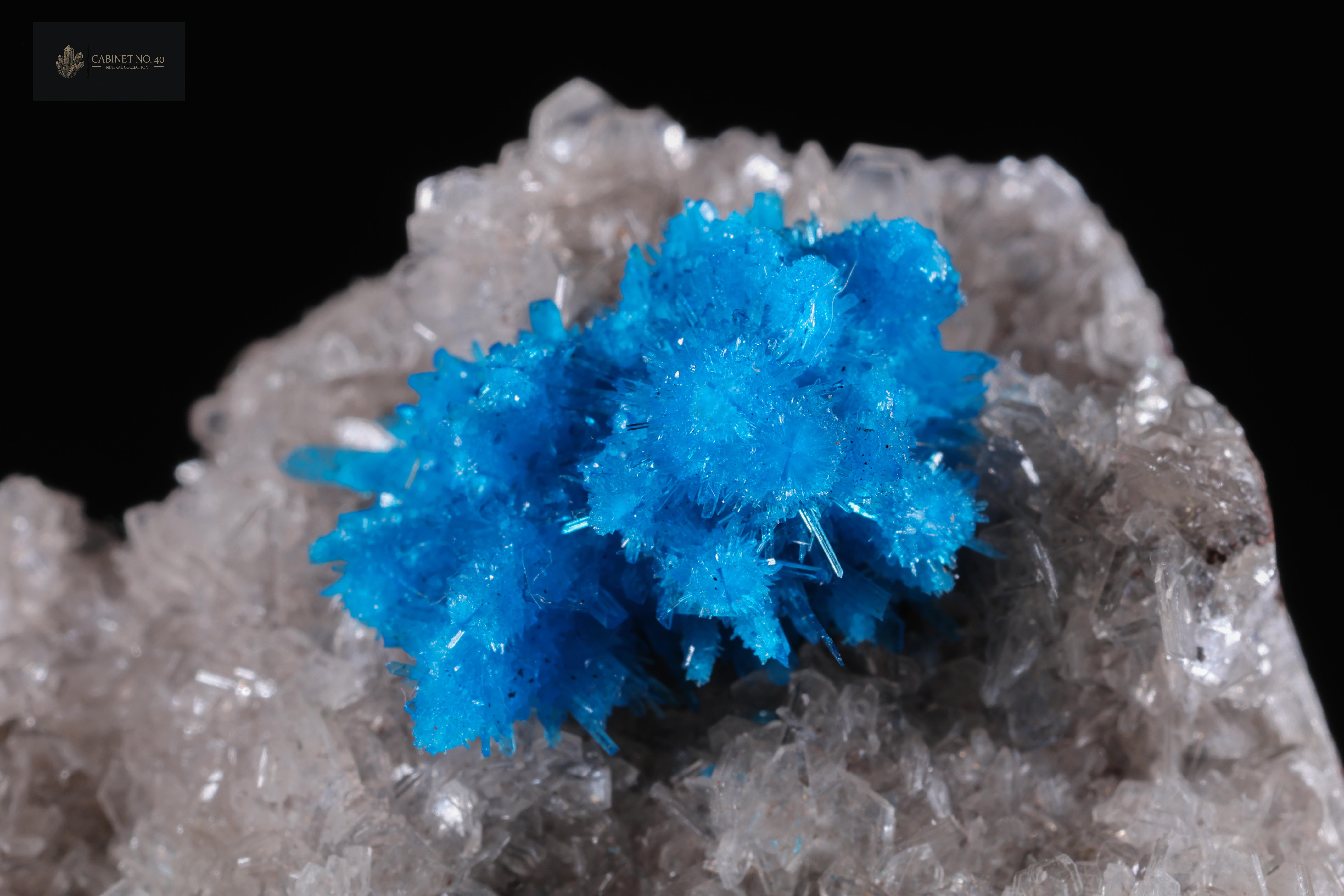
Cavansite is a rare hydrated calcium vanadium silicate, known for its intense blue color and characteristic radial crystal aggregates.
Properties
- Mohs hardness
- 3-4
- Luster
- Vitreous
- Density
- 2.21
- Cleavage
- Good on {010}
- Transparency
- Transparent
- Crystal system
- Orthorhombic
Diagnostic features
## Identification Cavansite can be recognized primarily by its characteristic, intensely blue color and radial or spherical aggregates of acicular crystals. It often occurs in association with white zeolites, creating a distinct contrast. Its vitreous luster and transparency are also helpful in identification. ## Distinguishing from Similar Minerals Cavansite is sometimes confused with pentagonite, which has an identical chemical composition but crystallizes in a different system (orthorhombic). Differences in crystal form are subtle and often require detailed analysis. Other blue minerals, such as azurite, usually have different hardness, density, and often different crystal habits. Azurite is also much harder and has a darker, more navy blue color. ## Crystal Forms Cavansite most often forms radial or spherical aggregates of small, acicular crystals. These crystals are usually elongated and form spherical clusters, often described as "ball-like" or "flower-like" forms. Single, well-formed crystals are less common.
Geological environment
## Genesis Cavansite is a secondary mineral, forming in low-temperature hydrothermal environments, often in fractures and cavities in volcanic rocks, especially basalts. It forms as a result of hydrothermal processes where solutions rich in calcium, vanadium, and silicon react in the presence of water. ## Mineral Associations Cavansite often co-occurs with other secondary minerals, such as zeolites (e.g., stilbite, heulandite, apophyllite), calcite, quartz, and chalcedony. These associated minerals often form the substrate on which spectacular cavansite aggregates are deposited. ## Localities The most important and well-known occurrences of cavansite are in India, especially in the Deccan region, in the states of Maharashtra and Gujarat. Specimens from these localities are prized for their intense color and well-formed shapes. Other, less significant occurrences have been reported in the United States (Oregon) and New Zealand.
Rarity
Very Rare
For collectors
## Quality Criteria The most prized cavansite specimens are characterized by an intense, deep blue color. The size and perfection of the radial or spherical crystal aggregates are also important. Specimens with well-formed, undamaged "balls" of cavansite on an aesthetic matrix, e.g., of white zeolites, are the most sought after. The absence of mechanical damage and impurities also affects collectible value. ## Popular Localities The most prized cavansite specimens come from India, especially from the Pune region in Maharashtra. These localities are famous for producing large and aesthetic specimens of exceptional color.
Care and storage
## Cleaning Cavansite is a delicate mineral and therefore requires careful cleaning. It is best to use a soft brush, such as a paintbrush, to remove dust. For heavier soiling, the specimen can be gently rinsed with lukewarm distilled water. Avoid a strong stream of water, which could damage the delicate crystal aggregates. ## What to Avoid Avoid using any chemical cleaning agents, acids, or solvents, as these can irreversibly damage the mineral's surface or alter its color. Cavansite is sensitive to high temperatures and sudden temperature changes, which can lead to cracks. Prolonged exposure to direct sunlight can cause the color to fade. This mineral is also sensitive to moisture, so it should be stored in a dry environment. ## Storage Cavansite should be stored in a closed display case or box, away from dust and direct light. Due to its softness, contact with harder minerals that could scratch it should be avoided. Ideal storage is in a place with stable temperature and low humidity.