SKU: P_26-6_17
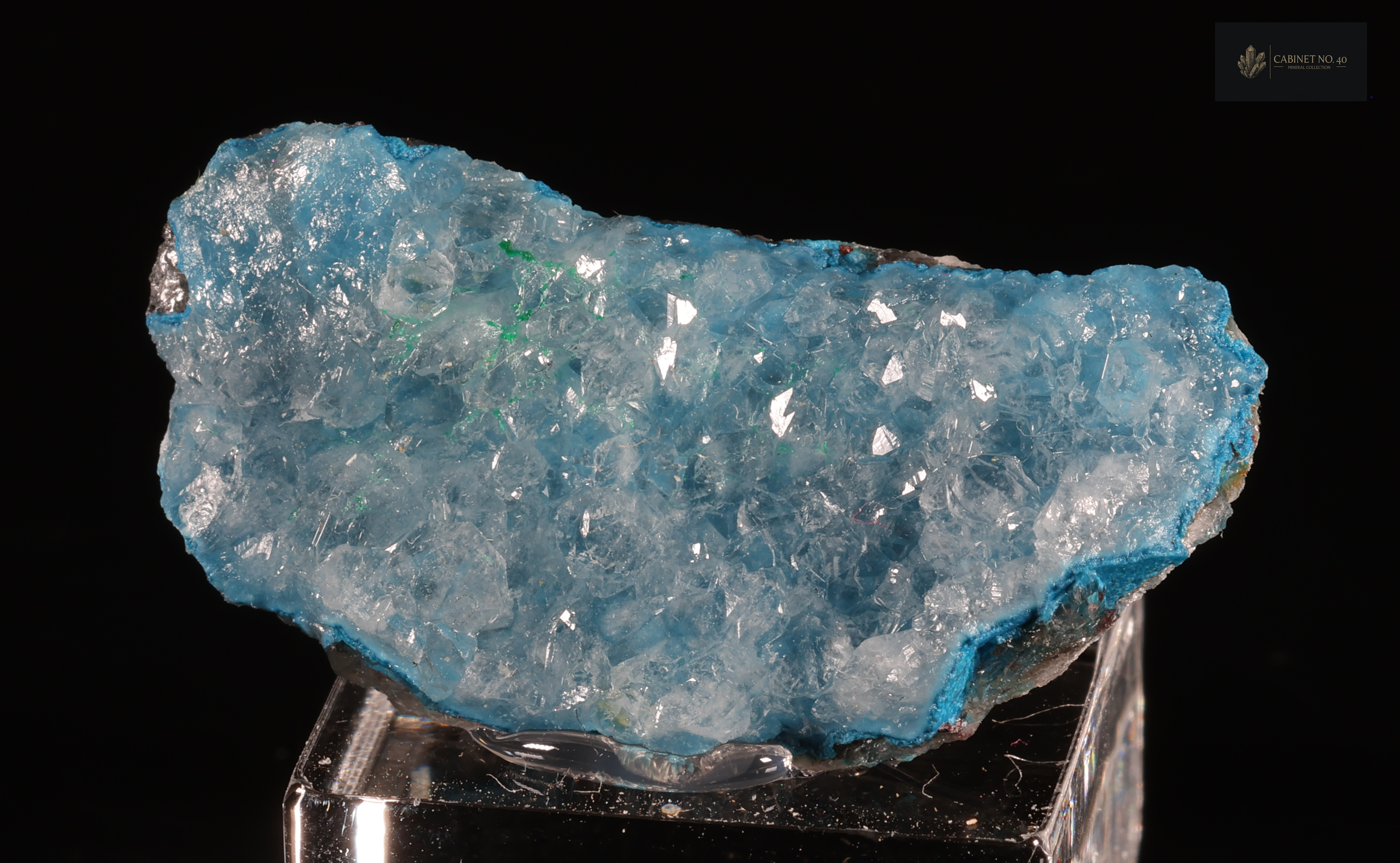
The presented specimen is a fragment of matrix covered with quartz druse, whose crystals are tinted blue by inclusions of shattuckite. The surface of the quartz shimmers in the light, revealing numerous shiny crystal faces of varying sizes, and their transparency allows for the intense blue to be seen within. Main features: quartz crystals tinted by inclusions of shattuckite; visible, compact shattuckite at the edge of the specimen. Condition: Very good, with no visible mechanical damage.
Price: 14 EUR (59 PLN)
Availability: In stock
Location: Omaue Mine, Opuwo Rural, Kunene Region, Namibia
Size: 29 x 12 x 15 mm
Weight: 8 g
Characteristics Shattuckite is a copper silicate mineral that typically forms fibrous, radial, or granular aggregates. Well-formed crystals are rarer. Its color ranges from light blue to dark blue, often with a turquoise hue. Shattuckite aggregates can be dense, compact, and sometimes form crusts on other copper minerals. Physical Properties This mineral has a Mohs hardness of 3.5, making it relatively soft. It has a specific gravity of approximately 4.11. Shattuckite is translucent, and its luster is usually dull to silky, especially in fibrous aggregates. It has good cleavage, meaning it breaks easily along specific planes. Colors and Varieties Shattuckite occurs exclusively in shades of blue, from light blue to intense, dark blue. The color is due to the presence of copper in its chemical composition. There are no specific commercial varieties, but differences in color intensity and aggregate form can influence its collector's appeal. History and Name Shattuckite was discovered in 1915 at the Shattuck Mine in Bisbee, Arizona, USA, from which it derives its name. It was described by Waldemar T. Schaller. It is a relatively young mineral in the history of mineralogy, and its discovery was associated with intense mining activity in areas rich in copper ores. Uses Shattuckite has no significant industrial applications due to its rarity and softness. It is primarily valued as a collector's mineral, especially sought after by enthusiasts of rare copper minerals. It is sometimes used in jewelry, but requires appropriate protection due to its low hardness.
Identification Shattuckite can be identified by its characteristic blue color and often fibrous or radial habit. It usually occurs in the oxidation zones of copper deposits. Its softness (3.5 on the Mohs scale) is also a diagnostic feature that can be checked with a scratch test. Distinguishing from Similar Minerals Shattuckite is sometimes confused with other blue copper minerals, such as chrysocolla, dioptase, or azurite. It differs from chrysocolla by its greater hardness and lack of waxy luster. Azurite is usually darker, has a vitreous luster, and reacts with acids, releasing carbon dioxide. Dioptase forms distinct, rhombohedral crystals with a vitreous luster, and its hardness is higher. The environment of occurrence and mineral associations are also key. Crystal Forms Shattuckite rarely forms well-developed crystals. It most often occurs as fibrous, radial, granular aggregates or as crusts. Crystals, if they do appear, are usually acicular or columnar, and small in size.
Genesis Shattuckite forms secondarily in the oxidation zones of copper deposits. It is formed by the weathering of primary copper minerals in the presence of silica and water. This process occurs under low-temperature hydrothermal conditions. Mineral Associations Shattuckite often co-occurs with other copper minerals, such as chrysocolla, malachite, azurite, cuprite, brochantite, and quartz. It can also form pseudomorphs after other minerals, retaining their shape but changing their chemical composition. Localities The most important and well-known occurrences of shattuckite are the Shattuck Mine in Bisbee, Arizona, USA, where it was discovered. Other significant localities include Namibia (Tsumeb), Democratic Republic of Congo (Katanga), Peru, and South Africa.
Quality Criteria The most prized shattuckite specimens are characterized by an intense, uniform blue color and well-developed fibrous or radial aggregates. Large, aesthetic aggregates, free from impurities and damage, are particularly sought after. Specimens with distinct crystals, though rare, fetch high prices. The aesthetics of its association with other minerals, especially if they create attractive contrasts, is also important. Market Prices The prices of shattuckite vary and depend on the quality, size, and rarity of the specimen. Small, less impressive specimens can cost from several tens to over a hundred Polish zlotys. Larger, well-colored, and aesthetic aggregates, especially those from renowned localities, can reach prices from several hundred to several thousand Polish zlotys. Specimens with crystals or in association with other rare copper minerals can be significantly more expensive. Popular Localities The most prized shattuckite specimens come from its discovery site – the Shattuck Mine in Bisbee, Arizona, USA. Specimens from Tsumeb in Namibia are also highly valued due to their quality and frequent occurrence in interesting mineral associations.
See mineralogical reference for Shattuckite in the Knowledge Base →