Shattuckite
Chemical formula: Cu<sup>2+</sup><sub>5</sub>(SiO<sub>3</sub>)<sub>4</sub>(OH)<sub>2</sub>
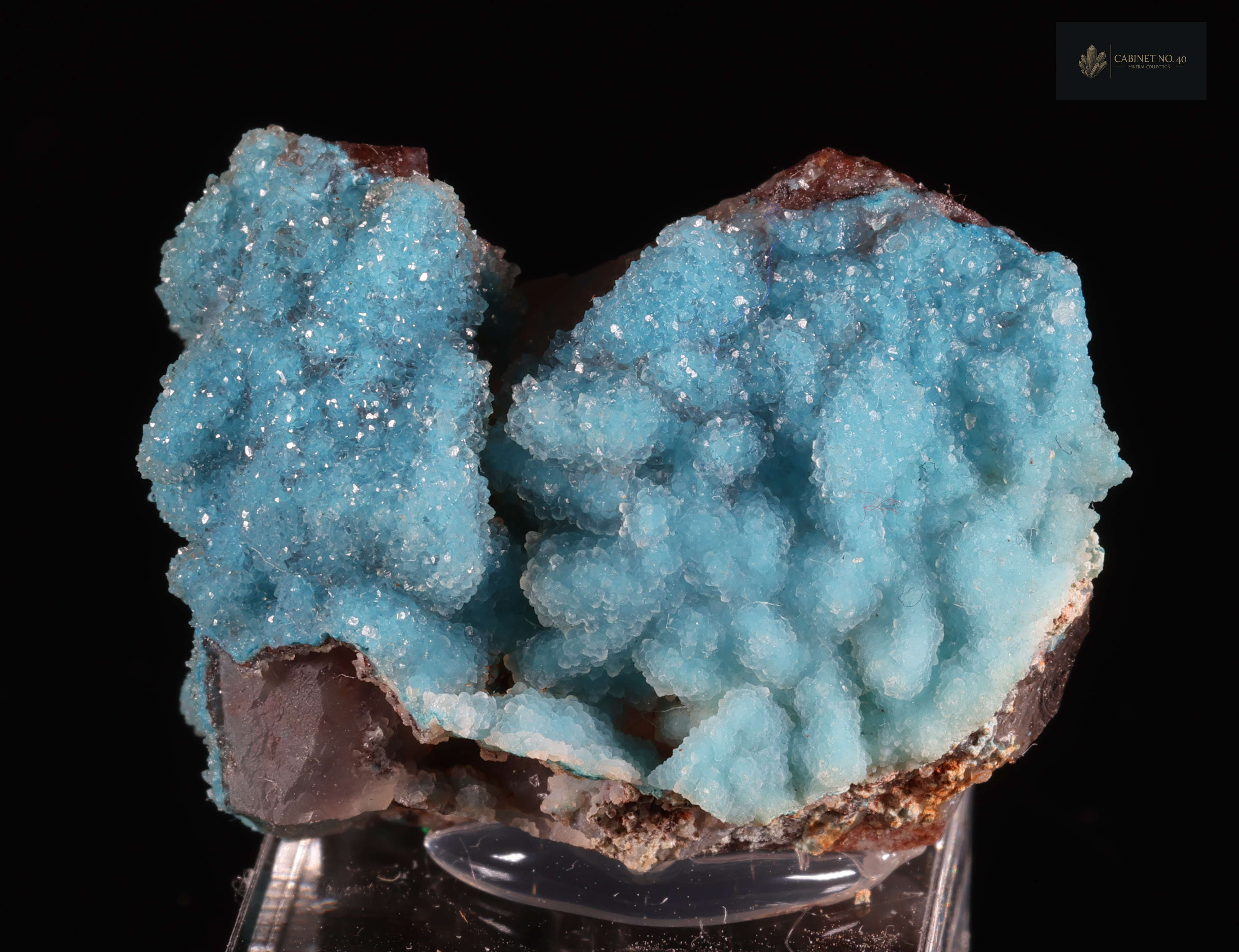
Shattuckite is a rare copper silicate mineral, characterized by its intense blue color, often occurring in fibrous or radial aggregates.
Properties
- Mohs hardness
- 3.5
- Luster
- Matowy do jedwabistego
- Streak
- Jasnoniebieska
- Density
- 4.11
- Cleavage
- on {010} {100}
- Fracture
- Nierówny
- Transparency
- Translucent
- Crystal system
- Orthorhombic
Diagnostic features
## Identification Shattuckite can be identified by its characteristic blue color and often fibrous or radial habit. It usually occurs in the oxidation zones of copper deposits. Its softness (3.5 on the Mohs scale) is also a diagnostic feature that can be checked with a scratch test. ## Distinguishing from Similar Minerals Shattuckite is sometimes confused with other blue copper minerals, such as chrysocolla, dioptase, or azurite. It differs from chrysocolla by its greater hardness and lack of waxy luster. Azurite is usually darker, has a vitreous luster, and reacts with acids, releasing carbon dioxide. Dioptase forms distinct, rhombohedral crystals with a vitreous luster, and its hardness is higher. The environment of occurrence and mineral associations are also key. ## Crystal Forms Shattuckite rarely forms well-developed crystals. It most often occurs as fibrous, radial, granular aggregates or as crusts. Crystals, if they do appear, are usually acicular or columnar, and small in size.
Geological environment
## Genesis Shattuckite forms secondarily in the oxidation zones of copper deposits. It is formed by the weathering of primary copper minerals in the presence of silica and water. This process occurs under low-temperature hydrothermal conditions. ## Mineral Associations Shattuckite often co-occurs with other copper minerals, such as chrysocolla, malachite, azurite, cuprite, brochantite, and quartz. It can also form pseudomorphs after other minerals, retaining their shape but changing their chemical composition. ## Localities The most important and well-known occurrences of shattuckite are the Shattuck Mine in Bisbee, Arizona, USA, where it was discovered. Other significant localities include Namibia (Tsumeb), Democratic Republic of Congo (Katanga), Peru, and South Africa.
Rarity
Rare
For collectors
## Quality Criteria The most prized shattuckite specimens are characterized by an intense, uniform blue color and well-developed fibrous or radial aggregates. Large, aesthetic aggregates, free from impurities and damage, are particularly sought after. Specimens with distinct crystals, though rare, fetch high prices. The aesthetics of its association with other minerals, especially if they create attractive contrasts, is also important. ## Market Prices The prices of shattuckite vary and depend on the quality, size, and rarity of the specimen. Small, less impressive specimens can cost from several tens to over a hundred Polish zlotys. Larger, well-colored, and aesthetic aggregates, especially those from renowned localities, can reach prices from several hundred to several thousand Polish zlotys. Specimens with crystals or in association with other rare copper minerals can be significantly more expensive. ## Popular Localities The most prized shattuckite specimens come from its discovery site – the Shattuck Mine in Bisbee, Arizona, USA. Specimens from Tsumeb in Namibia are also highly valued due to their quality and frequent occurrence in interesting mineral associations.
Care and storage
## Cleaning Shattuckite should be cleaned gently, using a soft brush and lukewarm water. Distilled water can be used to avoid mineral deposits. Avoid strong rubbing, which could damage the mineral's surface. ## What to Avoid The mineral is sensitive to acids, which can dissolve it. Avoid contact with household chemicals, detergents, and sudden temperature changes. Prolonged exposure to direct sunlight can potentially affect color intensity, so it is recommended to store it away from strong light. Shattuckite is also relatively soft, so it should be protected from scratches. ## Storage Shattuckite specimens are best stored in enclosed display cases or boxes lined with soft material to protect them from dust and mechanical damage. It is important to avoid areas of high humidity, which can promote the degradation of copper minerals. Proper storage conditions will help preserve its color and structural integrity.