SKU: K-0148_1-CD
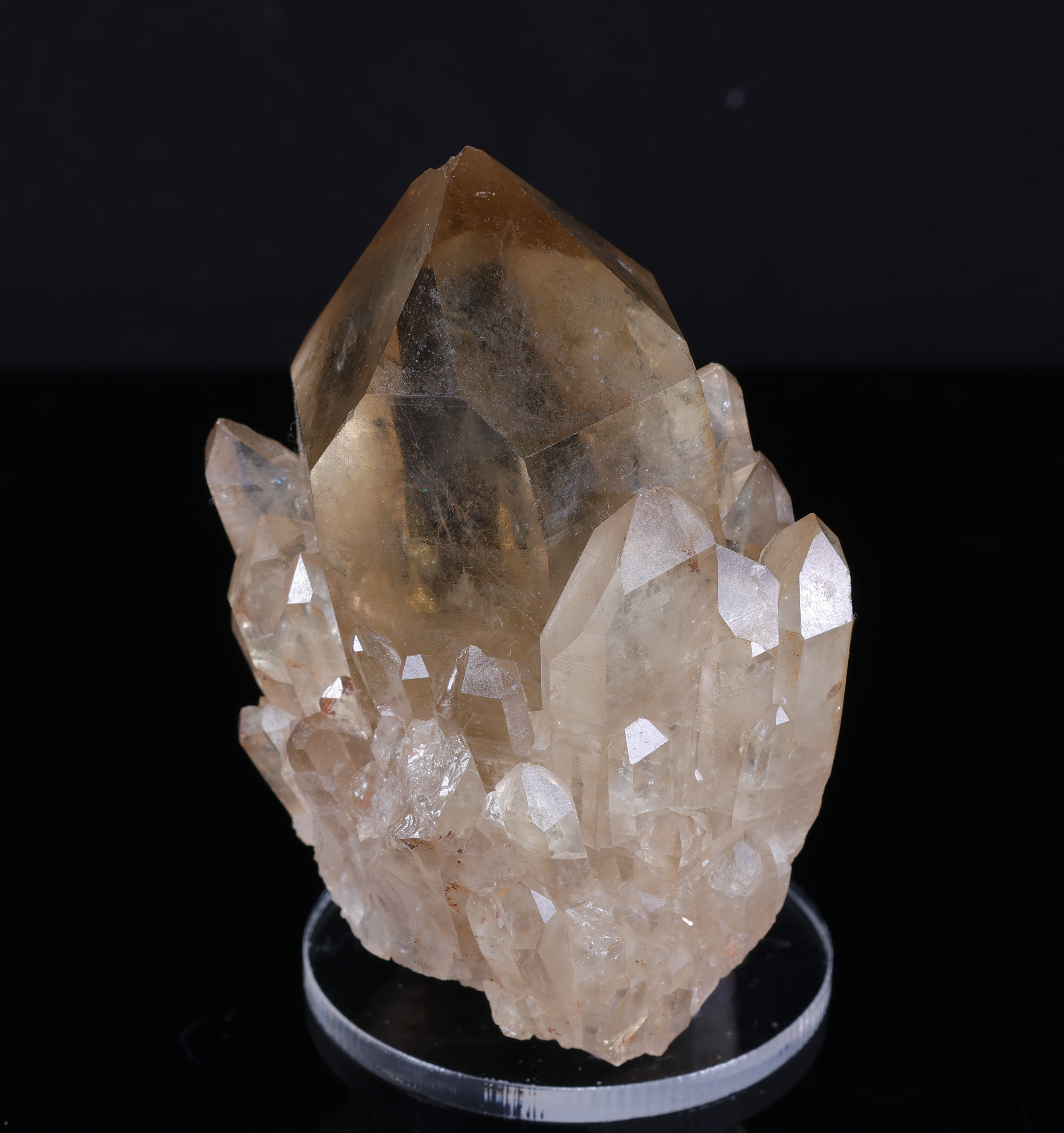
Unique crystal of Citrine - the dominant central crystal is surrounded by a wreath of smaller crystals at the base. It has a beautiful honey-yellow color. The upper part of the main crystal exhibits very good clarity, while the lower part smoothly transitions into a white, natural matrix. Main Features: natural honey color; high clarity of the apex; aesthetic form of crystal aggregation; ex coll. K.Urbanik. Condition: Good - visible minor damage (flea bite) at the very apex of the main crystal.
Price: 50 EUR (219 PLN)
Availability: In stock
Location: Lwena, Haut - Katanga, Congo
Size: 65 x 42 x 35 mm
Weight: 110 g
Chemical formula: SiO₂
Crystal system: trigonal
Mohs hardness: 7
Mineral group: Quartz Group
Rarity: Very Common
Characteristics Citrine is a variety of quartz characterized by a color ranging from light yellow to deep orange-brown. This color results from the presence of trace amounts of iron in the crystal structure. Citrine crystals often occur as prismatic columns terminated by sharp pyramids. Specimens can be transparent or translucent, and their surface exhibits a vitreous luster. Physical Properties Citrine has a hardness of 7 on the Mohs scale, making it a relatively scratch-resistant mineral. Its luster is vitreous. This mineral is transparent to translucent. Colors and Varieties The color of citrine ranges from light yellow, through golden yellow, to orange-brown. Natural citrine with intense coloration is rare. Most citrines available on the market are heat-treated amethysts or smoky quartz, which changes their color to yellow or orange. Such specimens often have a more reddish hue than natural citrines. History and Name The name "citrine" comes from the Latin word "citrus," referring to its lemon-like color. This mineral was known and used in antiquity, though it was often confused with topaz. The modern distinction and nomenclature became established in the 18th century. Uses Citrine is widely used in jewelry as an ornamental stone. It is crafted into rings, necklaces, earrings, and other jewelry items. Due to its hardness and attractive appearance, it is also valued by mineral collectors.
Identification Citrine can be identified by its yellow, orange, or yellow-orange color and vitreous luster. A hardness of 7 on the Mohs scale is also characteristic. Crystals often appear as hexagonal prisms terminated by pyramids. Distinguishing from Similar Minerals Citrine is sometimes confused with topaz, which also occurs in yellow shades. However, topaz is harder (8 on the Mohs scale) and has different cleavage. It can also be confused with yellow beryl or glass. From amethyst and smoky quartz, which are often heated to achieve citrine's color, it is distinguished by its color, although this distinction can be difficult without specialized testing. Crystal Forms Citrine usually occurs as well-formed prismatic crystals, often with distinct pyramidal faces. It can also form granular or massive aggregates.
Genesis Citrine, as a variety of quartz, forms under a wide range of geological conditions. It is most commonly found in pegmatites, hydrothermal veins, and in igneous and metamorphic rocks. Natural citrines form as a result of natural irradiation and heating of quartz containing trace amounts of iron. Mineral Associations Citrine often co-occurs with other quartz minerals, such as amethyst, smoky quartz, or rock crystal. It can also be found in association with feldspars, muscovite, and other minerals typical of pegmatites and hydrothermal veins. Localities Significant deposits of natural citrine are found in Brazil (especially in the state of Rio Grande do Sul), Madagascar, Russia (Urals), Spain, France, and the USA. Brazil is the main producer of citrine, both natural and heat-treated.
Quality Criteria The most prized citrine specimens are characterized by intense, uniform color, high transparency, and the absence of visible inclusions. Large, well-formed crystals with distinct faces are particularly sought after. Natural citrines with deep color are significantly more valuable than heat-treated ones. Popular Localities The most valued natural citrine specimens come from Brazil, especially from the Rio Grande do Sul region, where crystals of beautiful, natural color are found. Other important sources include Madagascar and Russia.
See mineralogical reference for Citrine in the Knowledge Base →