Citrine
Chemical formula: SiO₂
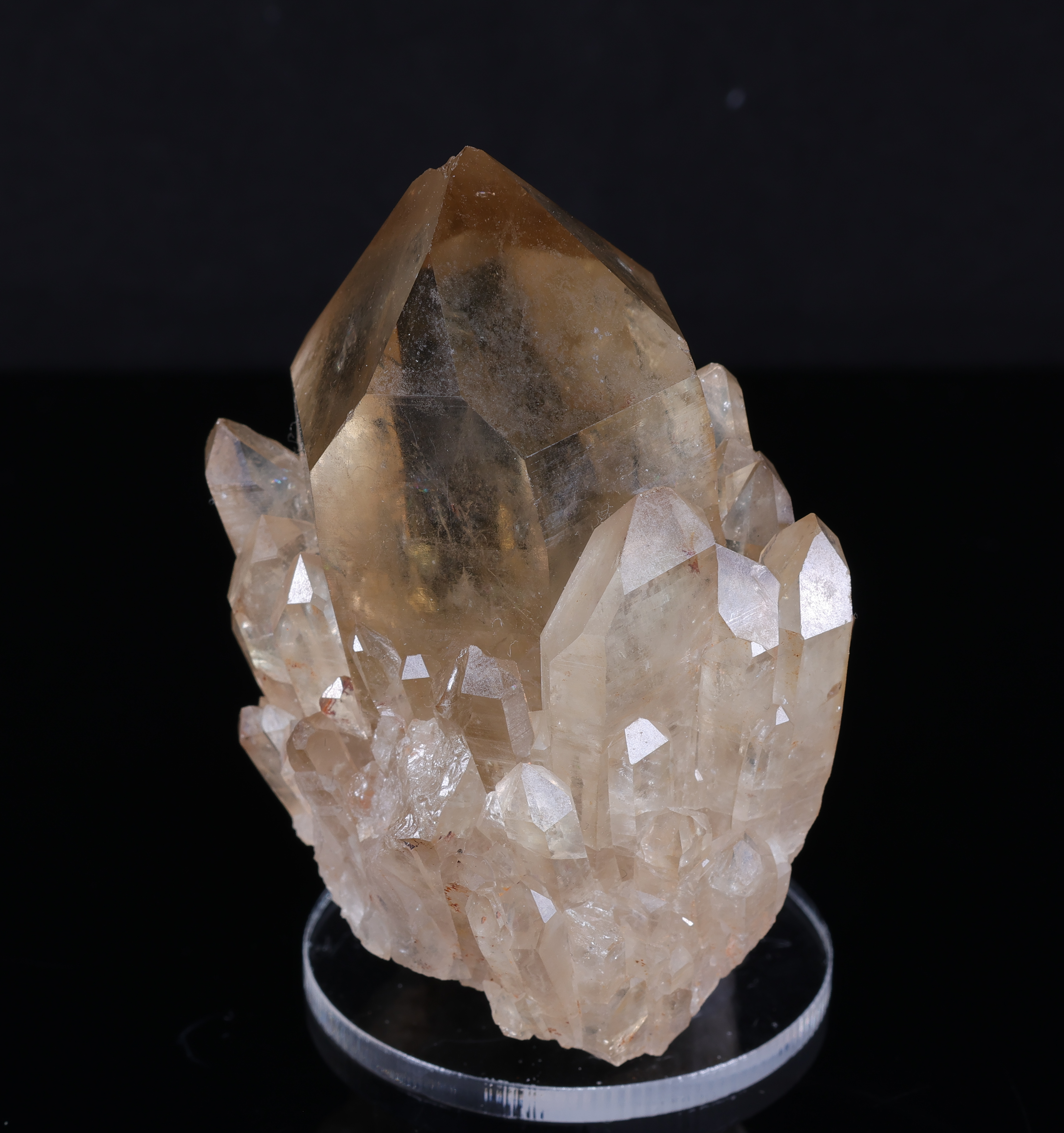
Citrine is a yellow, yellow-orange, or orange variety of quartz, valued in jewelry and for collecting.
Properties
- Mohs hardness
- 7
- Luster
- Vitreous
- Density
- 0
- Transparency
- Transparent,Translucent
- Crystal system
- Trigonal
Diagnostic features
## Identification Citrine can be identified by its yellow, orange, or yellow-orange color and vitreous luster. A hardness of 7 on the Mohs scale is also characteristic. Crystals often appear as hexagonal prisms terminated by pyramids. ## Distinguishing from Similar Minerals Citrine is sometimes confused with topaz, which also occurs in yellow shades. However, topaz is harder (8 on the Mohs scale) and has different cleavage. It can also be confused with yellow beryl or glass. From amethyst and smoky quartz, which are often heated to achieve citrine's color, it is distinguished by its color, although this distinction can be difficult without specialized testing. ## Crystal Forms Citrine usually occurs as well-formed prismatic crystals, often with distinct pyramidal faces. It can also form granular or massive aggregates.
Geological environment
## Genesis Citrine, as a variety of quartz, forms under a wide range of geological conditions. It is most commonly found in pegmatites, hydrothermal veins, and in igneous and metamorphic rocks. Natural citrines form as a result of natural irradiation and heating of quartz containing trace amounts of iron. ## Mineral Associations Citrine often co-occurs with other quartz minerals, such as amethyst, smoky quartz, or rock crystal. It can also be found in association with feldspars, muscovite, and other minerals typical of pegmatites and hydrothermal veins. ## Localities Significant deposits of natural citrine are found in Brazil (especially in the state of Rio Grande do Sul), Madagascar, Russia (Urals), Spain, France, and the USA. Brazil is the main producer of citrine, both natural and heat-treated.
Rarity
Uncommon
For collectors
## Quality Criteria The most prized citrine specimens are characterized by intense, uniform color, high transparency, and the absence of visible inclusions. Large, well-formed crystals with distinct faces are particularly sought after. Natural citrines with deep color are significantly more valuable than heat-treated ones. ## Popular Localities The most valued natural citrine specimens come from Brazil, especially from the Rio Grande do Sul region, where crystals of beautiful, natural color are found. Other important sources include Madagascar and Russia.
Care and storage
## Cleaning Citrine can be cleaned using a soft brush and lukewarm water with mild soap. After washing, rinse the specimen thoroughly with clean water and dry with a soft cloth. ## What to Avoid Avoid contact of citrine with strong chemicals, such as acids or bases, which can damage its surface. Prolonged exposure to intense sunlight can cause color fading, especially in artificially colored specimens. Sudden temperature changes can also be harmful. ## Storage Citrine should preferably be stored separately from other, harder minerals to prevent scratching. Ideal storage is in a soft pouch or a separate compartment in a display box, away from direct sunlight and heat sources.