SKU: P_26-2_32
Specimen with recognizable hessonite crystals embedded in rock with clinochlore and diopside. Rough, with the volume of the lump preserved.
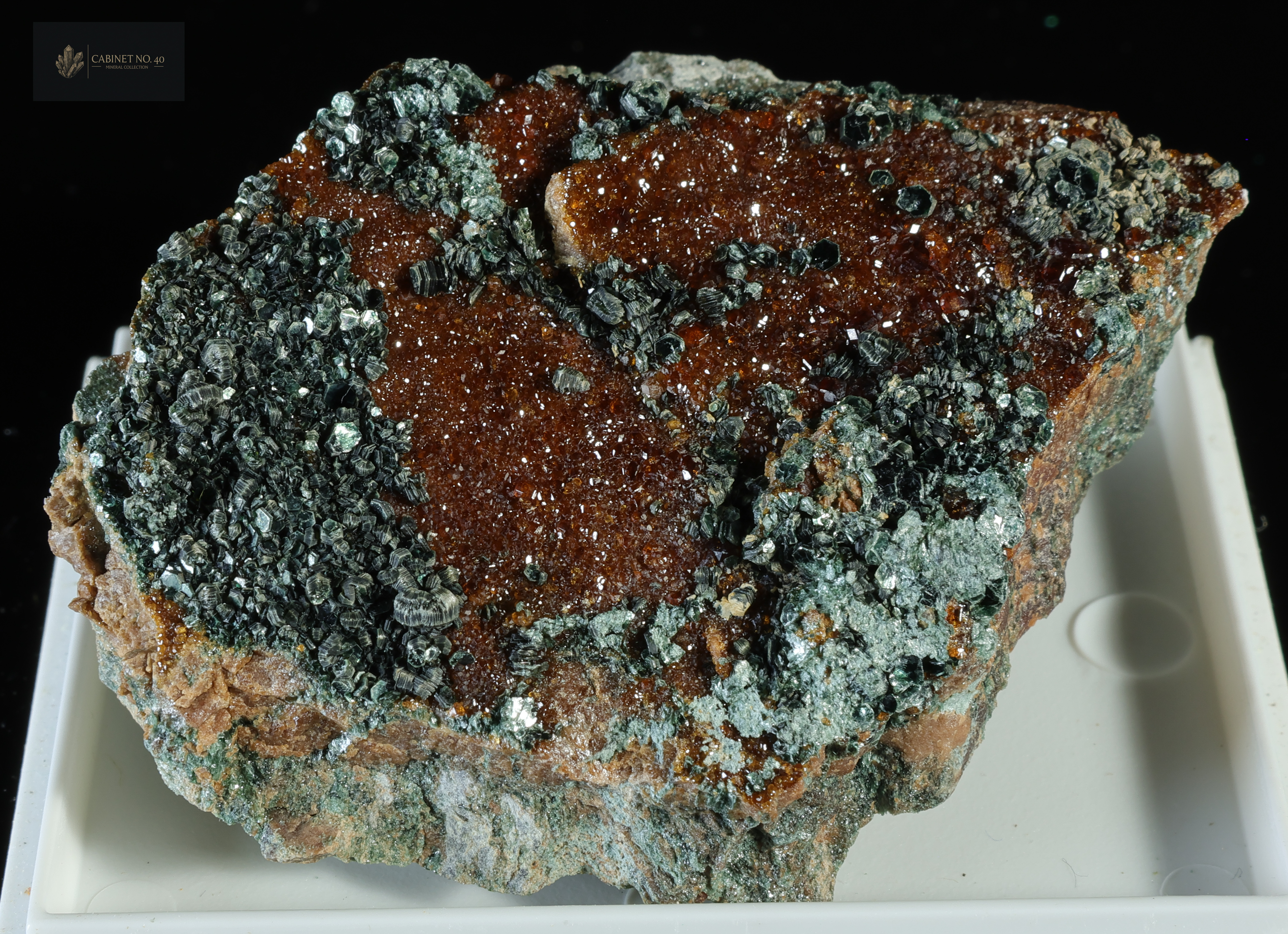
Price: 40 EUR (175 PLN)
Availability: In stock
Location: M. Rocca Sella, Val di Susa, Piemont, Italy
Size: 54 x 37 x 20 mm
Weight: 200 g
Chemical formula: (Mg,Fe)₅Al(Si₃Al)O₁₀(OH)₈
Crystal system: Monoclinic
Mohs hardness: 2.0–2.5
Rarity: Rare
Characteristics Clinochlore is a mineral belonging to the chlorite group, typically characterized by its green color. It occurs as platy, often hexagonal crystals, as well as in scaly, radial, or massive aggregates. Its name refers to the oblique (Greek "klino") arrangement of its optical axes and its green color (Greek "chloros"). Physical Properties Clinochlore is characterized by low hardness, ranging from 2-2.5 on the Mohs scale. It possesses perfect cleavage in one direction, making it easily separable into thin lamellae. The mineral's luster is vitreous to pearly, and its density is approximately 2.6 g/cm³. It is transparent to translucent. Colors and Varieties The most common colors of clinochlore are various shades of green: green, yellowish-green, olive-green, blackish-green, bluish-green. It can also occur in white or pink, although these are rarer varieties. History and Name Clinochlore was described in 1851. The name comes from the Greek words "klino" (oblique) and "chloros" (green), referring to its monoclinic crystal system and typical color. Uses Clinochlore has no significant industrial applications. It is primarily valued by mineral collectors for its aesthetic crystal forms and diverse coloration.
Identification Clinochlore can be identified by its green color, platy habit, and low hardness. Its perfect cleavage, which allows for easy separation into thin lamellae, is also characteristic. A vitreous to pearly luster is also a diagnostic feature. Distinguishing from Similar Minerals Clinochlore can be confused with other minerals of the chlorite group, which have similar physical properties and color. It is distinguished from other green minerals, such as serpentine or talc, by its perfect cleavage and lower hardness. It differs from mica by the lack of elasticity of its lamellae. Crystal Forms Clinochlore most often forms platy crystals, often with a hexagonal outline. It also occurs in scaly, radial, fibrous, or massive aggregates. Crystals can be single or form rosettes.
Genesis Clinochlore is a metamorphic mineral, forming under conditions of low to medium temperatures and pressures. It is a typical component of metamorphic rocks such as chlorite schists, greenschists, amphibolites, and serpentinites. It can also form as a result of hydrothermal alteration of magnesium-iron minerals in igneous rocks. Mineral Associations Clinochlore often co-occurs with other metamorphic minerals, such as epidote, garnet, actinolite, talc, serpentine, magnetite, as well as quartz and calcite. Localities Known localities of clinochlore are found in many places around the world. In the USA, it occurs in Pennsylvania (West Chester), Vermont, and California. In Europe, it can be found in Switzerland (Zermatt), Austria (Zillertal), Italy (Val Malenco), and Russia (Urals). In Poland, it occurs in the Sudetes.
Quality Criteria The most prized clinochlore specimens are those with well-formed, large, and aesthetic crystals, with intense and uniform green color. Transparency and absence of mechanical damage also increase the value of the specimen. Radial and rosette aggregates are also attractive. Popular Localities Particularly prized specimens come from the Alps (Switzerland, Austria, Italy), where beautiful, well-formed crystals occur. Other popular localities include Russia (Urals) and some locations in the USA.
See mineralogical reference for Clinochlore in the Knowledge Base →