Clinochlore
Chemical formula: Mg<sub>5</sub>Al(AlSi<sub>3</sub>O<sub>10</sub>)(OH)<sub>8</sub>
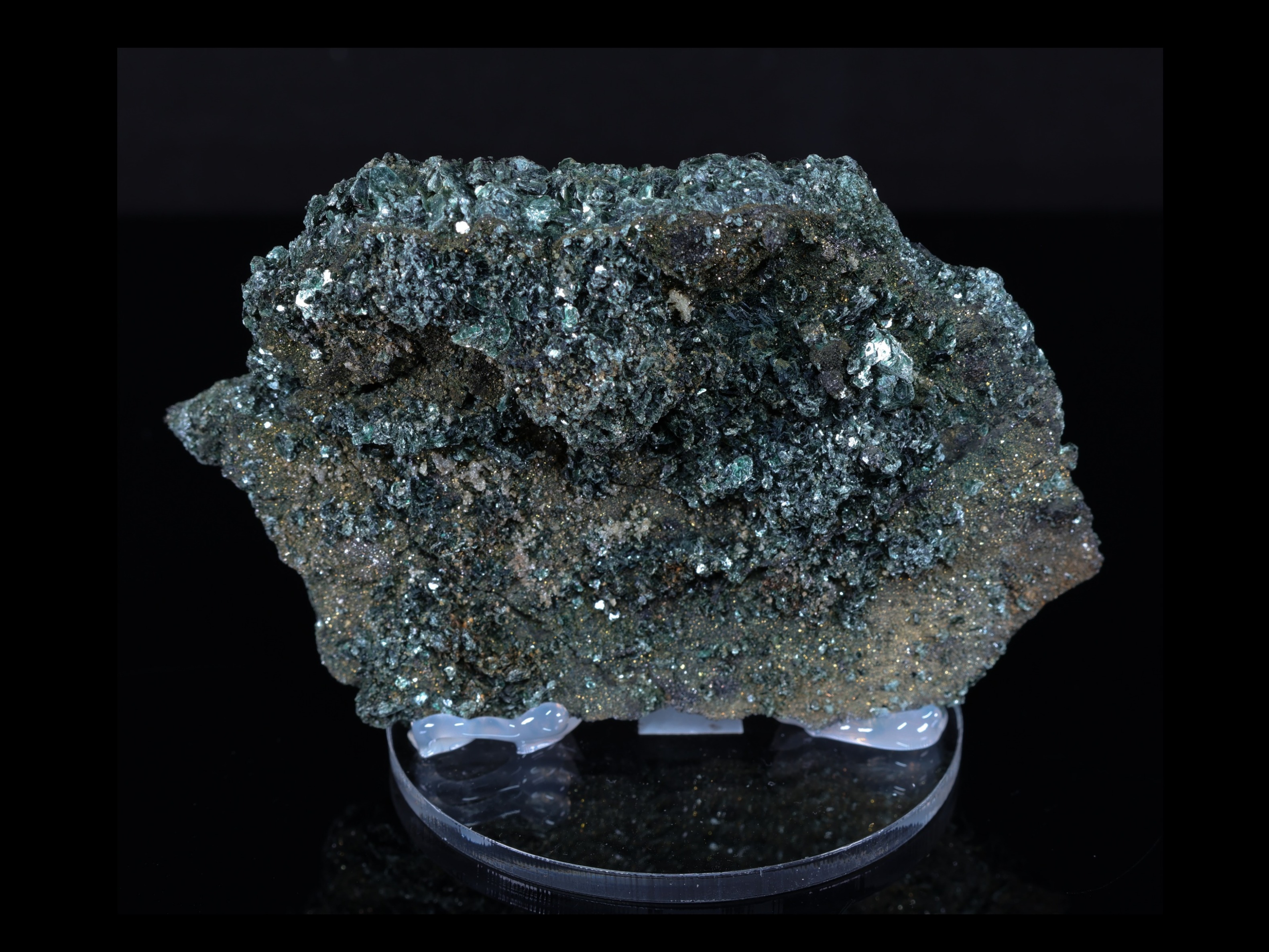
Clinochlore is a common mineral of the chlorite group, a magnesium-aluminum silicate, often found as green, platy crystals.
Properties
- Mohs hardness
- 2-2.5
- Luster
- Vitreous, Pearly
- Streak
- Greenish white to white
- Density
- 2.6
- Cleavage
- {001} Perfect
- Fracture
- Nierówny
- Transparency
- Transparent,Translucent
- Crystal system
- Monoclinic
Diagnostic features
## Identification Clinochlore can be identified by its green color, platy habit, and low hardness. Its perfect cleavage, which allows for easy separation into thin lamellae, is also characteristic. A vitreous to pearly luster is also a diagnostic feature. ## Distinguishing from Similar Minerals Clinochlore can be confused with other minerals of the chlorite group, which have similar physical properties and color. It is distinguished from other green minerals, such as serpentine or talc, by its perfect cleavage and lower hardness. It differs from mica by the lack of elasticity of its lamellae. ## Crystal Forms Clinochlore most often forms platy crystals, often with a hexagonal outline. It also occurs in scaly, radial, fibrous, or massive aggregates. Crystals can be single or form rosettes.
Geological environment
## Genesis Clinochlore is a metamorphic mineral, forming under conditions of low to medium temperatures and pressures. It is a typical component of metamorphic rocks such as chlorite schists, greenschists, amphibolites, and serpentinites. It can also form as a result of hydrothermal alteration of magnesium-iron minerals in igneous rocks. ## Mineral Associations Clinochlore often co-occurs with other metamorphic minerals, such as epidote, garnet, actinolite, talc, serpentine, magnetite, as well as quartz and calcite. ## Localities Known localities of clinochlore are found in many places around the world. In the USA, it occurs in Pennsylvania (West Chester), Vermont, and California. In Europe, it can be found in Switzerland (Zermatt), Austria (Zillertal), Italy (Val Malenco), and Russia (Urals). In Poland, it occurs in the Sudetes.
Rarity
Very Common
For collectors
## Quality Criteria The most prized clinochlore specimens are those with well-formed, large, and aesthetic crystals, with intense and uniform green color. Transparency and absence of mechanical damage also increase the value of the specimen. Radial and rosette aggregates are also attractive. ## Popular Localities Particularly prized specimens come from the Alps (Switzerland, Austria, Italy), where beautiful, well-formed crystals occur. Other popular localities include Russia (Urals) and some locations in the USA.
Care and storage
## Cleaning Clinochlore is a mineral with low hardness, so it should be handled with care. For cleaning, it is best to use a soft brush and lukewarm water. A mild soap can also be used, followed by thorough rinsing with distilled water. ## What to Avoid Avoid using strong chemical agents, which can damage the mineral's surface. Due to its low hardness, clinochlore is susceptible to scratching, so it should be protected from contact with harder minerals. Also, avoid sudden temperature changes and prolonged exposure to direct sunlight, which can affect the intensity of its color. ## Storage Clinochlore specimens are best stored in separate boxes or soft pouches to prevent scratching. An ideal location is one with a stable temperature and moderate humidity, away from direct sunlight. For display, enclosed display cases can be used to protect against dust and mechanical damage.