SKU: P_26-6_20
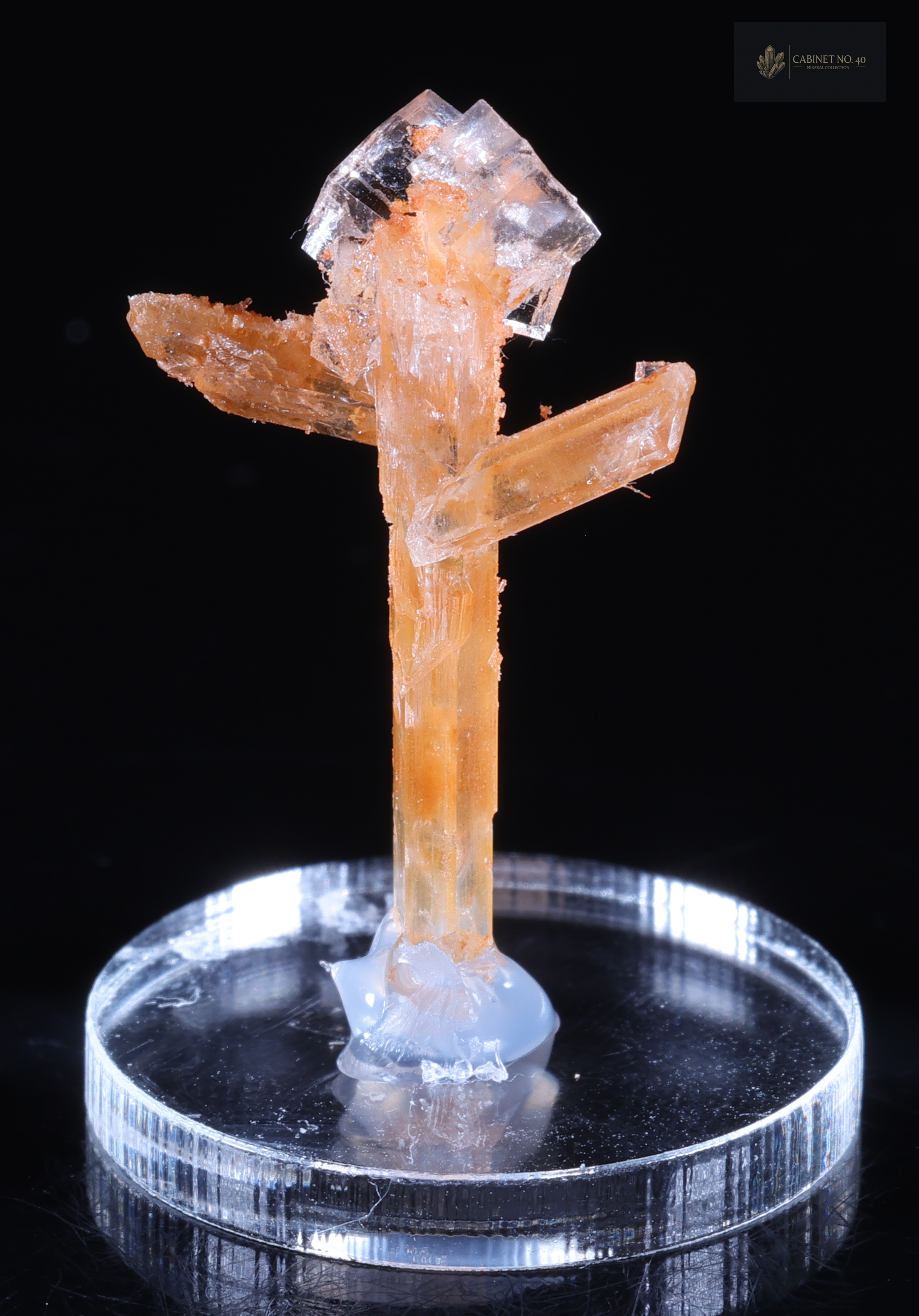
An extremely delicate specimen of gypsum. It consists of a central, columnar crystal forming a vertical axis, from which smaller, transparent crystals of halite grow at various angles. Main features: co-occurrence of halite and gypsum; contrast between the orange-brown gypsum and the colorless halite. Condition: The specimen is very fragile, as evidenced by the loose deposits on the gypsum and the subtle structure of the halite, however, there are no visible mechanical damages.
Price: 9 EUR (39 PLN)
Availability: In stock
Location: Solno mine, Inowrocław, Inowrocław County, Kuyavian-Pomeranian Voivodeship, Poland
Size: 16 x 8 x 28 mm
Weight: 1.8 g
Chemical formula: CaSO₄·2H₂O
Crystal system: Monoclinic
Mohs hardness: 2.0
Characteristics Gypsum is a common mineral found in many geological environments. Typical gypsum specimens are characterized by a variable appearance, from transparent, tabular crystals to compact, granular masses. It often forms tabular, columnar, or acicular crystals. Aggregates can be compact, granular, fibrous, lamellar, and also rosette-shaped, known as "desert roses". Physical Properties Gypsum is characterized by low hardness, 2 on the Mohs scale, which means it can be scratched with a fingernail. It has perfect cleavage in one direction, allowing for easy separation into thin sheets. The luster of gypsum is usually vitreous, pearly on cleavage surfaces, and silky in the case of fibrous varieties. Its density is 2.312 g/cm³. Colors and Varieties Gypsum occurs in many colors, from colorless and white, through yellow, pink, gray, to brown. The color often depends on impurities. The colorless, transparent variety of gypsum is known as selenite. The fibrous variety, with a silky luster, is satin spar. Rosette aggregates, formed in desert sands, are called "desert roses". History and Name The name "gypsum" comes from the Greek word "gypsos", meaning plaster or chalk, which refers to its use as a building binder. This mineral was known and used in antiquity, and its properties were described by Theophrastus and Pliny the Elder. Uses Gypsum has wide application in the construction industry for the production of plasters, plasterboards, and cement. It is also used in agriculture as a fertilizer, in medicine for immobilizing fractures, and in art for creating sculptures and casts. Transparent varieties of gypsum, such as selenite, are valued in collecting and jewelry.
Identification Gypsum can be identified by its low hardness (2 on the Mohs scale), the ability to scratch it with a fingernail, and perfect cleavage in one direction, which allows it to be separated into thin, flexible sheets. A white streak is also characteristic. Transparent varieties, such as selenite, are easily recognizable by their clarity and crystal habit. Distinguishing from Similar Minerals Gypsum can be confused with calcite, however, calcite is harder (3 on the Mohs scale) and reacts with hydrochloric acid, which gypsum does not. Barite can also be similar, but it is much heavier and has different cleavage. Fibrous varieties of gypsum (satin spar) can be confused with asbestos, however, gypsum is much softer and does not have fibers as flexible and durable as asbestos. Crystal Forms Gypsum forms tabular, columnar, or acicular crystals. Twinning is common, especially "swallowtail" twins. Aggregates can be compact, granular, fibrous (satin spar), lamellar, and also rosette-shaped (desert roses).
Genesis Gypsum forms mainly in evaporitic environments, i.e., as a result of the evaporation of saline marine or lake waters. It also forms in the oxidation zones of sulfide deposits, as a weathering product. It can occur in sedimentary rocks, such as limestones, marls, and shales. Mineral Associations Gypsum often co-occurs with other evaporite minerals, such as halite, anhydrite, calcite, dolomite, and also native sulfur. Localities Significant gypsum deposits are found worldwide. Important localities include: Spain (especially the famous selenite crystals from Naica in Mexico, although this is not Spain), USA (e.g., White Sands National Park in New Mexico), Italy, Germany, Poland (e.g., Nida Basin), and Russia.
Quality Criteria The most prized gypsum specimens are those with well-formed, transparent crystals, especially selenite varieties. The size of the crystals, their clarity, lack of mechanical damage, and attractive habit are also important. "Desert roses" are valued for their unique form. Specimens with rare inclusions or unusual colors may also be sought after. Popular Localities Among the most famous localities from which prized specimens originate are the Naica caves in Mexico, famous for their gigantic selenite crystals. Other important localities include desert areas where "desert roses" form, as well as deposits in Spain and the USA.
See mineralogical reference for Gypsum in the Knowledge Base →