SKU: 0309_3_AF
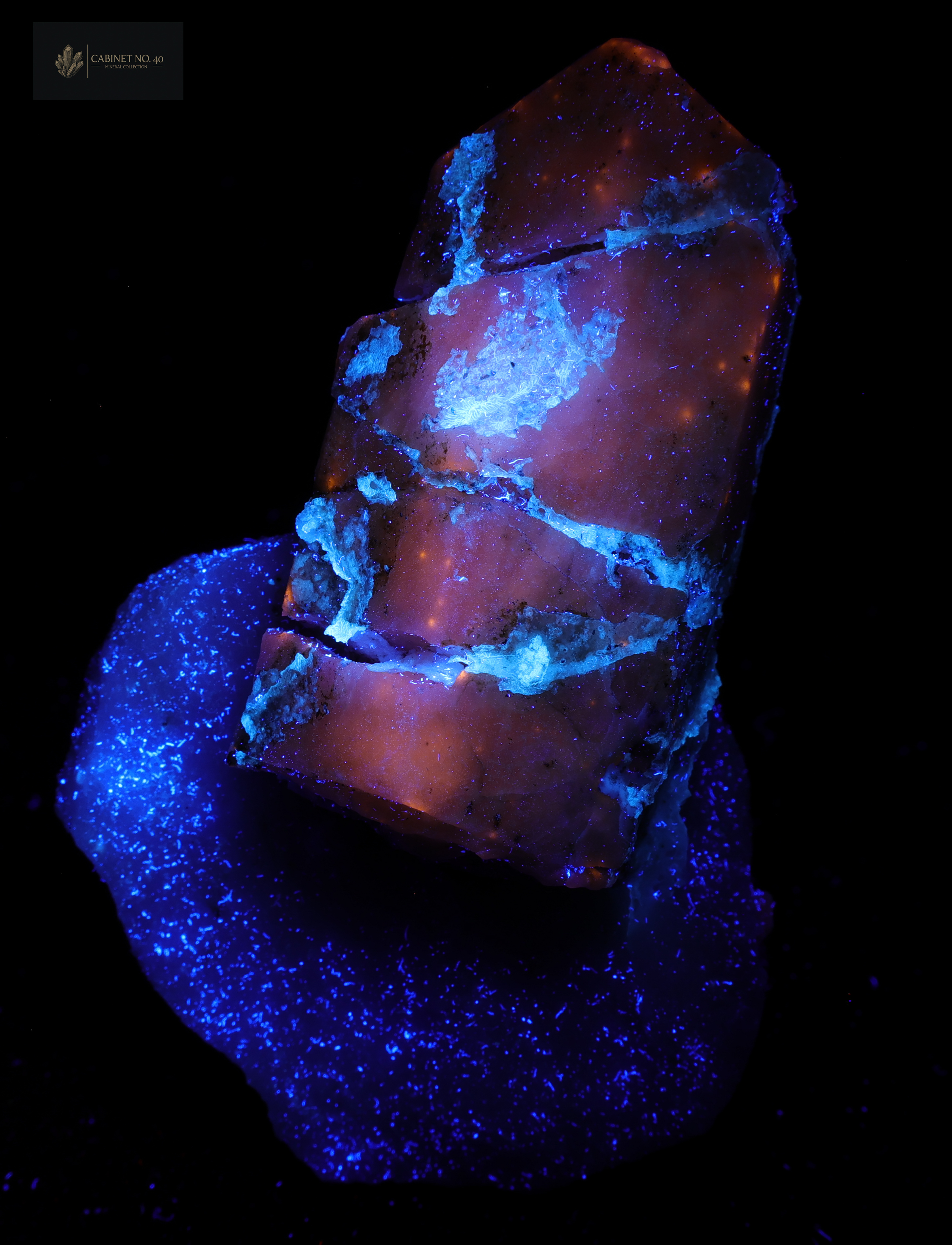
Hackmanite is a rare variety of sodalite known for its reaction to UV light, under which it changes color. This specimen displays a massive, blocky crystal with a violet-gray hue, set on a light matrix.
Price: 80 EUR (349 PLN)
Availability: In stock
Location: Afghanistan
Size: 46 x 78 x 40 mm
Weight: 120 g
Chemical formula: Na₈Al₆Si₆O₂₄(Cl,S)₂
Mohs hardness: 5.5–6.0
Rarity: Uncommon
Characteristics Hackmanite is a variety of sodalite, a sodium aluminum silicate with added chlorine. It typically occurs as massive aggregates or anhedral grains, less commonly forming well-developed crystals. It is characterized by tenebrescence, which is the ability to reversibly change color under ultraviolet radiation or sunlight. Initially colorless or pale specimens can take on an intense pink, violet, or blue hue, which fades after some time in darkness. Physical Properties The Mohs hardness of hackmanite is approximately 5.5-6. It has a vitreous luster and is transparent to translucent. The fracture is uneven to conchoidal. This mineral does not exhibit distinct cleavage. Colors and Varieties Naturally, hackmanite occurs in white, colorless, pink, violet, and blue. The most valued specimens are those that exhibit strong tenebrescence, changing color from light to intensely pink or violet after exposure to UV light. Varieties differ in the intensity and permanence of this color change. History and Name Hackmanite was named after the Finnish geologist Victor Hackman (1866-1941), who first described this mineral. It was discovered on the Kola Peninsula in Russia in the early 20th century. Uses Due to its unique tenebrescence property, hackmanite is sought after by mineral collectors. It is sometimes used in jewelry, although its light sensitivity and relatively low hardness limit its use in everyday jewelry.
Identification Hackmanite is most easily identified by its characteristic tenebrescence – the ability to change color under UV radiation and then return to its original color in darkness. It usually occurs as massive aggregates or grains, often in alkaline rocks. Distinguishing from Similar Minerals It can be confused with other minerals of similar color, such as sodalite or fluorite. The key distinguishing feature is tenebrescence, which is not present in typical sodalite or fluorite. Fluorite is also significantly softer. Crystal Forms Hackmanite rarely forms well-developed crystals. It most commonly occurs as anhedral grains, massive aggregates, or intergrowths in igneous rocks.
Genesis Hackmanite forms in alkaline igneous rocks, such as nepheline syenites and associated pegmatites. It forms under conditions of high sodium and chlorine activity. Mineral Associations It coexists with other alkaline minerals, such as nepheline, albite, microcline, aegirine, and other minerals from the sodalite group. Localities The most important hackmanite deposits are located on the Kola Peninsula in Russia, especially in the Khibiny Massif and Lovozero Tundras. Other known localities include Mont Saint-Hilaire in Canada, Greenland, and Afghanistan.
Quality Criteria The most valued hackmanite specimens are those that exhibit strong and distinct tenebrescence, meaning an intense color change from light to deep pink, violet, or blue after UV irradiation. The size of the specimen and its aesthetics, including the absence of cracks and damage, are also important. Popular Localities The most sought-after specimens come from the Kola Peninsula in Russia, especially from the Khibiny and Lovozero Massifs. Specimens from Mont Saint-Hilaire in Canada are also prized for their quality and often associated rare minerals.
See mineralogical reference for Hackmanite in the Knowledge Base →