SKU: K-0149_3-ML
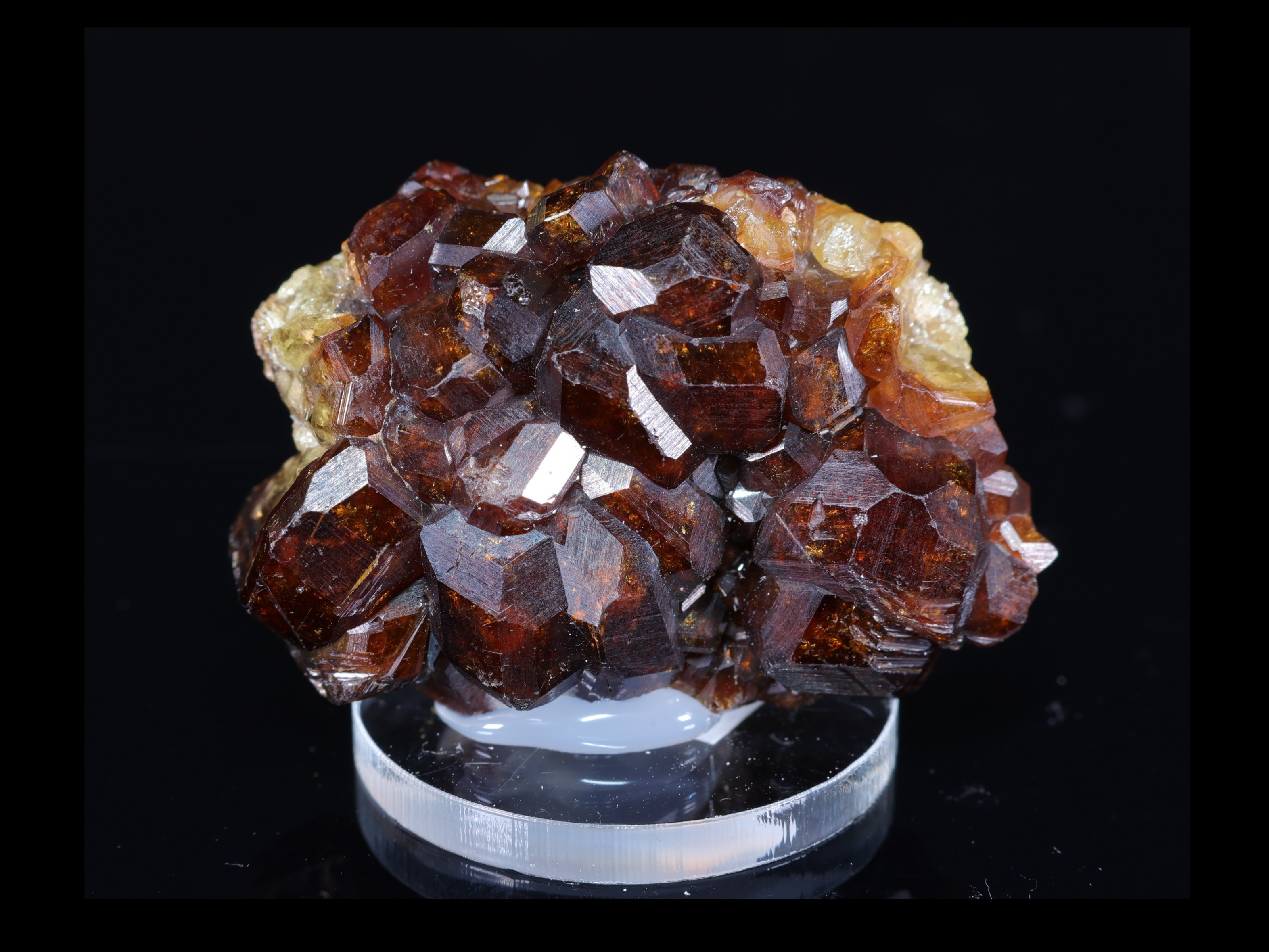
Aesthetic cluster of grossular garnet crystals with a deep brown-red color and distinct luster. The crystals are densely packed, forming a compact mass, in which the contrasting bright matrix is visible in the lateral parts. Main Features: saturated color; high luster of the faces; dodecahedral habit; clear contrast with the matrix; ex coll. K. Urbanik. Condition: Very good - the edges of the crystals are sharp, and the surfaces of the faces are clean.
Price: 27 EUR (119 PLN)
Availability: In stock
Location: Kayes Region, Mali
Size: 30 x 15 x 30 mm
Weight: 33 g
Chemical formula: Ca₃Al₂(SiO₄)₃
Crystal system: isometric
Mohs hardness: 6,5–7
Mineral group: Garnet Group
Rarity: Uncommon
Characteristics Grossular is a mineral belonging to the garnet group, a calcium aluminum silicate. Typical grossular specimens occur as isometric crystals, most commonly rhombic dodecahedra or trapezohedra. Crystal surfaces are often smooth and lustrous. This mineral is characterized by high hardness and a lack of distinct cleavage, which contributes to its durability. Physical Properties Grossular has a hardness ranging from 6.5-7.5 on the Mohs scale. Its luster is usually vitreous, and the mineral can be transparent to translucent. The density of grossular ranges from 3.55 to 3.73 g/cm³. It exhibits no cleavage, and its fracture is conchoidal to uneven. Colors and Varieties Grossular occurs in a wide range of colors, which is one of its most characteristic features. The most common shades are green (from light green to emerald green), yellow, orange, brown, and also colorless specimens. Known varieties include hessonite (orange-brown), tsavorite (emerald green), and hydrogrossular (an opaque variety of green, pink, or white color, containing hydroxyl groups). History and Name The name "grossular" comes from the Latin word "grossularia," meaning gooseberry, which refers to the green color of some varieties of this mineral. It was first described in 1808 by Abraham Gottlob Werner. Uses Grossular is a prized gemstone, especially its transparent, intensely colored varieties, such as tsavorite and hessonite. It is also sought after by mineral collectors due to its aesthetic crystals and variety of colors.
Identification Grossular can be identified by its isometric crystals, most commonly rhombic dodecahedra, and vitreous luster. Its hardness (6.5-7.5 on the Mohs scale) and lack of distinct cleavage are also characteristic. The color is variable but often occurs in shades of green, yellow, orange, and brown. Distinguishing from Similar Minerals Grossular can be confused with other garnets, such as almandine or spessartine, but differs from them in chemical composition and often color. The tsavorite variety can be mistaken for emerald, but tsavorite has a higher refractive index and no cleavage. Hydrogrossular, due to its opacity and color, can be confused with jadeite, but differs from it in hardness and density. Crystal Forms Grossular most often forms well-developed isometric crystals, with rhombic dodecahedra and trapezohedra being dominant. It can also occur in massive, granular, or compact forms.
Genesis Grossular typically forms in metamorphic rocks, especially in skarns, which develop at the contact of magmatic intrusions with limestones or dolomites. It also occurs in marbles and serpentinites. Its presence is an indicator of high temperatures and pressures during metamorphism. Mineral Associations Grossular often co-occurs with minerals such as diopside, vesuvianite, wollastonite, calcite, epidote, and quartz. In skarns, it can be associated with ore minerals. Localities Known grossular deposits are found in Canada (Jeffrey Mine, Asbestos, Quebec - known for green and pink grossulars), Pakistan (Gilgit-Baltistan), Tanzania (Arusha area - source of tsavorite), Kenya (Taita Taveta - also tsavorite), Mexico (Sierra de Cruces, Coahuila - hessonite), Italy (Val d'Ala, Piedmont), and Russia (Urals).
Quality Criteria The most prized grossular specimens are those characterized by intense and uniform color, high transparency, and a lack of visible inclusions. Well-formed, undamaged crystals with distinct faces are particularly sought after. The size of the specimen also affects its collector's value. Popular Localities The most sought-after grossular specimens come from the Jeffrey Mine in Canada (green and pink grossulars), Tanzania and Kenya (emerald-green tsavorites), and Mexico (orange-brown hessonites).
See mineralogical reference for Grossular Garnet in the Knowledge Base →