Grossular Garnet
Chemical formula: Ca₃Al₂(SiO₄)₃
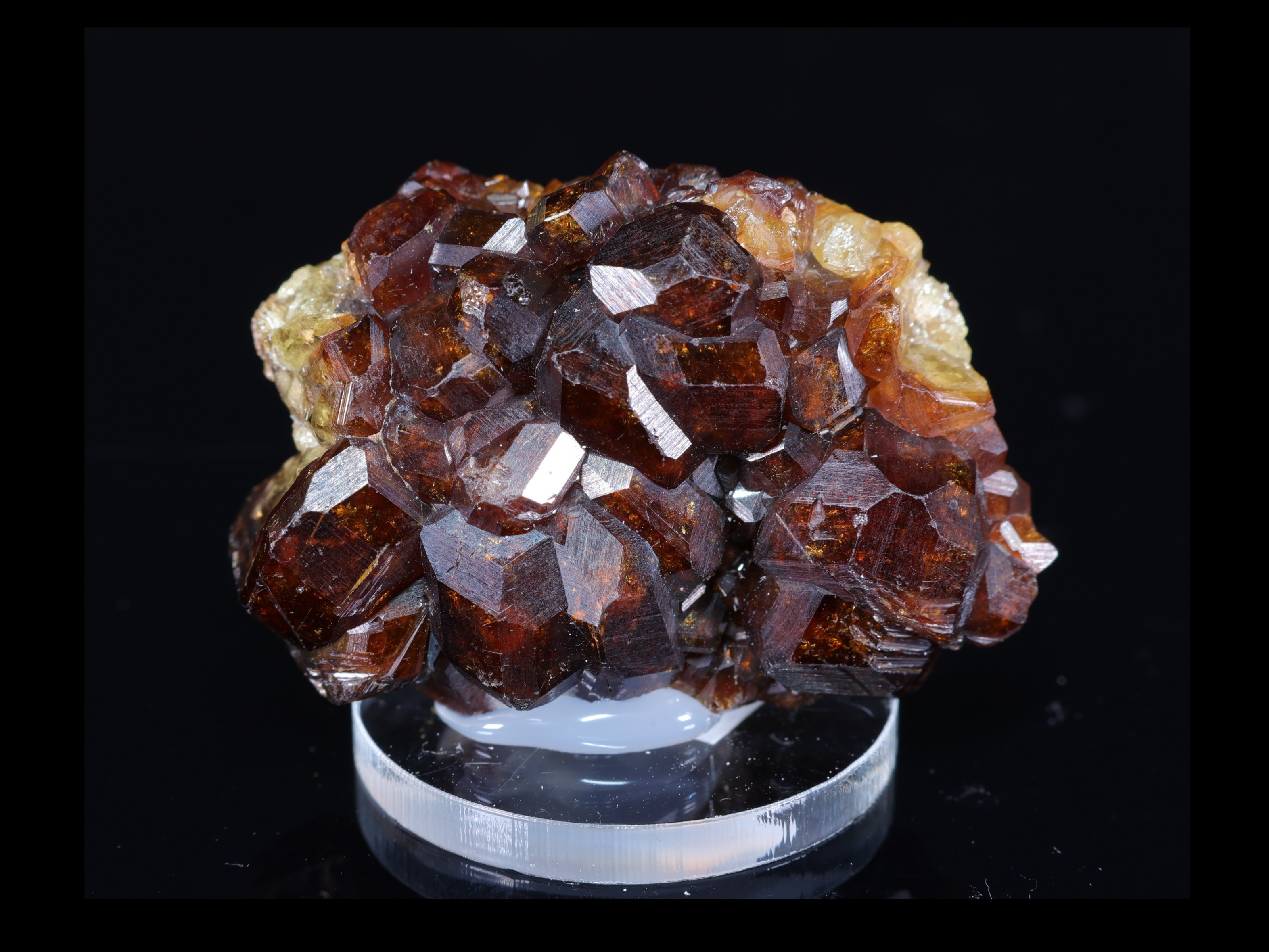
Grossular is a mineral from the garnet group, a calcium aluminum silicate, valued for its variety of colors and occurrence in well-formed crystals.
Properties
- Mohs hardness
- 6.5-7
- Color
- Brown, orange, red, yellow, green, white, colorless, pink
- Luster
- Szklisty
- Streak
- White to pale Brownish white
- Density
- 3.594
- Cleavage
- Brak
- Fracture
- Irregular/Uneven,Sub-Conchoidal
- Transparency
- Transparent,Translucent
- Crystal system
- Isometric
Diagnostic features
## Identification Grossular can be identified by its isometric crystals, most commonly rhombic dodecahedra, and vitreous luster. Its hardness (6.5-7.5 on the Mohs scale) and lack of distinct cleavage are also characteristic. The color is variable but often occurs in shades of green, yellow, orange, and brown. ## Distinguishing from Similar Minerals Grossular can be confused with other garnets, such as almandine or spessartine, but differs from them in chemical composition and often color. The tsavorite variety can be mistaken for emerald, but tsavorite has a higher refractive index and no cleavage. Hydrogrossular, due to its opacity and color, can be confused with jadeite, but differs from it in hardness and density. ## Crystal Forms Grossular most often forms well-developed isometric crystals, with rhombic dodecahedra and trapezohedra being dominant. It can also occur in massive, granular, or compact forms.
Geological environment
## Genesis Grossular typically forms in metamorphic rocks, especially in skarns, which develop at the contact of magmatic intrusions with limestones or dolomites. It also occurs in marbles and serpentinites. Its presence is an indicator of high temperatures and pressures during metamorphism. ## Mineral Associations Grossular often co-occurs with minerals such as diopside, vesuvianite, wollastonite, calcite, epidote, and quartz. In skarns, it can be associated with ore minerals. ## Localities Known grossular deposits are found in Canada (Jeffrey Mine, Asbestos, Quebec - known for green and pink grossulars), Pakistan (Gilgit-Baltistan), Tanzania (Arusha area - source of tsavorite), Kenya (Taita Taveta - also tsavorite), Mexico (Sierra de Cruces, Coahuila - hessonite), Italy (Val d'Ala, Piedmont), and Russia (Urals).
Rarity
Not very common
For collectors
## Quality Criteria The most prized grossular specimens are those characterized by intense and uniform color, high transparency, and a lack of visible inclusions. Well-formed, undamaged crystals with distinct faces are particularly sought after. The size of the specimen also affects its collector's value. ## Popular Localities The most sought-after grossular specimens come from the Jeffrey Mine in Canada (green and pink grossulars), Tanzania and Kenya (emerald-green tsavorites), and Mexico (orange-brown hessonites).
Care and storage
## Cleaning Grossular can be cleaned using warm water with mild soap. A soft brush or cloth should be used to remove dirt from the stone's surface. After washing, the mineral should be thoroughly rinsed with clean water and dried with a soft cloth. ## What to Avoid Avoid using aggressive chemical agents, such as acids or strong detergents, which can damage the stone's surface. Grossular is sensitive to sudden temperature changes, so it is not recommended to expose it to extreme heat or cold. Prolonged exposure to direct sunlight can, in some cases, lead to color fading, especially for intensely colored varieties. ## Storage Grossular should be stored separately from other, harder minerals to avoid scratches. It is best to wrap it in a soft cloth or place it in a separate compartment in a mineral box. Optimal storage is at a stable temperature and humidity, away from direct light.