SKU: 0253_4-CG
An exceptionally attractive specimen of pyromorphite with a vivid color, set on kidney-shaped malachite. The crystals of pyromorphite form dense, lustrous clusters that contrast phenomenally with the deep green background. Main Features: neon color of pyromorphite; kidney-shaped malachite; strong color contrast; ex coll. K. Urbanik. Condition: Very good - the crystals of pyromorphite are intact.
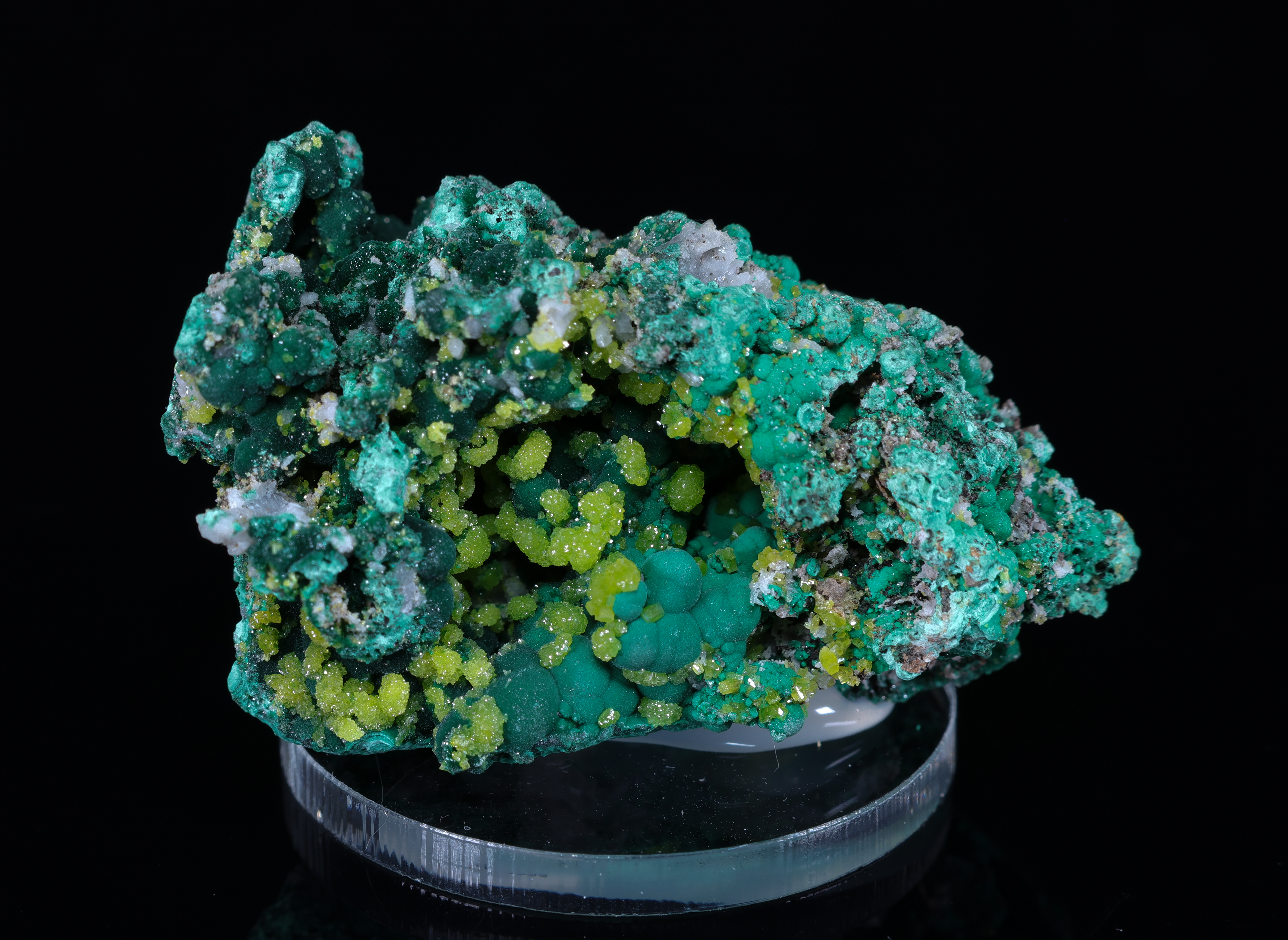
Price: 57 EUR (249 PLN)
Availability: In stock
Location: Palabanda, M’fouati District, Bouenza Department, Congo (Brazzaville)
Size: 40 x 22 x 23 mm
Weight: 23 g
Chemical formula: Pb₅(PO₄)₃Cl / Cu₂CO₃(OH)₂
Crystal system: Hexagonal (pyromorphite), Monoclinic (malachite)
Mohs hardness: 3.5–4 / 3.5–4
Mineral group: Apatite Group Minerals
Rarity: Rare
Characteristics Pyromorphite is a phosphate mineral with the formula Pb₅(PO₄)₃Cl, belonging to the apatite group. It occurs as hexagonal crystals, often columnar or barrel-shaped, as well as in granular, reniform, or radial aggregates. Pyromorphite crystals can be hollow or have rounded edges. It often forms attractive, well-formed collector's specimens. Physical Properties Pyromorphite has a Mohs hardness of 3.5-4. Its specific gravity is 7.04. This mineral has a resinous to subadamantine luster, and its streak is white. It is transparent to translucent. Colors and Varieties Pyromorphite occurs in a wide range of colors, most commonly green (from light green to dark green), yellow, yellowish-green, orange-yellow, as well as shades of brown, white, and colorless. The color in transmitted light is colorless or slightly tinted. The intensity and hue of the color depend on chemical impurities. History and Name The name pyromorphite comes from the Greek words "pyr" (fire) and "morphe" (form), referring to its property of melting and crystallizing into spherical shapes upon careful heating. The mineral was described in 1813. Uses Pyromorphite is primarily a collector's mineral, valued for its beautiful colors and well-formed crystals. Due to its lead content, it can also be locally used as an ore of this metal, although it is not of great industrial significance.
Identification Pyromorphite can be identified by its characteristic habit of hexagonal crystals, often barrel-shaped, and by its resinous or subadamantine luster. Color, especially green and yellow, is also an important diagnostic feature. Its low hardness (3.5-4 on the Mohs scale) allows it to be scratched by a steel blade. Distinguishing from Similar Minerals Pyromorphite is sometimes confused with mimetite, with which it forms an isomorphic series. Distinguishing these two minerals often requires chemical analysis, but pyromorphite usually has more intense green and yellow colors, and its crystals are often more barrel-shaped. Vanadinite is also similar, but it has a higher density and often a more intense reddish-orange color. Crystal Forms Typical crystal forms of pyromorphite include hexagonal prisms, often with distinct prismatic and pyramidal faces. It often forms barrel-shaped crystals, hollow or with rounded edges. It also occurs in granular, reniform, radial, and botryoidal aggregates.
Genesis Pyromorphite is a secondary mineral, formed in the oxidation zones of lead deposits. It forms as a result of the reaction of phosphate-bearing solutions with lead minerals, such as galena. It occurs in paragenesis with other secondary lead minerals. Mineral Associations Pyromorphite often co-occurs with minerals such as galena, cerussite, anglesite, vanadinite, mimetite, barite, quartz, and limonite. Localities Significant pyromorphite localities include Bad Ems in Germany, Les Farges in France, Broken Hill in Australia, Bunker Hill in the USA (Idaho), as well as locations in China, Mexico, and the United Kingdom.
Quality Criteria The most prized pyromorphite specimens are those with well-formed, large, and intensely colored crystals. High transparency, absence of mechanical damage, and aesthetic arrangement of crystals on the matrix significantly increase the value of the specimen. Specimens with rare color varieties are also sought after. Popular Localities Particularly valued specimens come from Les Farges in France, where beautiful green crystals are found, and from Broken Hill in Australia, known for large, often yellow and brown crystals. Chinese deposits also provide high-quality specimens of various colors.
See mineralogical reference for Pyromorphite in the Knowledge Base →