Pyromorphite
Chemical formula: Pb<sup>2+</sup><sub>5</sub>(PO<sub>4</sub>)<sub>3</sub>Cl
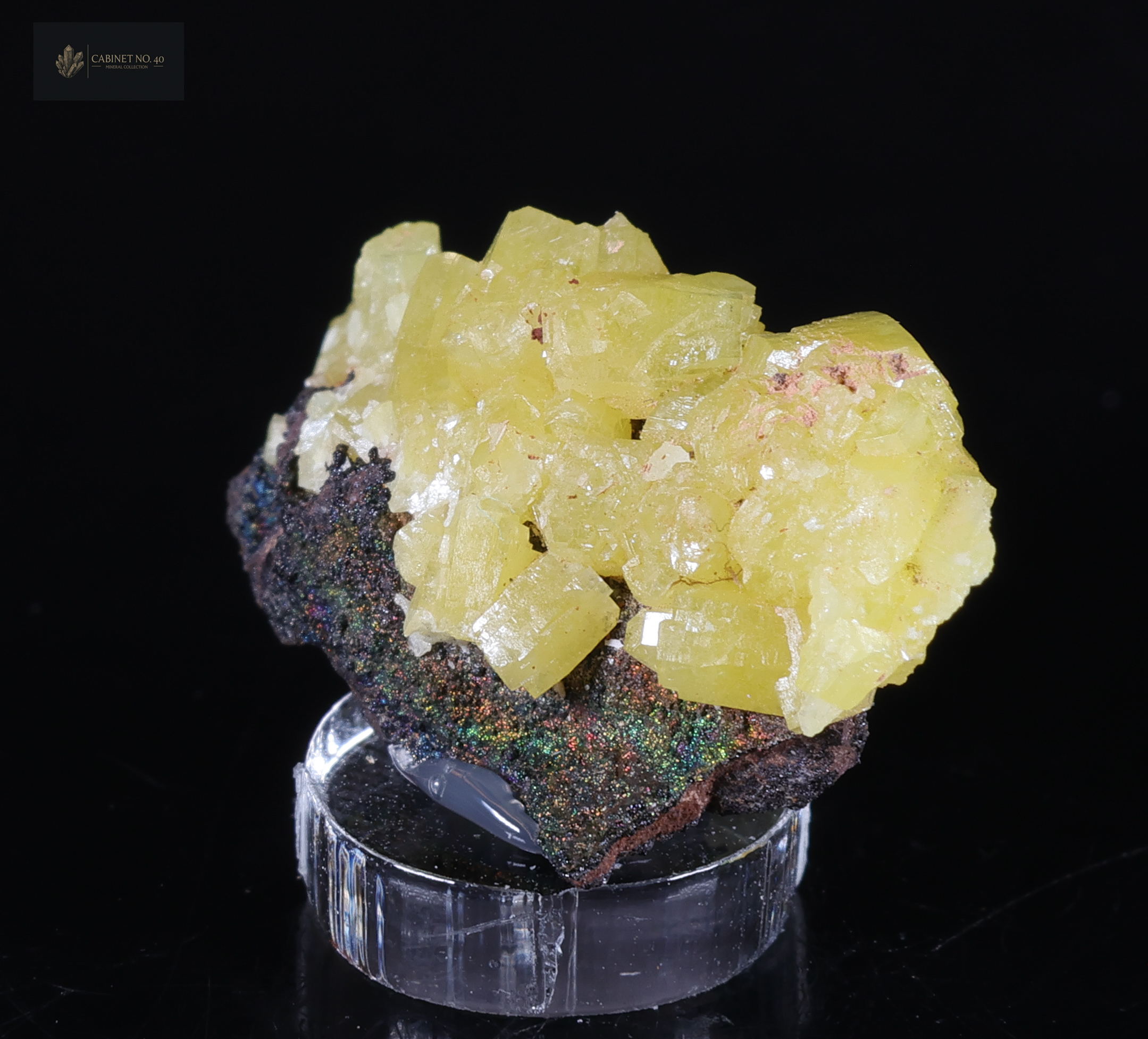
Pyromorphite is a phosphate mineral, often characterized by vivid colors and occurring as hexagonal crystals.
Properties
- Mohs hardness
- 3.5-4
- Luster
- Resinous to sub-adamantine
- Streak
- White
- Density
- 7.04
- Cleavage
- In traces on <mi>{10_11}</mi>.
- Fracture
- Muszlowy do nierównego
- Transparency
- Transparent,Translucent
- Crystal system
- Hexagonal
Diagnostic features
## Identification Pyromorphite can be identified by its characteristic habit of hexagonal crystals, often barrel-shaped, and by its resinous or subadamantine luster. Color, especially green and yellow, is also an important diagnostic feature. Its low hardness (3.5-4 on the Mohs scale) allows it to be scratched by a steel blade. ## Distinguishing from Similar Minerals Pyromorphite is sometimes confused with mimetite, with which it forms an isomorphic series. Distinguishing these two minerals often requires chemical analysis, but pyromorphite usually has more intense green and yellow colors, and its crystals are often more barrel-shaped. Vanadinite is also similar, but it has a higher density and often a more intense reddish-orange color. ## Crystal Forms Typical crystal forms of pyromorphite include hexagonal prisms, often with distinct prismatic and pyramidal faces. It often forms barrel-shaped crystals, hollow or with rounded edges. It also occurs in granular, reniform, radial, and botryoidal aggregates.
Geological environment
## Genesis Pyromorphite is a secondary mineral, formed in the oxidation zones of lead deposits. It forms as a result of the reaction of phosphate-bearing solutions with lead minerals, such as galena. It occurs in paragenesis with other secondary lead minerals. ## Mineral Associations Pyromorphite often co-occurs with minerals such as galena, cerussite, anglesite, vanadinite, mimetite, barite, quartz, and limonite. ## Localities Significant pyromorphite localities include Bad Ems in Germany, Les Farges in France, Broken Hill in Australia, Bunker Hill in the USA (Idaho), as well as locations in China, Mexico, and the United Kingdom.
Rarity
Very Common
For collectors
## Quality Criteria The most prized pyromorphite specimens are those with well-formed, large, and intensely colored crystals. High transparency, absence of mechanical damage, and aesthetic arrangement of crystals on the matrix significantly increase the value of the specimen. Specimens with rare color varieties are also sought after. ## Popular Localities Particularly valued specimens come from Les Farges in France, where beautiful green crystals are found, and from Broken Hill in Australia, known for large, often yellow and brown crystals. Chinese deposits also provide high-quality specimens of various colors.
Care and storage
## Cleaning Pyromorphite can be cleaned gently using a soft brush and lukewarm water. For more stubborn dirt, distilled water can be used. Avoid vigorous scrubbing to prevent damage to the crystal surfaces. ## What to Avoid Avoid contact with acids and strong chemical agents, which can damage the mineral. Prolonged exposure to direct sunlight can lead to fading of some colored varieties. Pyromorphite is sensitive to sudden temperature changes. ## Storage Pyromorphite specimens are best stored in closed display cases or boxes, away from dust and moisture. Due to its relatively low hardness, avoid contact with harder minerals that could scratch its surface. It is advisable to place specimens on a soft substrate, such as cotton wool or foam.