SKU: F-0160_3-US
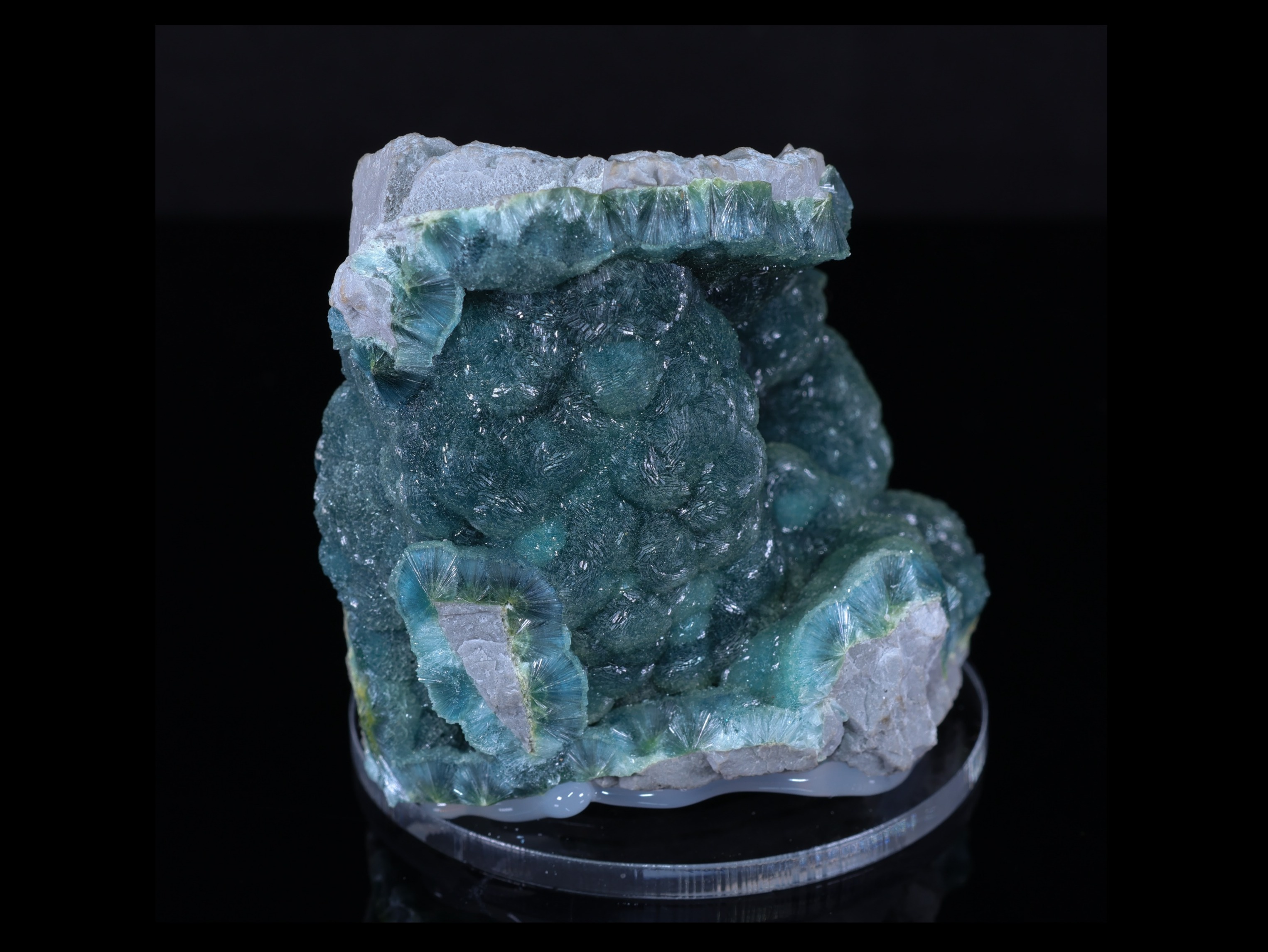
An exceptional specimen of Wavellite from the classic, world-renowned location in Arkansas. The mineral forms dense, spherical aggregates with an intense green color and distinct luster. The crystal structure is clearly visible on the fractures, creating striking 'stars' typical of the finest specimens from Mauldin Mt. The aggregates are set on a light matrix. Main Features: intense green color; radiating structure; botryoidal habit; classic location; ex coll. K. Urbanik. Condition: Very good - the spherical aggregates are complete and intact.
Price: 80 EUR (349 PLN)
Availability: In stock
Location: Arkansas, Montgomery, Mauldin Mt, USA
Size: 50 x 50 x 45 mm
Weight: 123 g
Chemical formula: Al₃(PO₄)₂(OH,F)₃·5H₂O
Crystal system: rhombic
Mohs hardness: 3,5–4
Mineral group: Apatite Group Minerals
Rarity: Uncommon
Characteristics Wavellite is a phosphate mineral that crystallizes in the orthorhombic system. It often forms characteristic radial or spherical aggregates, resembling sea urchins or stars, composed of tiny, acicular crystals. The color of wavellite is usually green to yellowish-green, although white, colorless, yellow, brown, and even blue specimens are also found. The mineral's surface often has a vitreous or pearly luster, which adds to its charm. Physical Properties Wavellite has a Mohs hardness of 3.5-4, making it a relatively soft mineral. Its density is approximately 2.36 g/cm³. This mineral exhibits perfect cleavage along {110}, good cleavage along {101}, and distinct cleavage along {010}. Wavellite's luster is vitreous or pearly, and its streak is white. It is transparent to translucent. Colors and Varieties The most common colors of wavellite are various shades of green, from light green to yellowish-green. Colorless, white, yellow, brown, and less commonly blue specimens also occur. The color in transmitted light is colorless. History and Name Wavellite was discovered in 1805 and named after William Wavell, an English physician and botanist, who first described this mineral in Devon, England. Uses Wavellite has no significant industrial uses. It is primarily valued as a collector's mineral due to its attractive crystal forms and colors.
Identification Wavellite is most easily identified by its characteristic radial or spherical aggregates of acicular crystals. Greenish colors and a vitreous or pearly luster are also good diagnostic features. A Mohs hardness of 3.5-4 distinguishes it from harder minerals. Distinguishing from Similar Minerals Wavellite is sometimes confused with certain zeolites or prehnite, which can also form radial aggregates. However, wavellite typically has a more acicular crystal habit and a different hardness. Chemical testing (for the presence of phosphates) can definitively confirm the mineral's identity. Crystal Forms Wavellite most often occurs as radial, spherical, or hemispherical aggregates, often forming spherulites. Crystals are usually small, acicular, or tabular, rarely reaching larger sizes.
Genesis Wavellite is a secondary mineral, forming in weathering zones of rocks rich in aluminum and phosphates. It often occurs in fissures and cavities in shales, sandstones, limestones, and also in the oxidation zones of phosphate deposits. Mineral Associations Wavellite often co-occurs with minerals such as limonite, quartz, chalcedony, calcite, barite, and other phosphates, such as strengite or turquoise. Localities Known localities of wavellite include Devon, England (type locality), the United States (Arkansas, Pennsylvania), the Czech Republic (Krušné hory), Germany (Saxony), Brazil, and Australia.
Quality Criteria The most prized wavellite specimens are those with intense, uniform color (especially green or blue), well-formed, radial aggregates, and distinct luster. Large, complete spherulites without mechanical damage are particularly sought after. Specimens set on an aesthetic matrix also increase their collector's value. Popular Localities Particularly prized wavellite specimens come from Arkansas in the United States, where beautiful green spherulites occur. Other popular localities include Devon, England, and some localities in Brazil.
See mineralogical reference for Wavellite in the Knowledge Base →