Wavellite
Chemical formula: Al<sub>3</sub>(PO<sub>4</sub>)<sub>2</sub>(OH)<sub>3</sub>·5H<sub>2</sub>O
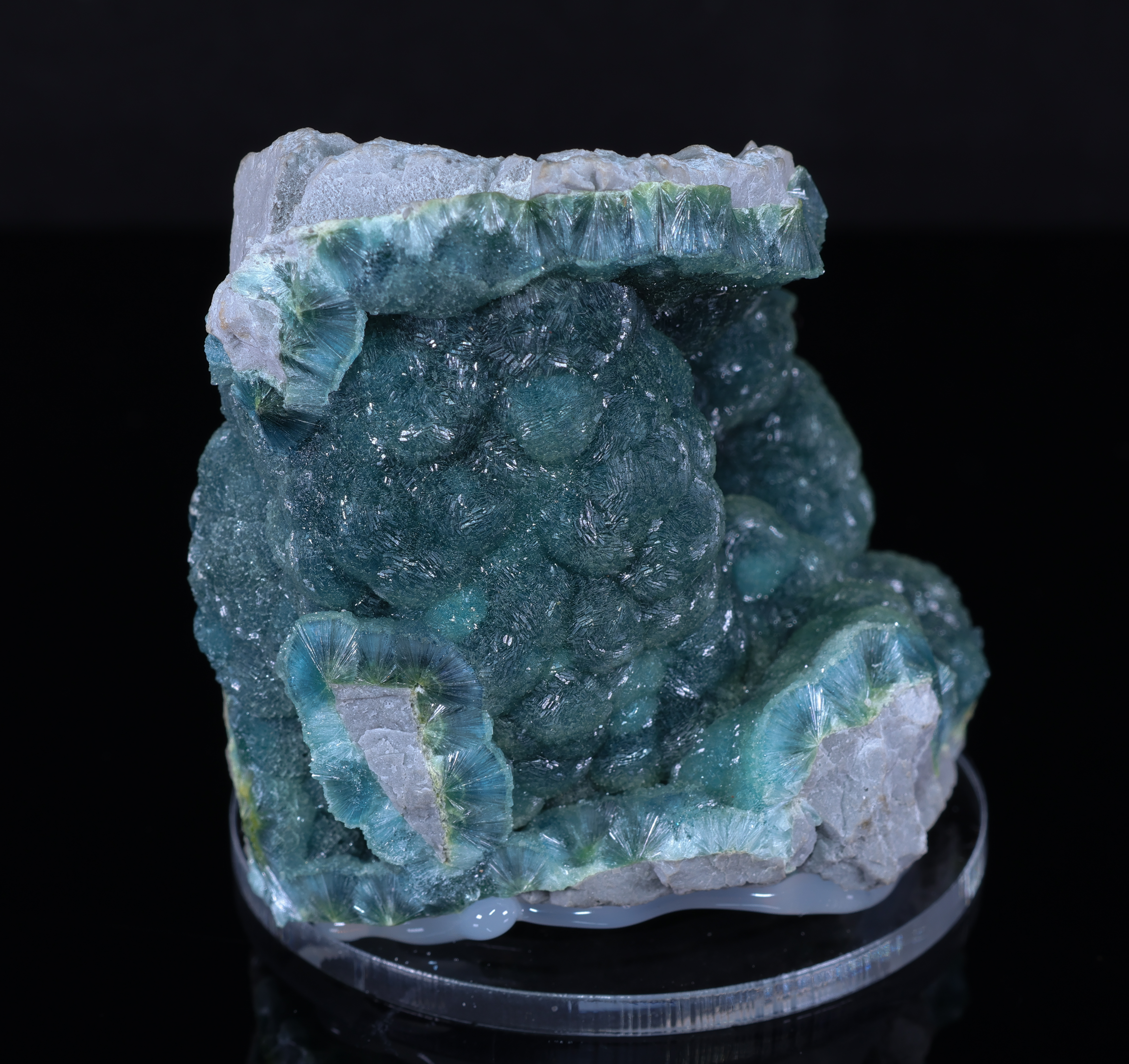
Wavellite is a hydrated aluminum phosphate, often forming attractive greenish radial aggregates.
Properties
- Mohs hardness
- 3.5-4
- Luster
- Szklisty, perłowy
- Streak
- White.
- Density
- 2.36
- Cleavage
- Perfect on {110}, good on {101}, distinct on {010}.
- Fracture
- Nierówny do muszlowego
- Transparency
- Transparent,Translucent
- Crystal system
- Orthorhombic
Diagnostic features
## Identification Wavellite is most easily identified by its characteristic radial or spherical aggregates of acicular crystals. Greenish colors and a vitreous or pearly luster are also good diagnostic features. A Mohs hardness of 3.5-4 distinguishes it from harder minerals. ## Distinguishing from Similar Minerals Wavellite is sometimes confused with certain zeolites or prehnite, which can also form radial aggregates. However, wavellite typically has a more acicular crystal habit and a different hardness. Chemical testing (for the presence of phosphates) can definitively confirm the mineral's identity. ## Crystal Forms Wavellite most often occurs as radial, spherical, or hemispherical aggregates, often forming spherulites. Crystals are usually small, acicular, or tabular, rarely reaching larger sizes.
Geological environment
## Genesis Wavellite is a secondary mineral, forming in weathering zones of rocks rich in aluminum and phosphates. It often occurs in fissures and cavities in shales, sandstones, limestones, and also in the oxidation zones of phosphate deposits. ## Mineral Associations Wavellite often co-occurs with minerals such as limonite, quartz, chalcedony, calcite, barite, and other phosphates, such as strengite or turquoise. ## Localities Known localities of wavellite include Devon, England (type locality), the United States (Arkansas, Pennsylvania), the Czech Republic (Krušné hory), Germany (Saxony), Brazil, and Australia.
Rarity
Uncommon
For collectors
## Quality Criteria The most prized wavellite specimens are those with intense, uniform color (especially green or blue), well-formed, radial aggregates, and distinct luster. Large, complete spherulites without mechanical damage are particularly sought after. Specimens set on an aesthetic matrix also increase their collector's value. ## Popular Localities Particularly prized wavellite specimens come from Arkansas in the United States, where beautiful green spherulites occur. Other popular localities include Devon, England, and some localities in Brazil.
Care and storage
## Cleaning Wavellite specimens should be cleaned gently, using a soft brush or paintbrush. Distilled water can be used, but prolonged soaking should be avoided, especially for specimens with porous matrices. ## What to Avoid Avoid contact of wavellite with acids and strong bases, which can damage the mineral. Due to its moderate hardness, it should be protected from scratches. Prolonged exposure to direct sunlight can lead to fading of some colored varieties. Sudden temperature changes should also be avoided. ## Storage Wavellite is best stored in enclosed display cases or boxes, away from dust and moisture. It is advisable to place it on a soft surface to prevent mechanical damage. Specimens with delicate, radial aggregates require particular care during handling and display.