SKU: B_20_0009
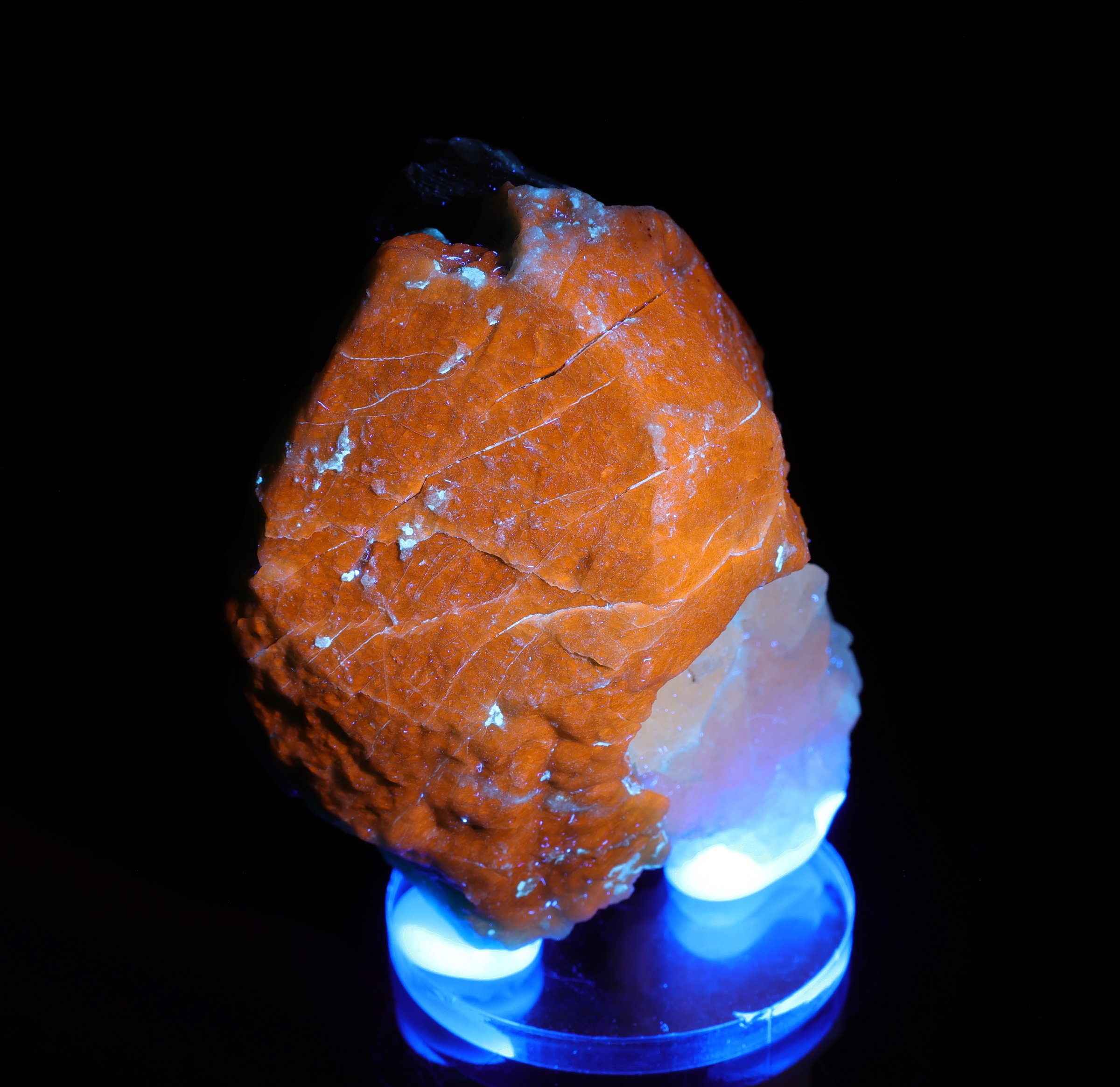
Specimen of green apatite, distinguished primarily by its orange fluorescence under UV light. The main mass of apatite exhibits a deep, oceanic green color, but has not developed sharp, geometric crystal faces. Main Features: deep oceanic shade of green; massive, irregular form of apatite; very strong orange UV reaction; presence of white matrix and mica. Condition: Fair - the main mineral does not possess well-formed, sharp edges or terminations.
Price: 11 EUR (49 PLN)
Availability: In stock
Location: -, Pakistan
Size: 46 x 39 x 54 mm
Weight: 72.5 g
Chemical formula: Ca₅(PO₄)₃(F,Cl,OH)
Mohs hardness: 5
Characteristics Apatite is the name of a group of phosphate minerals, which includes fluorapatite, chlorapatite, and hydroxylapatite, differing mainly in their content of fluorine ions, chlorine ions, or hydroxyl groups. Typical apatite specimens form prismatic or tabular crystals, often with a distinct hexagonal cross-section. It can also occur as massive, granular, or radial aggregates. The color of apatite is highly variable, ranging from colorless, through white, yellow, green, blue, violet, pink, to brown and gray. Transparent crystals are valued in jewelry, while opaque specimens are typical for industrial applications. Physical Properties Apatite is characterized by a hardness of 5 on the Mohs scale, making it a reference mineral for this value. It has a vitreous to resinous luster. It is transparent to translucent, depending on the purity and thickness of the specimen. The density of apatite ranges from 3.1-3.2 g/cm³. It has indistinct cleavage, and its fracture is conchoidal to uneven. Colors and Varieties The color of apatite is highly diverse and depends on the presence of impurities. The most common shades are green (e.g., asparagus stone), blue (e.g., moroxite), yellow, and violet. There are also colorless, white, pink, brown, and gray varieties. Some specimens exhibit a cat's eye effect or asterism, which increases their collectible and gemological value. History and Name The name "apatite" comes from the Greek word "apatein," meaning "to deceive" or "to mislead." It was given in 1786 by Abraham Gottlob Werner because apatite was often confused with other minerals, such as beryl, tourmaline, or olivine, due to its varied colors and forms. It is a mineral known since antiquity, but its precise definition as a distinct species occurred relatively late. Uses Apatite is the main source of phosphorus, used in the production of phosphate fertilizers. It is also a component of tooth enamel and bones, which is significant in medicine and dentistry. Transparent varieties of apatite, especially those with intense colors, are cut as gemstones, although due to their relatively low hardness, they require careful handling. Fluorapatite is used in the production of glass and ceramics.
Identification Apatite can be identified by its hardness (5 on the Mohs scale), which is a diagnostic feature. It often occurs as hexagonal crystals, which can be prismatic or tabular. The luster is vitreous to resinous, and the streak is white. The variability of colors is also characteristic of this mineral. Distinguishing from Similar Minerals Apatite is often confused with beryl, tourmaline, olivine, or quartz. It is distinguished from beryl and tourmaline by its lower hardness. It differs from olivine by its crystallographic system and lack of conchoidal fracture. It is distinguished from quartz by its significantly lower hardness. In case of doubt, a hardness test is crucial for identification. Crystal Forms Apatite most commonly forms hexagonal crystals, with prismatic, tabular, or acicular habits. Flattened prism faces and the presence of pyramids are common. It can also form granular, massive, radial, reniform, or botryoidal aggregates.
Genesis Apatite is a common mineral, occurring in a wide range of geological environments. It forms in igneous (acidic and basic), metamorphic, and sedimentary rocks. In igneous rocks, it crystallizes as an accessory mineral in granites, syenites, diorites, and gabbros, as well as in pegmatites and carbonatites. In metamorphic rocks, it occurs in marbles, gneisses, and schists. In sedimentary rocks, it forms as a result of diagenetic processes, often as phosphorites, which are the main source of phosphorus. Mineral Associations Apatite often co-occurs with minerals such as quartz, orthoclase, biotite, muscovite, hornblende, calcite, dolomite, fluorite, tourmaline, beryl, and also with metal ores. Localities Known localities of apatite include Russia (Kola Peninsula), Canada (Ontario, Quebec), Brazil (Minas Gerais), Mexico (Durango), USA (Maine, California), Norway (Kragerø), Germany (Saxony), Pakistan, Madagascar, and Myanmar. In Poland, apatite occurs, among others, in Sudetic pegmatites and in carbonatites near Ełk.
Quality Criteria The most prized apatite specimens are those with distinct, well-formed crystals, with intense and rare colors, such as blue, violet, or pink. Transparency and lack of inclusions also increase collectible value. Large specimens, especially those with a cat's eye effect or asterism, are particularly sought after. Popular Localities Among the most sought-after specimens are those from Brazil (especially from Minas Gerais, known for beautiful, transparent crystals), Mexico (Durango, with large, well-formed crystals), Canada (Ontario, Quebec, with blue and green varieties), and Madagascar (pink and green specimens).
See mineralogical reference for Apatite in the Knowledge Base →