SKU: B_36_0019
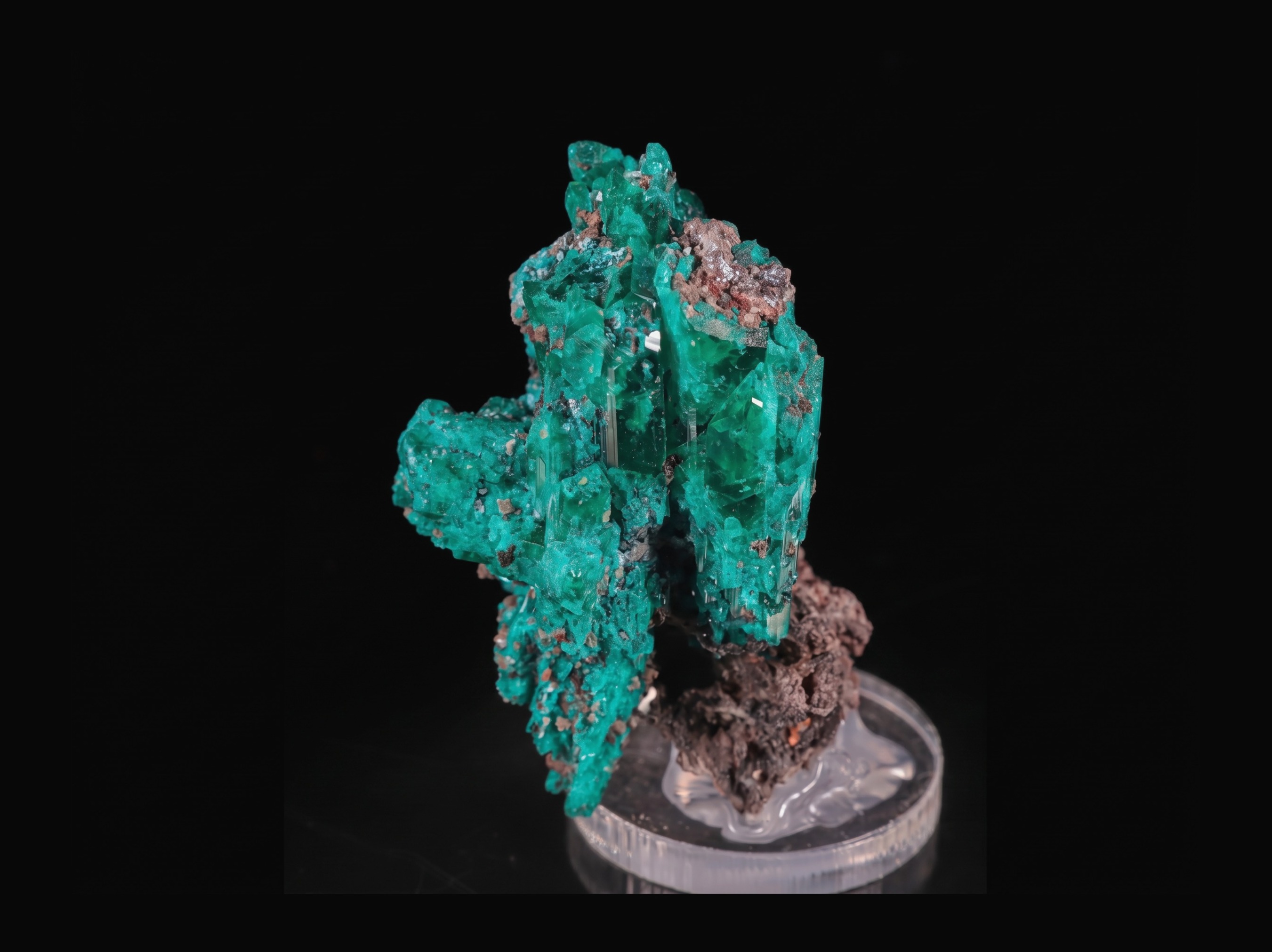
A specimen of dioptase characterized by the presence of large crystals with a deep green color. Main Features: large crystals; distinct striations on the faces; saturated green. Condition: Good.
Price: 64 EUR (279 PLN)
Availability: In stock
Location: N'tola Mine, Mindouli, Mindouli District, Pool Department, Republic of the Congo
Size: 19 x 24 x 33 mm
Weight: 13 g
Chemical formula: Cu₆Si₆O₁₈·₆H₂O
Mohs hardness: 5.0
Characteristics Dioptase is a hydrated copper silicate that typically forms short prismatic or rhombohedral crystals with an intense, emerald-green or blue-green coloration. It often occurs in crystalline aggregates, forming aesthetic druses on a rock matrix. Its color is one of its most recognizable features, giving it a unique appearance among copper minerals. Physical Properties The hardness of dioptase on the Mohs scale is 5. This mineral is characterized by a vitreous luster. It is transparent to translucent, which allows for the observation of its deep color. The density of dioptase is 3.28 g/cm³. It has perfect cleavage in one direction. Colors and Varieties Dioptase primarily occurs in shades of emerald green and blue-green. This color is constant and characteristic of the species; there are no significant color varieties or commercial names. History and Name Dioptase was discovered and described in 1797. The name of the mineral comes from the Greek words "dia" (through) and "optazo" (to see), which refers to the ability to discern internal cleavage planes in transparent crystals. Uses Dioptase has no industrial applications due to its rarity and fragility. It is a prized collector's mineral, sought after for its intense color and aesthetic crystal forms.
Identification Dioptase can be identified by its intense, emerald-green or blue-green color, vitreous luster, and characteristic, well-formed short prismatic or rhombohedral crystals. A green streak is also a diagnostic feature. Distinguishing from Similar Minerals Dioptase is sometimes confused with some varieties of emerald or chrysocolla. It differs from emerald by its lower hardness (5 on the Mohs scale compared to 7.5-8 for emerald) and different crystal habit. From chrysocolla, which is amorphous and usually has a more matte luster, dioptase differs in its crystalline structure and vitreous luster. Crystal Forms Dioptase typically forms well-developed short prismatic or rhombohedral crystals. They often occur as druses, which are aggregates of small crystals covering the surface of a rock.
Genesis Dioptase forms in the oxidation zones of copper deposits, often in dry and desert environments. It forms as a result of hydrothermal processes, where solutions rich in copper and silica react with surrounding rocks. Mineral Associations Dioptase often co-occurs with other secondary copper minerals such as chrysocolla, malachite, azurite, calcite, and quartz. Localities The most known and prized localities for dioptase are in Kazakhstan (Altyn-Tyube), Namibia (Tsumeb), the Democratic Republic of Congo (Mindouli, Reneville), and the United States (Arizona).
Quality Criteria The most prized dioptase specimens are those with well-formed, large, transparent crystals of intense, emerald-green color. Specimens with crystal druses on an aesthetic rock matrix are particularly sought after. Clarity and absence of mechanical damage also influence collector value. Popular Localities The most sought-after dioptase specimens come from Tsumeb, Namibia, where crystals of exceptional size and quality are found. Other valued localities include Altyn-Tyube in Kazakhstan and areas in the Democratic Republic of Congo.
See mineralogical reference for Dioptase in the Knowledge Base →