Dioptase
Chemical formula: Cu<sup>2+</sup>SiO<sub>3</sub>·H<sub>2</sub>O
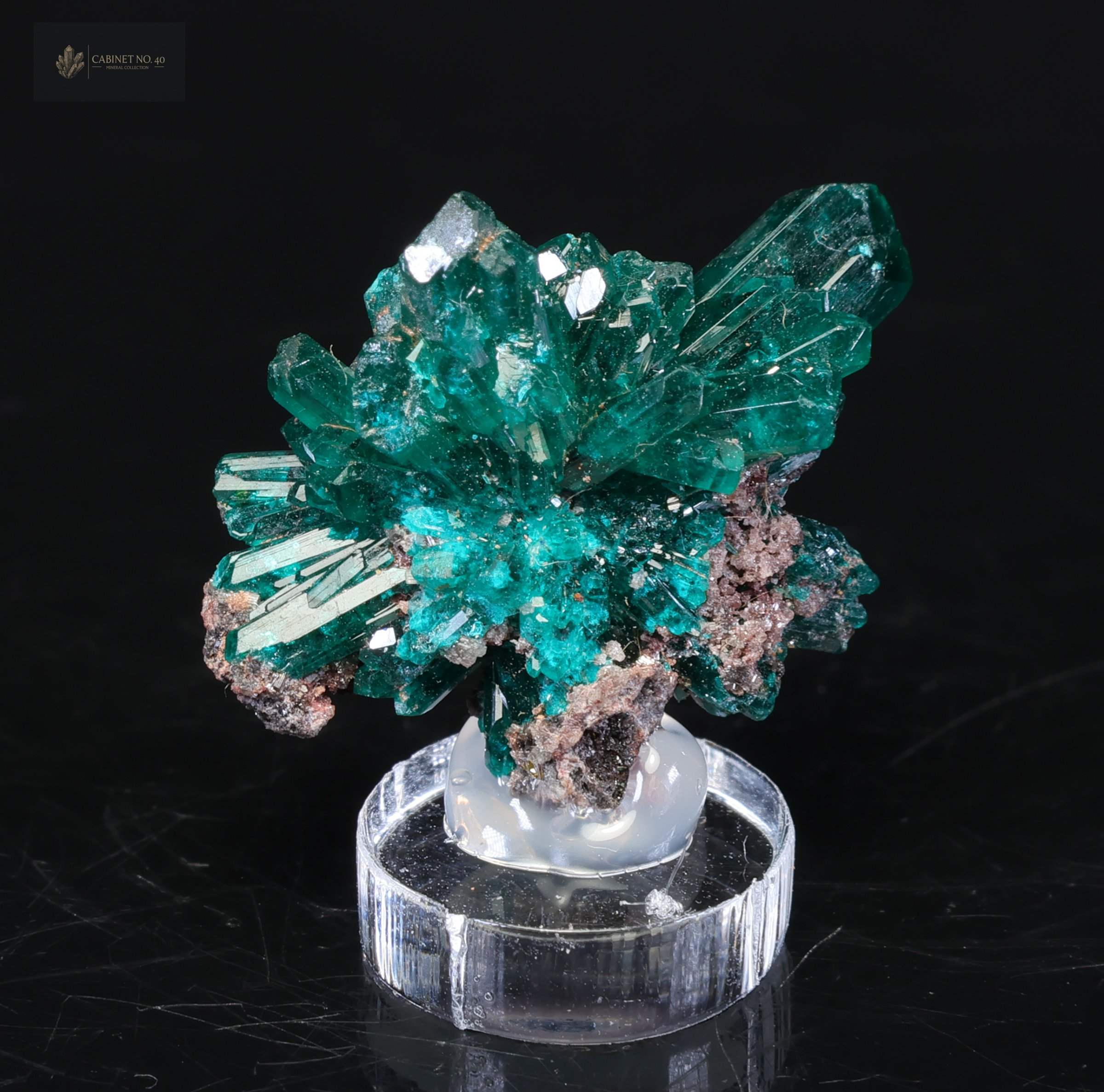
Dioptase is a rare copper silicate mineral, known for its intense green color and characteristic, well-formed crystals.
Properties
- Mohs hardness
- 5
- Luster
- Vitreous
- Streak
- Green
- Density
- 3.28
- Cleavage
- Perfect on <mi>{10_11}</mi>
- Fracture
- Muszlowy do nierównego
- Transparency
- Transparent,Translucent
- Crystal system
- Trigonal
Diagnostic features
## Identification Dioptase can be identified by its intense, emerald-green or blue-green color, vitreous luster, and characteristic, well-formed short prismatic or rhombohedral crystals. A green streak is also a diagnostic feature. ## Distinguishing from Similar Minerals Dioptase is sometimes confused with some varieties of emerald or chrysocolla. It differs from emerald by its lower hardness (5 on the Mohs scale compared to 7.5-8 for emerald) and different crystal habit. From chrysocolla, which is amorphous and usually has a more matte luster, dioptase differs in its crystalline structure and vitreous luster. ## Crystal Forms Dioptase typically forms well-developed short prismatic or rhombohedral crystals. They often occur as druses, which are aggregates of small crystals covering the surface of a rock.
Geological environment
## Genesis Dioptase forms in the oxidation zones of copper deposits, often in dry and desert environments. It forms as a result of hydrothermal processes, where solutions rich in copper and silica react with surrounding rocks. ## Mineral Associations Dioptase often co-occurs with other secondary copper minerals such as chrysocolla, malachite, azurite, calcite, and quartz. ## Localities The most known and prized localities for dioptase are in Kazakhstan (Altyn-Tyube), Namibia (Tsumeb), the Democratic Republic of Congo (Mindouli, Reneville), and the United States (Arizona).
Rarity
Uncommon
For collectors
## Quality Criteria The most prized dioptase specimens are those with well-formed, large, transparent crystals of intense, emerald-green color. Specimens with crystal druses on an aesthetic rock matrix are particularly sought after. Clarity and absence of mechanical damage also influence collector value. ## Popular Localities The most sought-after dioptase specimens come from Tsumeb, Namibia, where crystals of exceptional size and quality are found. Other valued localities include Altyn-Tyube in Kazakhstan and areas in the Democratic Republic of Congo.
Care and storage
## Cleaning Dioptase is a relatively soft mineral, so it requires gentle cleaning. It is best to use a soft brush and lukewarm water. Distilled water can also be used to avoid hard water deposits. Avoid strong rubbing, which can scratch the surface of the crystals. ## What to Avoid Avoid contact of dioptase with acids and other aggressive chemicals, which can damage the mineral. High temperatures and sudden temperature changes are also not recommended. Prolonged exposure to direct sunlight can potentially affect the intensity of the color, so it is advisable to store it in a shaded place. The mineral is sensitive to impacts and pressure due to its cleavage. ## Storage Dioptase is best stored in closed display cases or boxes lined with soft material to protect it from dust and mechanical damage. Due to its susceptibility to scratching, avoid storing it with harder minerals. Stable temperature conditions and moderate humidity are recommended.