SKU: B_26_0006
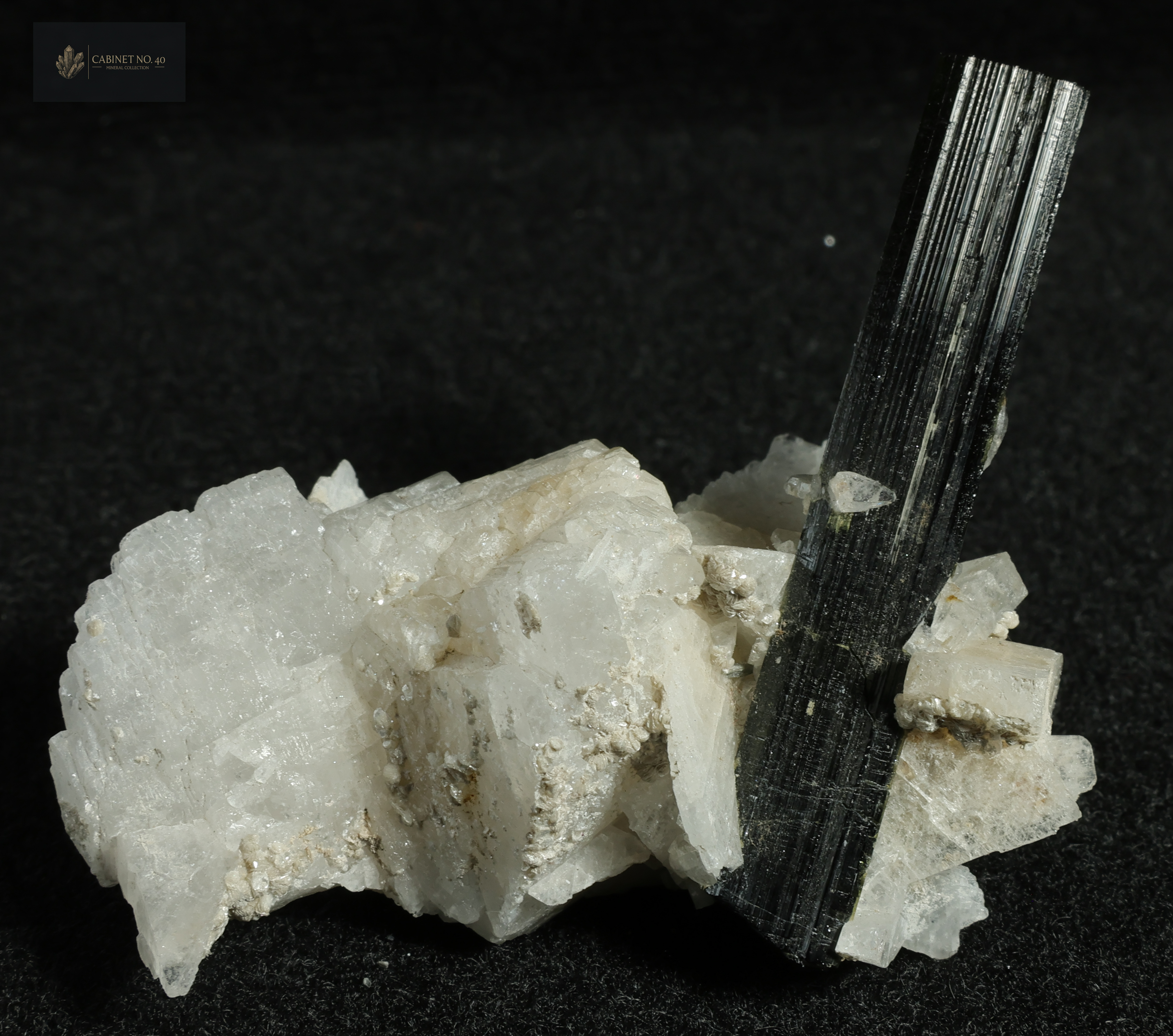
A specimen featuring a distinct, single elbaite crystal embedded in a natural matrix. The crystal is black, prismatic, with very well-preserved side faces and a natural termination. The striation is clear and continuous.
Price: 80 EUR (349 PLN)
Availability: In stock
Location: Laghman, Afghanistan
Size: 50 x 50 x 30 mm
Weight: 31.1 g
Chemical formula: Na(Li,Al)₃Al₆Si₆O₁₈(BO₃)₃(OH)₄
Crystal system: Trigonal
Mohs hardness: 7.0–7.5
Rarity: Uncommon
Characteristics Elbaite is a mineral belonging to the tourmaline group, a borosilicate. It typically occurs as elongated, prismatic crystals with a triangular or hexagonal cross-section, often with distinct striations along the c-axis. It can also form radial aggregates or massive habits. Elbaite specimens often exhibit color zoning, where different colors occur within a single crystal, both parallel and perpendicular to the crystallographic axis. Physical Properties Elbaite has a hardness of 7.5 on the Mohs scale, making it a relatively scratch-resistant mineral. It has a vitreous to greasy luster. Its streak is white. It is transparent to translucent, which allows for its use in jewelry. The density of elbaite is approximately 2.9 g/cm³. Colors and Varieties Elbaite occurs in a wide range of colors, including green, blue-green, blue, red to pink, orange, yellow, and colorless. Its color diversity is one of its most recognizable features. Known varieties include rubellite (pink to red), indicolite (blue), and verdelite (green). History and Name Elbaite was described in 1913. Its name comes from the island of Elba in Italy, where this mineral was first identified. It is one of the most important minerals in the tourmaline group, due to its aesthetic qualities and chemical diversity. Uses Elbaite is a prized gemstone, used in jewelry making. Its variety of colors and high hardness make it popular among designers and collectors. Colorless and transparent varieties can also be used in optics for the production of polarizers.
Identification Elbaite can be identified by its characteristic prismatic habit, often with vertical striations on the crystal faces. A key feature is also the wide range of colors, often occurring in zones within a single crystal. A hardness of 7.5 on the Mohs scale and a vitreous luster are also helpful in identification. Distinguishing from Similar Minerals Elbaite can be confused with other tourmalines, such as schorl (black tourmaline) or dravite, but differs from them in chemical composition and often in color. It is distinguished from garnets by its crystal habit and the absence of isometric forms. It is distinguished from beryl (emerald, aquamarine) by different crystal forms and often the presence of striations. Crystal Forms Elbaite most often forms elongated, prismatic crystals with a triangular or hexagonal cross-section. Vertical striations are often present on them. Aggregates can be radial, massive, or form druses.
Genesis Elbaite primarily forms in granitic pegmatites, which are coarse-grained igneous rocks. It also occurs in some hydrothermal veins and in metamorphic rocks. Its formation is associated with crystallization processes from solutions rich in boron, lithium, and aluminum during the final stages of magma solidification. Mineral Associations Elbaite often co-occurs with other pegmatitic minerals, such as quartz, feldspars (orthoclase, albite), muscovite, lepidolite, spodumene, beryl, and other tourmalines. Localities Known elbaite localities are found worldwide. The most important include: Brazil (Minas Gerais), Madagascar (Antananarivo), United States (California, Maine), Pakistan (Gilgit-Baltistan), Afghanistan (Nuristan), Russia (Urals), and Italy (Elba Island).
Quality Criteria The most prized elbaite specimens are those with intense, uniform colors or with distinct, aesthetic color zoning. Transparency, absence of inclusions and fractures, and well-formed, undamaged crystals are also important. Large, well-formed crystals are particularly sought after. Specimens grown on a matrix are often more valuable. Popular Localities The most prized elbaite specimens come from Brazil, especially from the state of Minas Gerais, where many famous, multicolored crystals have been found. Other important sources include Madagascar, Afghanistan, and Pakistan, known for high-quality jewelry specimens.
See mineralogical reference for Elbaite in the Knowledge Base →