Elbaite
Chemical formula: Na(Al<sub>1.5</sub>Li<sub>1.5</sub>)Al<sub>6</sub>(Si<sub>6</sub>O<sub>18</sub>)(BO<sub>3</sub>)<sub>3</sub>(OH)<sub>3</sub>OH
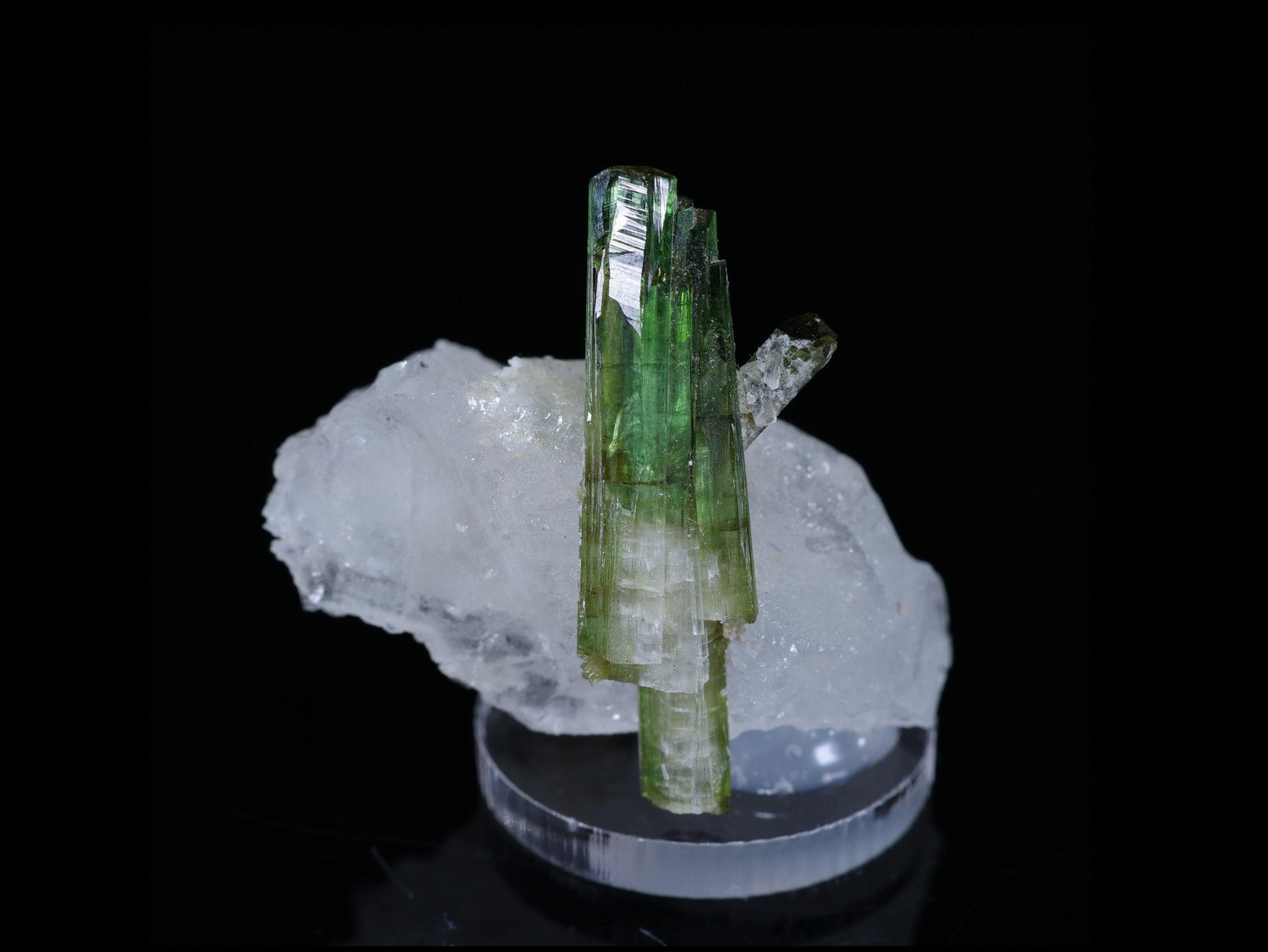
Elbaite is a mineral from the tourmaline group, characterized by a rich variety of colors, from colorless to intensely green, blue, red, and pink.
Properties
- Mohs hardness
- 7.5
- Luster
- Vitreous to oily.
- Streak
- White
- Density
- 2.9
- Cleavage
- on <mi>{11_20} and {10_11}</mi>
- Fracture
- Muszlowy
- Transparency
- Transparent,Translucent
- Crystal system
- Trigonal
Diagnostic features
## Identification Elbaite can be identified by its characteristic prismatic habit, often with vertical striations on the crystal faces. A key feature is also the wide range of colors, often occurring in zones within a single crystal. A hardness of 7.5 on the Mohs scale and a vitreous luster are also helpful in identification. ## Distinguishing from Similar Minerals Elbaite can be confused with other tourmalines, such as schorl (black tourmaline) or dravite, but differs from them in chemical composition and often in color. It is distinguished from garnets by its crystal habit and the absence of isometric forms. It is distinguished from beryl (emerald, aquamarine) by different crystal forms and often the presence of striations. ## Crystal Forms Elbaite most often forms elongated, prismatic crystals with a triangular or hexagonal cross-section. Vertical striations are often present on them. Aggregates can be radial, massive, or form druses.
Geological environment
## Genesis Elbaite primarily forms in granitic pegmatites, which are coarse-grained igneous rocks. It also occurs in some hydrothermal veins and in metamorphic rocks. Its formation is associated with crystallization processes from solutions rich in boron, lithium, and aluminum during the final stages of magma solidification. ## Mineral Associations Elbaite often co-occurs with other pegmatitic minerals, such as quartz, feldspars (orthoclase, albite), muscovite, lepidolite, spodumene, beryl, and other tourmalines. ## Localities Known elbaite localities are found worldwide. The most important include: Brazil (Minas Gerais), Madagascar (Antananarivo), United States (California, Maine), Pakistan (Gilgit-Baltistan), Afghanistan (Nuristan), Russia (Urals), and Italy (Elba Island).
Rarity
Common
For collectors
## Quality Criteria The most prized elbaite specimens are those with intense, uniform colors or with distinct, aesthetic color zoning. Transparency, absence of inclusions and fractures, and well-formed, undamaged crystals are also important. Large, well-formed crystals are particularly sought after. Specimens grown on a matrix are often more valuable. ## Popular Localities The most prized elbaite specimens come from Brazil, especially from the state of Minas Gerais, where many famous, multicolored crystals have been found. Other important sources include Madagascar, Afghanistan, and Pakistan, known for high-quality jewelry specimens.
Care and storage
## Cleaning Elbaite can be cleaned using a soft brush and lukewarm water with mild soap. The specimen should be thoroughly rinsed to remove any soap residue. For specimens with numerous fissures or inclusions, it is recommended to use distilled water only. ## What to Avoid Avoid cleaning elbaite with ultrasonic cleaners or steam, as this can damage specimens, especially those with internal fractures or inclusions. The mineral is sensitive to sudden temperature changes, which can lead to cracking. Prolonged exposure to direct sunlight can cause some elbaite colors to fade. Avoid contact with aggressive chemicals, such as acids or strong bases. ## Storage Elbaite should be stored in a separate box or soft pouch to prevent scratching by harder minerals. Ideal conditions include stable temperature and low humidity. Jewelry specimens are best stored away from direct light.