SKU: B_36_0026
Aesthetic specimen showcasing the classic paragenesis from the Yanga Koubenza mine - intense blue of the fine-grained azurite brush and sharp, smoky cerussite crystals with high transparency. Main Features: blue azurite; sharp, smoky cerussite crystals; excellent contrast on the matrix. Condition: Very good.
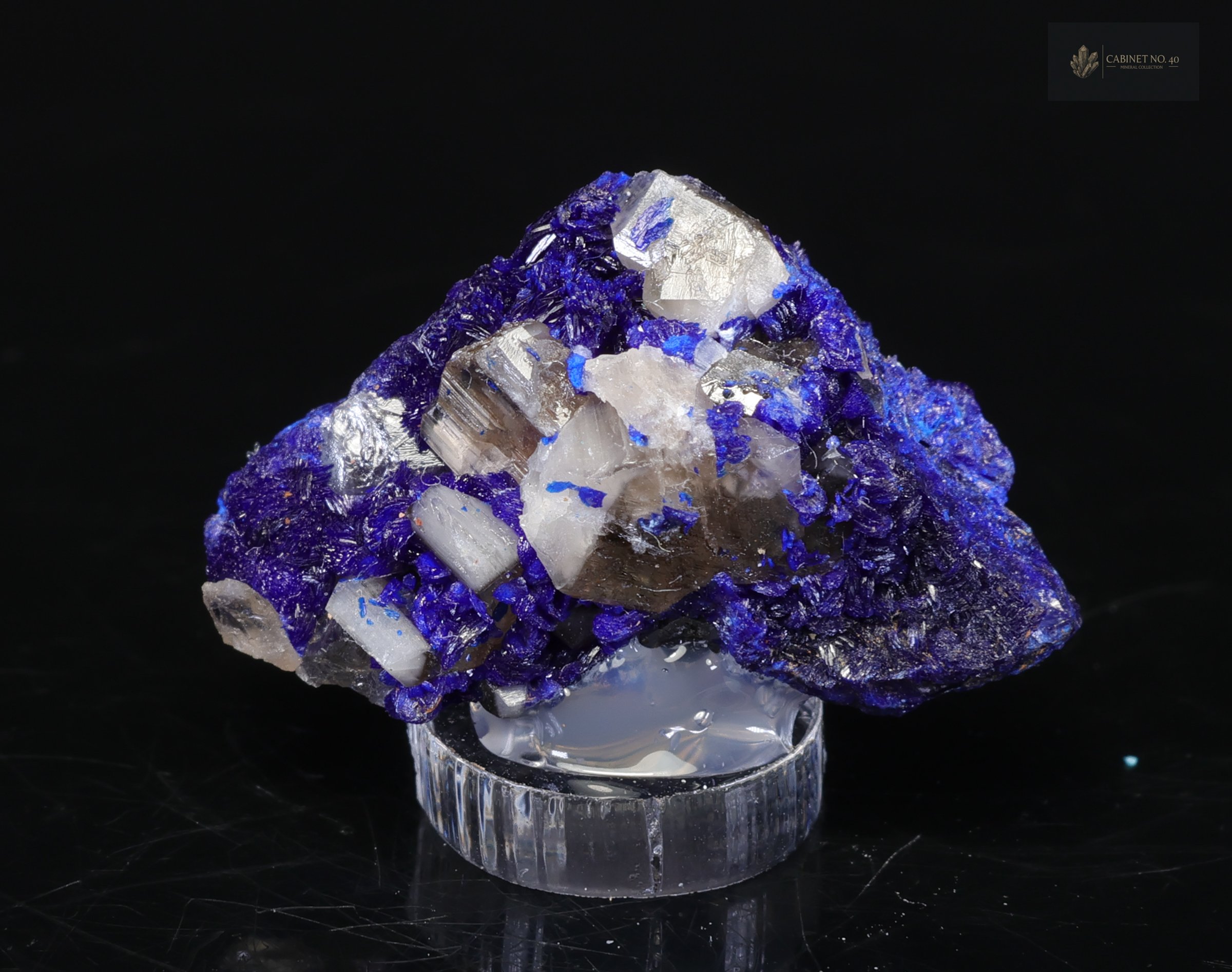
Price: 27 EUR (119 PLN)
Availability: In stock
Location: Yanga Koubenza quarries, Mfouati, Mfouati District, Bouenza Department, Republic of the Congo
Size: 20 x 10 x 14 mm
Weight: 4 g
Chemical formula: Cu₃(CO₃)₂(OH)₂
Mohs hardness: 3.5-4
Characteristics Azurite is a copper carbonate mineral characterized by its intense, azure color. It most commonly occurs as well-formed crystals with a tabular, prismatic, or isometric habit, often forming radial, reniform, or earthy aggregates. Its deep blue color is very distinctive, making it easily recognizable among other minerals. It frequently co-occurs with malachite, forming attractive, bicolored specimens. Physical Properties Azurite has a Mohs hardness of 3.5-4, which means it is relatively soft. It has a vitreous luster, and its streak is light blue. The specific gravity of azurite is approximately 3.77 g/cm³. It is transparent to translucent. It exhibits perfect cleavage along {011}, good along {100}, and trace along {110}. Colors and Varieties The dominant color of azurite is deep blue, ranging from light blue to a dark, azure shade. This color is stable; however, under the influence of external factors such as high temperature or humidity, azurite can undergo pseudomorphosis into malachite, changing its color to green. There are no typical commercial varieties of azurite, but its color and crystal form are the main criteria for evaluating specimens. History and Name The name azurite comes from the Persian word “lazhward,” meaning blue, which refers to its characteristic color. This mineral was known and used in antiquity as a pigment and ornamental stone. It was officially described in 1824. Uses Azurite was historically used as a blue pigment in painting, especially during the Middle Ages and Renaissance. Currently, its main use is as a collector's mineral, valued for its intense colors and aesthetic crystal forms. It is less frequently used as an ornamental stone in jewelry due to its low hardness and sensitivity to external factors.
Identification Azurite is easily recognizable by its characteristic, intense blue color and vitreous luster. It often occurs in aggregates with green malachite, which further aids identification. The streak of azurite is light blue, which is an important diagnostic feature. Distinguishing from Similar Minerals Azurite can be confused with lapis lazuli or sodalite due to similar color, but azurite is significantly softer and has a different streak. Distinguishing it from malachite is simple due to the difference in color (blue azurite, green malachite), although they often occur together. In case of doubt, a hardness and streak test can help with identification. Crystal Forms Azurite forms crystals with a tabular, prismatic, or isometric habit. It often occurs as radial, reniform, earthy, or botryoidal aggregates. Azurite crystals can be well-formed, creating aesthetic shapes that are prized by collectors.
Genesis Azurite is a secondary mineral, formed in the oxidation zones of copper deposits. It forms as a result of the reaction of solutions containing copper ions with carbonates, often in the presence of carbon dioxide. It occurs in sedimentary rocks, especially limestones, and in the weathering zones of copper ores. Mineral Associations Azurite often co-occurs with other copper minerals, such as malachite (often forming pseudomorphs), cuprite, chrysocolla, tenorite, and native copper. It can also occur with iron and manganese minerals. Localities Notable localities for rich azurite deposits include Tsumeb in Namibia, Chessy in France, Bisbee and Morenci in Arizona (USA), Laurion in Greece, and Broken Hill in Australia. In Poland, azurite occurs in small quantities in the Świętokrzyskie Mountains and Lower Silesia.
Quality Criteria The most prized azurite specimens are those with well-formed, large crystals of intense, deep blue color. Purity and absence of mechanical damage are also important. Specimens where azurite co-occurs with malachite, creating attractive color contrasts, are particularly sought after. The size and aesthetic appeal of the crystal form also influence collectible value. Popular Localities The most prized azurite specimens come from Tsumeb (Namibia), where large, perfectly formed crystals have been found. Other important localities include Chessy (France) and Bisbee and Morenci (Arizona, USA), known for beautiful crystal aggregates.
See mineralogical reference for Azurite in the Knowledge Base →