Azurite
Chemical formula: Cu<sup>2+</sup><sub>3</sub>(CO<sub>3</sub>)<sub>2</sub>(OH)<sub>2</sub>
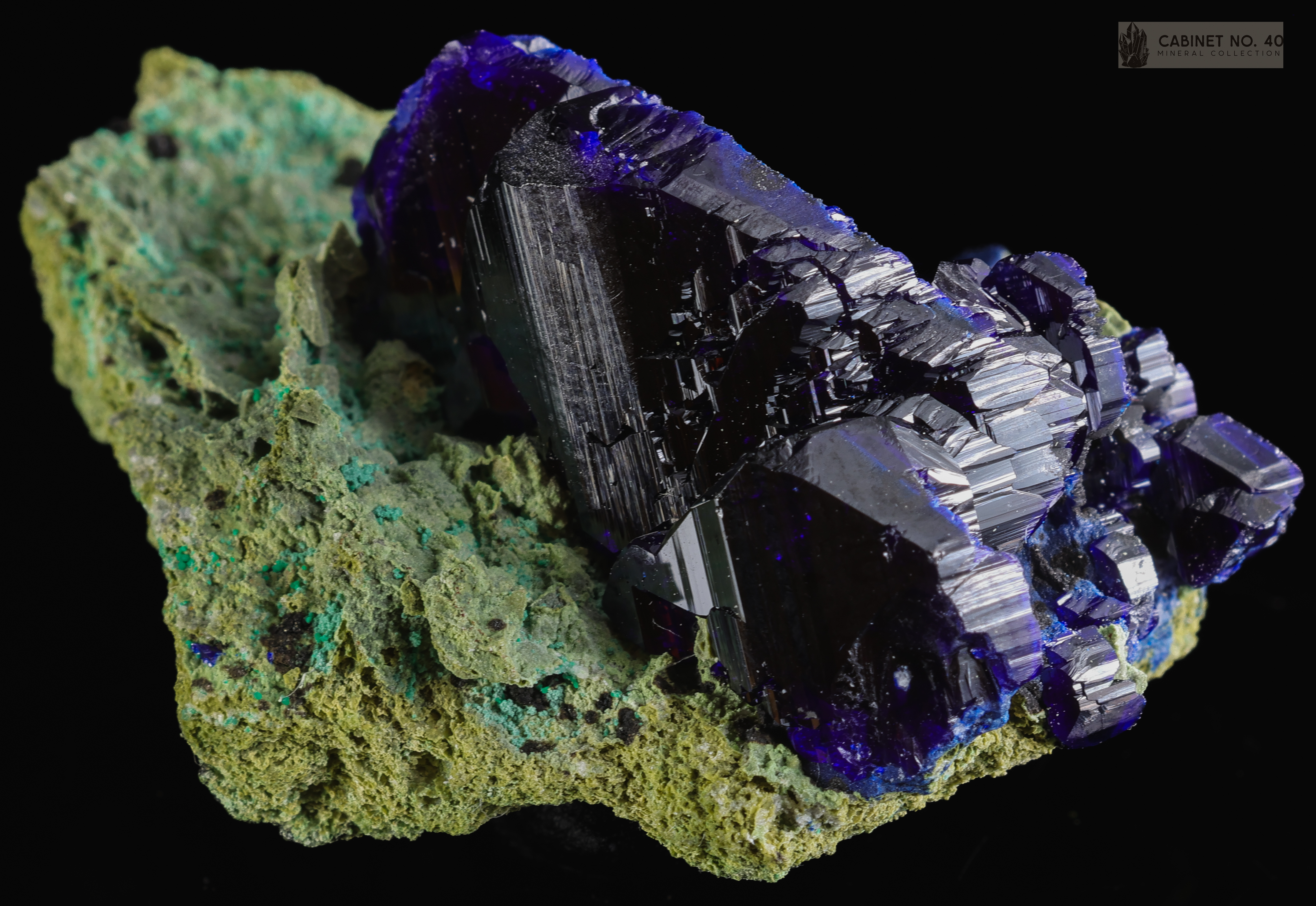
Azurite is a mineral from the copper carbonate group, known for its intense, deep blue color, often occurring as crystals or aggregates on host rocks.
Properties
- Mohs hardness
- 3.5-4
- Luster
- Vitreous
- Streak
- Light blue
- Density
- 3.77
- Cleavage
- Perfect on {011}; on {100} fair; on {110} in traces.
- Fracture
- Brak danych
- Transparency
- Transparent,Translucent
- Crystal system
- Monoclinic
Diagnostic features
## Identification Azurite is easily recognizable by its characteristic, intense blue color and vitreous luster. It often occurs in aggregates with green malachite, which further aids identification. The streak of azurite is light blue, which is an important diagnostic feature. ## Distinguishing from Similar Minerals Azurite can be confused with lapis lazuli or sodalite due to similar color, but azurite is significantly softer and has a different streak. Distinguishing it from malachite is simple due to the difference in color (blue azurite, green malachite), although they often occur together. In case of doubt, a hardness and streak test can help with identification. ## Crystal Forms Azurite forms crystals with a tabular, prismatic, or isometric habit. It often occurs as radial, reniform, earthy, or botryoidal aggregates. Azurite crystals can be well-formed, creating aesthetic shapes that are prized by collectors.
Geological environment
## Genesis Azurite is a secondary mineral, formed in the oxidation zones of copper deposits. It forms as a result of the reaction of solutions containing copper ions with carbonates, often in the presence of carbon dioxide. It occurs in sedimentary rocks, especially limestones, and in the weathering zones of copper ores. ## Mineral Associations Azurite often co-occurs with other copper minerals, such as malachite (often forming pseudomorphs), cuprite, chrysocolla, tenorite, and native copper. It can also occur with iron and manganese minerals. ## Localities Notable localities for rich azurite deposits include Tsumeb in Namibia, Chessy in France, Bisbee and Morenci in Arizona (USA), Laurion in Greece, and Broken Hill in Australia. In Poland, azurite occurs in small quantities in the Świętokrzyskie Mountains and Lower Silesia.
Rarity
Very Common
For collectors
## Quality Criteria The most prized azurite specimens are those with well-formed, large crystals of intense, deep blue color. Purity and absence of mechanical damage are also important. Specimens where azurite co-occurs with malachite, creating attractive color contrasts, are particularly sought after. The size and aesthetic appeal of the crystal form also influence collectible value. ## Popular Localities The most prized azurite specimens come from Tsumeb (Namibia), where large, perfectly formed crystals have been found. Other important localities include Chessy (France) and Bisbee and Morenci (Arizona, USA), known for beautiful crystal aggregates.
Care and storage
## Cleaning Azurite is a delicate mineral, so it should be cleaned carefully. It is best to use a soft, dry brush to remove dust. For heavier soiling, the specimen can be gently wiped with a damp cloth moistened with distilled water, then immediately dried. ## What to Avoid Azurite is sensitive to high temperatures, acids, and ammonia, which can cause its decomposition or color change. Prolonged exposure to direct sunlight should be avoided, as this can lead to color fading. High humidity is also not recommended, as it can promote pseudomorphosis into malachite. Ultrasonic cleaners or strong chemical agents should not be used. ## Storage Azurite specimens are best stored in enclosed display cases or boxes, away from heat sources, direct sunlight, and moisture. It is advisable to place a desiccant in the container to ensure stable conditions. Due to its softness, contact with harder minerals that could scratch it should be avoided.