SKU: P_26-7_26
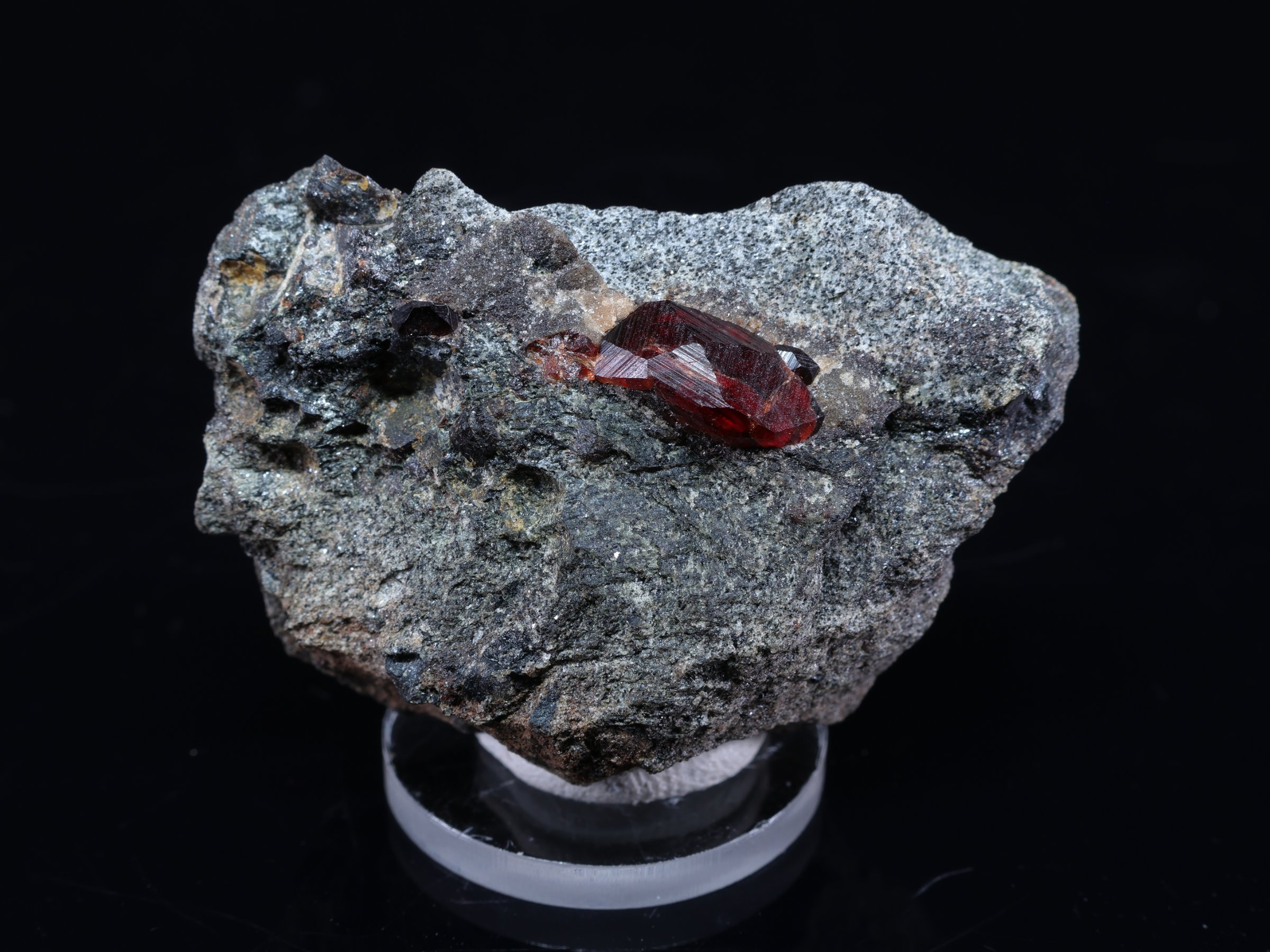
The specimen features a saturated, burgundy color and is set on a dark gray, compact matrix. The crystal exhibits a distinct glassy luster and well-formed faces, which reveal a deep cherry translucency under appropriate lighting. Main features: deep cherry-red color; strong glassy luster; high visual contrast with the matrix. Condition: Very good.
Price: 14 EUR (59 PLN)
Availability: In stock
Location: Colle del Vento, Villar Focchiardo, Metropolitan City of Turin Province, Piedmont, Italy
Size: 48 x 26 x 31 mm
Weight: 41.9 g
Chemical formula: Fe²⁺₃Al₂(SiO₄)₃
Mohs hardness: 7-7.5
Characteristics Almandine is a common mineral belonging to the garnet group, an iron aluminum silicate. It most often occurs as isometric crystals with a rhombic dodecahedron or icositetrahedron habit, less frequently in the form of granular aggregates. Its color ranges from dark red, through reddish-brown, to almost black. It often exhibits a vitreous luster. Physical Properties Almandine is characterized by a Mohs hardness of 7-7.5, which makes it relatively scratch-resistant. It has a density in the range of 4.31-4.32 g/cm³. It is a brittle mineral, with a conchoidal to uneven fracture. It does not exhibit cleavage. Colors and Varieties The typical color of almandine is deep red, often with a purple or brown tint. Varieties of almandine are usually defined by the intensity and hue of the red. Some specimens may exhibit an asterism effect, forming a four-rayed star on the surface when cut en cabochon. History and Name The name "almandine" comes from Alabanda, a city in Caria in Asia Minor, where Pliny the Elder in the 1st century AD described red-colored gemstones. This mineral was known and used as an ornamental stone already in antiquity. Uses Almandine, due to its hardness and attractive color, is widely used as a gemstone. It is used for making rings, necklaces, and other ornaments. Lower quality specimens are used as an abrasive material, similar to other garnets.
Identification Almandine can be identified by its characteristic dark red color, vitreous luster, and the typical isometric crystal habit of garnets, most often rhombic dodecahedra. Its hardness (7-7.5 on the Mohs scale) is also a diagnostic feature. Distinguishing from Similar Minerals Almandine can be confused with other garnets, such as pyrope or spessartine, as well as with ruby or spinel. It differs from pyrope usually by its darker color and higher density. It differs from ruby and spinel by the absence of cleavage and a different crystallographic system. Crystal Forms Almandine most often forms well-developed crystals with a rhombic dodecahedron or icositetrahedron habit. It also occurs as granular aggregates, often in metamorphic rocks.
Genesis Almandine primarily forms in metamorphic rocks, such as mica schists, gneisses, and amphibolites, under conditions of medium to high-grade regional metamorphism. It can also occur in pegmatites and in alluvial secondary deposits, where it is resistant to weathering. Mineral Associations Almandine often co-occurs with minerals such as micas (muscovite, biotite), quartz, feldspars, staurolite, kyanite, and sillimanite. In some cases, it may be associated with cordierite. Localities Significant almandine deposits are found in India (especially in the states of Odisha and Rajasthan), Sri Lanka, Brazil, USA (Idaho, Alaska), Czech Republic, Austria, Norway, Madagascar, and Tanzania.
Quality Criteria The most prized almandine specimens are those with an intense, deep red color, high transparency, and vitreous luster. Large, well-formed crystals without visible inclusions are particularly sought after. Specimens exhibiting an asterism effect are also highly valued. Popular Localities Particularly prized almandine specimens come from India, where large and clear crystals are found. Sri Lanka is also a known source of high-quality stones. In the USA, Idaho is known for the occurrence of good quality gem almandine garnets.
See mineralogical reference for Almandine in the Knowledge Base →