Almandine
Chemical formula: Fe<sup>2+</sup><sub>3</sub>Al<sub>2</sub>(SiO<sub>4</sub>)<sub>3</sub>
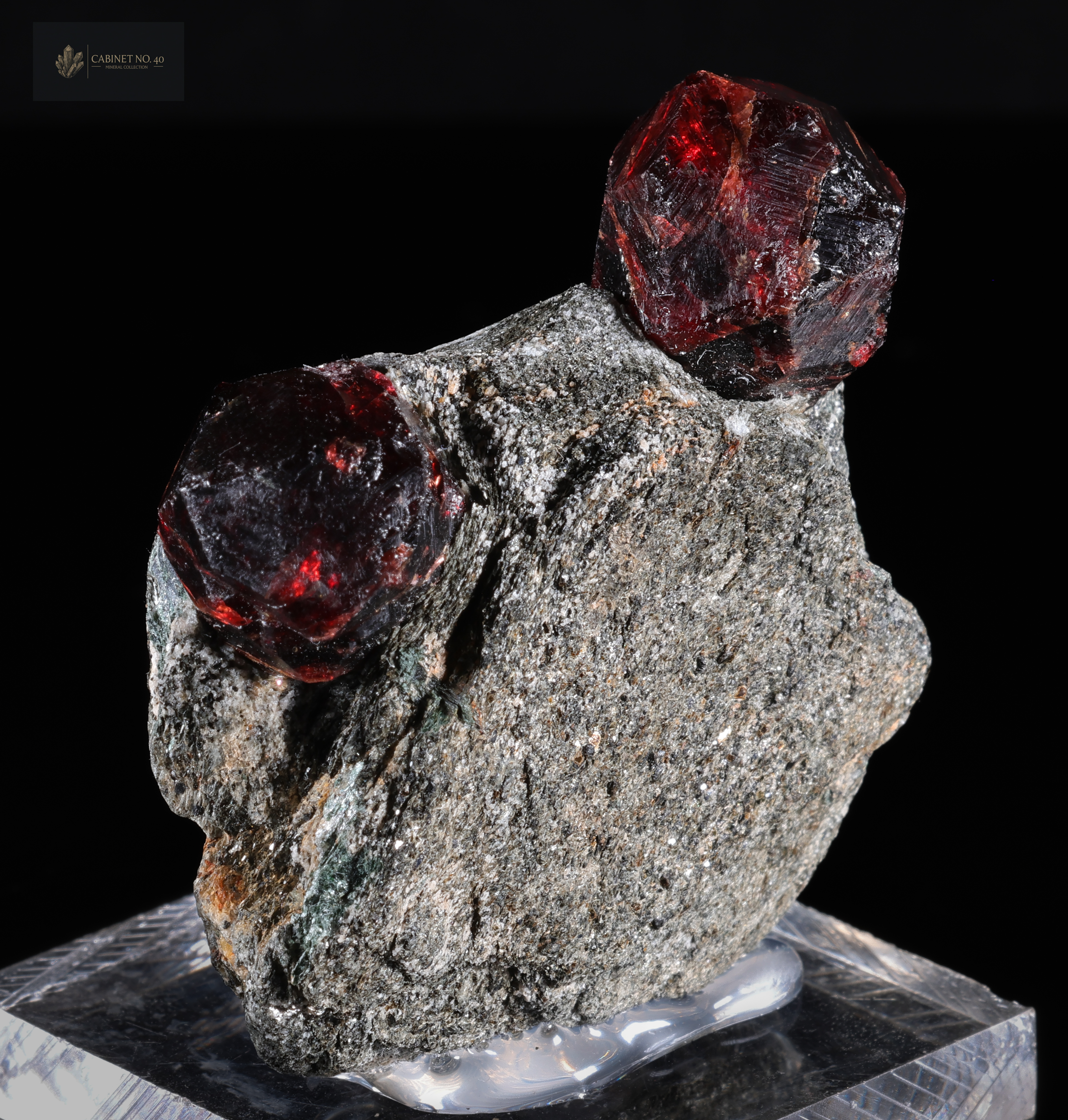
Almandine is a common mineral from the garnet group, an iron aluminum silicate, valued for its deep red colors and often occurring as well-formed crystals.
Properties
- Mohs hardness
- 7-7.5
- Color
- Deep red, brownish red, red-violet, black
- Luster
- Vitreous - Resinous
- Streak
- White
- Density
- 4.318
- Cleavage
- None
- Fracture
- Sub-Conchoidal
- Transparency
- Transparent,Translucent
- Crystal system
- Isometric
Diagnostic features
## Identification Almandine can be identified by its characteristic dark red color, vitreous luster, and the typical isometric crystal habit of garnets, most often rhombic dodecahedra. Its hardness (7-7.5 on the Mohs scale) is also a diagnostic feature. ## Distinguishing from Similar Minerals Almandine can be confused with other garnets, such as pyrope or spessartine, as well as with ruby or spinel. It differs from pyrope usually by its darker color and higher density. It differs from ruby and spinel by the absence of cleavage and a different crystallographic system. ## Crystal Forms Almandine most often forms well-developed crystals with a rhombic dodecahedron or icositetrahedron habit. It also occurs as granular aggregates, often in metamorphic rocks.
Geological environment
## Genesis Almandine primarily forms in metamorphic rocks, such as mica schists, gneisses, and amphibolites, under conditions of medium to high-grade regional metamorphism. It can also occur in pegmatites and in alluvial secondary deposits, where it is resistant to weathering. ## Mineral Associations Almandine often co-occurs with minerals such as micas (muscovite, biotite), quartz, feldspars, staurolite, kyanite, and sillimanite. In some cases, it may be associated with cordierite. ## Localities Significant almandine deposits are found in India (especially in the states of Odisha and Rajasthan), Sri Lanka, Brazil, USA (Idaho, Alaska), Czech Republic, Austria, Norway, Madagascar, and Tanzania.
Rarity
Common
For collectors
## Quality Criteria The most prized almandine specimens are those with an intense, deep red color, high transparency, and vitreous luster. Large, well-formed crystals without visible inclusions are particularly sought after. Specimens exhibiting an asterism effect are also highly valued. ## Popular Localities Particularly prized almandine specimens come from India, where large and clear crystals are found. Sri Lanka is also a known source of high-quality stones. In the USA, Idaho is known for the occurrence of good quality gem almandine garnets.
Care and storage
## Cleaning Almandine can be cleaned with warm water and mild soap. A soft brush should be used to remove dirt from crevices. After washing, the mineral should be thoroughly rinsed with clean water and dried with a soft cloth. ## What to Avoid Avoid cleaning almandine in ultrasonic cleaners, especially if the specimen has inclusions or fractures, as vibrations can cause damage. The mineral should also not be exposed to sudden temperature changes or contact with aggressive chemicals, which can dull its surface. ## Storage Almandine is best stored separately from other, harder minerals to prevent scratching. It is ideal to wrap it in a soft cloth or place it in a separate pouch or box. Specimens should be stored away from direct sunlight, which can affect the intensity of the color.