SKU: P_26-6_47
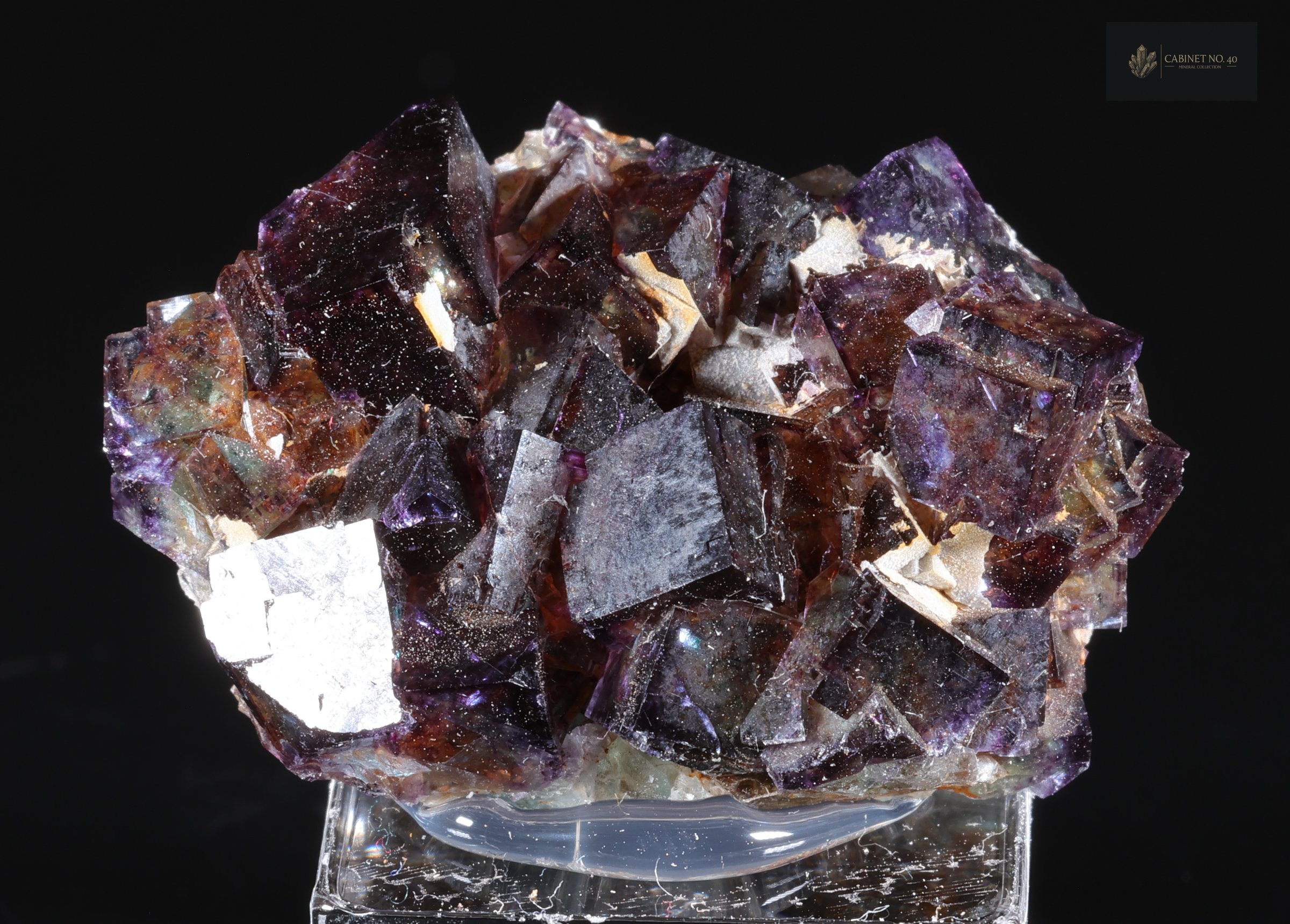
The fluorite specimen consists of numerous well-formed crystals ranging in color from dark purple to nearly black, with visible lighter purple and brownish reflections. The crystals exhibit partial transparency, creating the illusion of a black hue. Main features: fluorite crystals; dark purple to black color with lighter reflections; partially transparent. Condition: Very good.
Price: 9 EUR (39 PLN)
Availability: In stock
Location: Okorusu Mine, Otjiwarongo Constituency, Otjozondjupa Region, Namibia
Size: 30 x 16 x 19 mm
Weight: 15.5 g
Chemical formula: CaF₂
Mohs hardness: 4.0
Characteristics Fluorite is a mineral composed of calcium fluoride, found in many geological environments. Typical fluorite specimens are well-formed crystals with a cubic habit, less commonly octahedral or rhombic dodecahedral. It often forms massive, granular, or radial aggregates. Crystal surfaces can be smooth and lustrous, though they may also exhibit zonal growths or depressions. This mineral is prized for its color diversity, which is one of its most characteristic features. Physical Properties Fluorite has a hardness of 4 on the Mohs scale, meaning it is relatively soft and can be scratched with a knife. It exhibits a vitreous luster. It is transparent, though some specimens may be translucent. The density of fluorite is 3.175. It possesses excellent cleavage along octahedral planes, causing it to easily break into regularly shaped fragments. Colors and Varieties Fluorite occurs in an exceptionally wide range of colors, including purple, lilac, golden yellow, green, colorless, blue, pink, champagne, brown, red, and black. The color is often zonal, meaning different parts of the crystal have distinct colorations. Color changes can be caused by the presence of trace element impurities or structural defects. Some varieties of fluorite exhibit fluorescence under ultraviolet light, a phenomenon from which the mineral derives its name. History and Name The name "fluorite" comes from the Latin word "fluere," meaning "to flow," referring to its low melting point and use as a flux in metallurgy. This mineral was known and used in antiquity, but its formal description and name were established in later centuries. The first mentions of fluorite as a distinct mineral date back to 1529. Uses Fluorite is used in industry as a flux in metallurgy, for the production of hydrofluoric acid, and in the ceramic and optical industries for manufacturing lenses and prisms due to its low light dispersion. Specimens of high purity and attractive color are valued in jewelry and as ornamental and collectible stones.
Identification Fluorite can be identified by its characteristic crystal habit (most often cubes), wide range of colors, vitreous luster, and relatively low hardness (4 on the Mohs scale). A key diagnostic feature is its excellent cleavage along octahedral planes, often manifested by visible fractures or stepped surfaces. Many fluorite specimens also exhibit fluorescence under UV light. Distinguishing from Similar Minerals Fluorite is sometimes confused with some minerals of similar appearance, such as amethyst (a variety of quartz) or calcite. It is distinguished from amethyst by its significantly lower hardness (amethyst has a hardness of 7) and excellent cleavage, which quartz lacks. From calcite (hardness 3), fluorite is harder, and its cleavage is octahedral, whereas calcite has rhombohedral cleavage. The streak of fluorite is white, which also helps distinguish it from other darker-colored minerals. Crystal Forms Fluorite most commonly forms cubic crystals, often with visible modifications of faces. Octahedral or rhombic dodecahedral crystals are less common. Crystals can be single or form twins and aggregates. Granular, massive, or radial aggregates are also frequently found, as are crusts and coatings.
Genesis Fluorite forms in diverse geological environments. It is common in hydrothermal veins, where it crystallizes from hot aqueous solutions. It also occurs in pegmatites, greisens, skarn rocks, and in sedimentary carbonate rocks, where it forms as a result of diagenetic processes. It can also be a component of some igneous rocks, especially granites. Mineral Associations Fluorite often co-occurs with many other minerals. In hydrothermal veins, it is accompanied by quartz, calcite, barite, galena, sphalerite, chalcopyrite, and pyrite. In pegmatites, it can occur with topaz, beryl, and tourmaline. In sedimentary rocks, it is often found with dolomite and calcite. Localities Numerous locations worldwide are known for rich fluorite deposits. The most important include: United States (Illinois, Kentucky, Colorado), Mexico (Naica, San Luis Potosí), China (Inner Mongolia, Hunan), Germany (Saxony, Harz), United Kingdom (Derbyshire, Cornwall), Spain (Asturias), Russia (Dalnegorsk), and Namibia (Erongo). In Poland, fluorite occurrences are known in Lower Silesia, e.g., in the vicinity of Kletno and Stanisławów.
Quality Criteria The collector's appeal of fluorite depends on several factors. The most important are the intensity and purity of color, the transparency of the crystals, and their size and perfection of form. Specimens with well-formed, undamaged crystals are highly valued, especially those with rare colors or interesting zonal colorations. Specimens with matrix, i.e., intergrown with another rock or mineral, can also be highly sought after, provided they present an aesthetic composition. Popular Localities The most prized fluorite localities are those that yield specimens of exceptional aesthetic quality. Beautiful, often multicolored crystals come from China, especially from Hunan province and Inner Mongolia. Spanish deposits in Asturias are famous for large, purple and green cubes. From the United Kingdom, especially Derbyshire, come classic blue and purple specimens. Mexico, particularly the Naica region, provides impressive, large crystals. The United States, especially Illinois and Kentucky, are also sources of high-quality fluorites.
See mineralogical reference for Fluorite in the Knowledge Base →