Dark Brown Vesuvianite from Pakistan

SKU: 0264_3-PK

An aesthetic specimen characterized by distinct color and structural contrast. The lower part consists of a dense group of shiny, dark brown, in places almost black vesuvianite crystals with well-formed faces and a vitreous luster. Main Features: dark brown vesuvianite crystals; strong white and brown contrast; well-preserved edges; ex coll. K.Urbanik. Condition: Very good - the main vesuvianite crystals are complete and have intact faces.
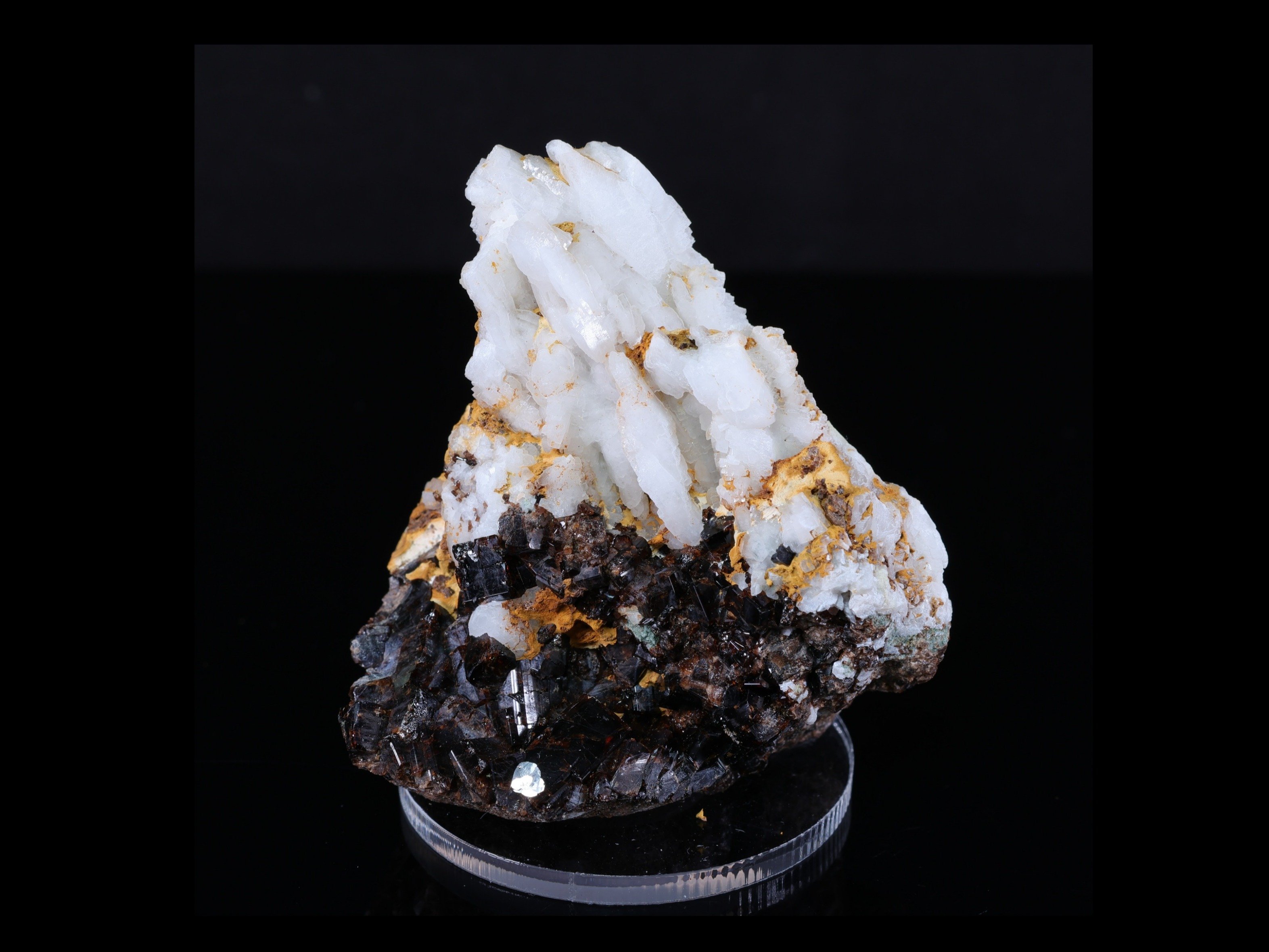
Dark Brown Vesuvianite from Pakistan

Price: 37 EUR (159 PLN)

Availability: In stock

Location: -, Pakistan

Size: 50 x 36 x 55 mm

Weight: 77 g

Chemical formula: Ca₁₀(Mg,Fe)₂Al₄(SiO₄)₅(Si₂O₇)₂(OH)₄

Crystal system: Tetragonal

Mohs hardness: 6.5

Mineral group: Vesuvianite Group

Rarity: Uncommon

Characteristics Vesuvianite is a silicate mineral with a complex chemical composition, belonging to the sorosilicate group. Typical vesuvianite specimens are characterized by prismatic or columnar crystals with a square or octagonal cross-section. It often forms massive or granular aggregates. Its appearance varies, from transparent and well-formed crystals to massive, opaque forms. Physical Properties Vesuvianite has a hardness of 6.5 on the Mohs scale. The luster of the mineral is usually vitreous, sometimes resinous. It is transparent to translucent. The density of vesuvianite is approximately 3.32 g/cm³. Colors and Varieties The color of vesuvianite is highly variable and can include shades of brown, yellow, green (including emerald green), white, red, purple, violet, as well as blue-green and blue. Brownish-black specimens also occur. The green, chromium-rich variety is known as californite, often mistaken for jadeite. History and Name The mineral was discovered in 1795. The name "vesuvianite" comes from Mount Vesuvius in Italy, where well-formed crystals of this mineral were first found. Historically, it was also called idocrase. Uses Vesuvianite is primarily a collector's mineral. Transparent varieties with attractive colors are sometimes cut as ornamental stones, although they are rarely found in jewelry due to their moderate hardness and cleavage.

Diagnostic features

Identification Vesuvianite can be identified by its tetragonal crystal habit, variable color, vitreous luster, and hardness of 6.5 on the Mohs scale. It often occurs in metamorphic rocks and skarns. Distinguishing from Similar Minerals Due to its color variability, vesuvianite can be confused with many other minerals. Green varieties may resemble jadeite, epidote, diopside, or garnet. It differs from epidote by the lack of distinct cleavage and a different crystallographic system. It differs from garnets by crystal habit and hardness. Brown varieties can be confused with andradite garnets. Crystal Forms Vesuvianite typically forms columnar or prismatic crystals, often with a square or octagonal cross-section. Crystal terminations can be pyramidal. It also occurs in granular, massive, or radial aggregates.

Formation environment

Genesis Vesuvianite primarily forms as a result of contact metamorphism, especially in skarns, where limestones and dolomites are altered in contact with magmatic intrusions. It can also occur in some regionally metamorphic rocks, such as gneisses and marbles, and in hydrothermal veins. Mineral Associations Vesuvianite often co-occurs with garnets (especially grossular and andradite), diopside, wollastonite, epidote, calcite, quartz, fluorite, and magnetite. Localities Significant vesuvianite localities are found in many places around the world. Classic specimens come from Vesuvius in Italy. Other important localities include Jeffrey Mine in Canada (pink and purple varieties), Pakistan (green and brown crystals), Russia (Urals), USA (California, Vermont, Maine), Mexico, and Switzerland.

For the collector

Quality Criteria The most prized vesuvianite specimens are those with well-formed, transparent crystals, intense and rare colors (e.g., purple, emerald green), without visible inclusions or damage. Crystal size also affects their collector's value. Popular Localities Specimens from historical localities, such as Vesuvius, and those with exceptional colors from the Jeffrey Mine in Canada are particularly sought after. Crystals from Pakistan and Russia are also highly regarded by collectors.

See mineralogical reference for Vesuvianite in the Knowledge Base →

View product →