Vesuvianite
Chemical formula: (Ca,Na)<sub>19</sub>(Al,Mg,Fe<sup>3+</sup>)<sub>13</sub>(SiO<sub>4</sub>)<sub>10</sub>(Si<sub>2</sub>O<sub>7</sub>)<sub>4</sub>(OH,F,O)<sub>10</sub>
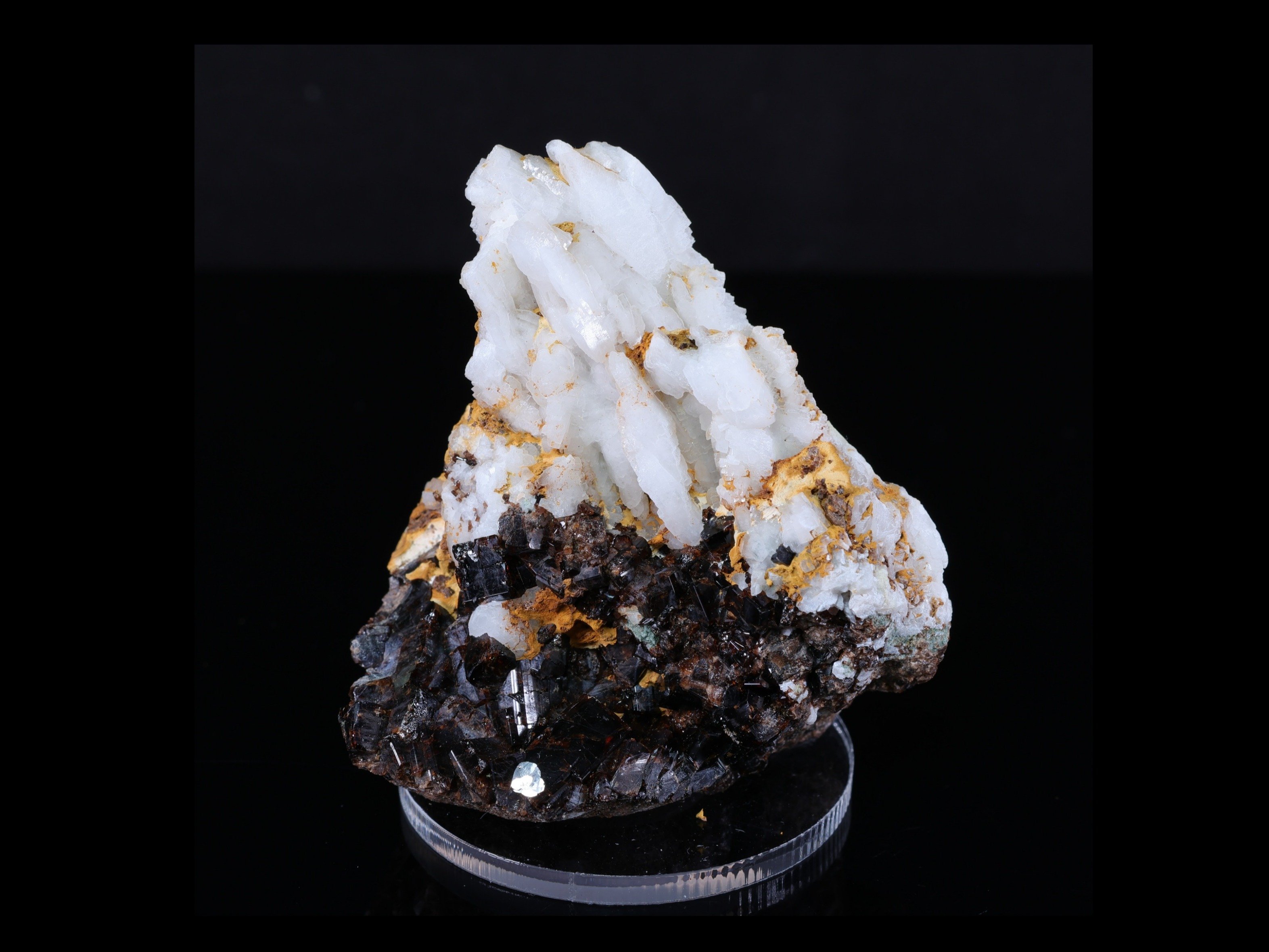
Vesuvianite is a complex calcium, magnesium, and aluminum silicate, often found in tetragonal crystals of variable color.
Properties
- Mohs hardness
- 6.5
- Luster
- Szklisty do żywicznego
- Streak
- White
- Density
- 3.32
- Cleavage
- Poor on {110} Very poor on {100} {001}
- Fracture
- Muszlowy do nierównego
- Transparency
- Transparent,Translucent
- Crystal system
- Tetragonal
Diagnostic features
## Identification Vesuvianite can be identified by its tetragonal crystal habit, variable color, vitreous luster, and hardness of 6.5 on the Mohs scale. It often occurs in metamorphic rocks and skarns. ## Distinguishing from Similar Minerals Due to its color variability, vesuvianite can be confused with many other minerals. Green varieties may resemble jadeite, epidote, diopside, or garnet. It differs from epidote by the lack of distinct cleavage and a different crystallographic system. It differs from garnets by crystal habit and hardness. Brown varieties can be confused with andradite garnets. ## Crystal Forms Vesuvianite typically forms columnar or prismatic crystals, often with a square or octagonal cross-section. Crystal terminations can be pyramidal. It also occurs in granular, massive, or radial aggregates.
Geological environment
## Genesis Vesuvianite primarily forms as a result of contact metamorphism, especially in skarns, where limestones and dolomites are altered in contact with magmatic intrusions. It can also occur in some regionally metamorphic rocks, such as gneisses and marbles, and in hydrothermal veins. ## Mineral Associations Vesuvianite often co-occurs with garnets (especially grossular and andradite), diopside, wollastonite, epidote, calcite, quartz, fluorite, and magnetite. ## Localities Significant vesuvianite localities are found in many places around the world. Classic specimens come from Vesuvius in Italy. Other important localities include Jeffrey Mine in Canada (pink and purple varieties), Pakistan (green and brown crystals), Russia (Urals), USA (California, Vermont, Maine), Mexico, and Switzerland.
Rarity
Very Common
For collectors
## Quality Criteria The most prized vesuvianite specimens are those with well-formed, transparent crystals, intense and rare colors (e.g., purple, emerald green), without visible inclusions or damage. Crystal size also affects their collector's value. ## Popular Localities Specimens from historical localities, such as Vesuvius, and those with exceptional colors from the Jeffrey Mine in Canada are particularly sought after. Crystals from Pakistan and Russia are also highly regarded by collectors.
Care and storage
## Cleaning Vesuvianite can be cleaned with a soft brush and lukewarm water. For heavier dirt, a mild soap can be used, followed by thoroughly rinsing the specimen with clean water. ## What to Avoid Avoid using aggressive chemical agents that can damage the mineral's surface. Vesuvianite is sensitive to sudden temperature changes, which can lead to cracks. Prolonged exposure to direct sunlight can cause some colored varieties to fade. It is also important to avoid impacts, as the mineral has poor cleavage. ## Storage Vesuvianite specimens are best stored in a dry place, away from direct sunlight and heat sources. They should be protected from dust by placing them in closed display cases or boxes lined with soft material to prevent scratches.