SKU: 0230_4-PK
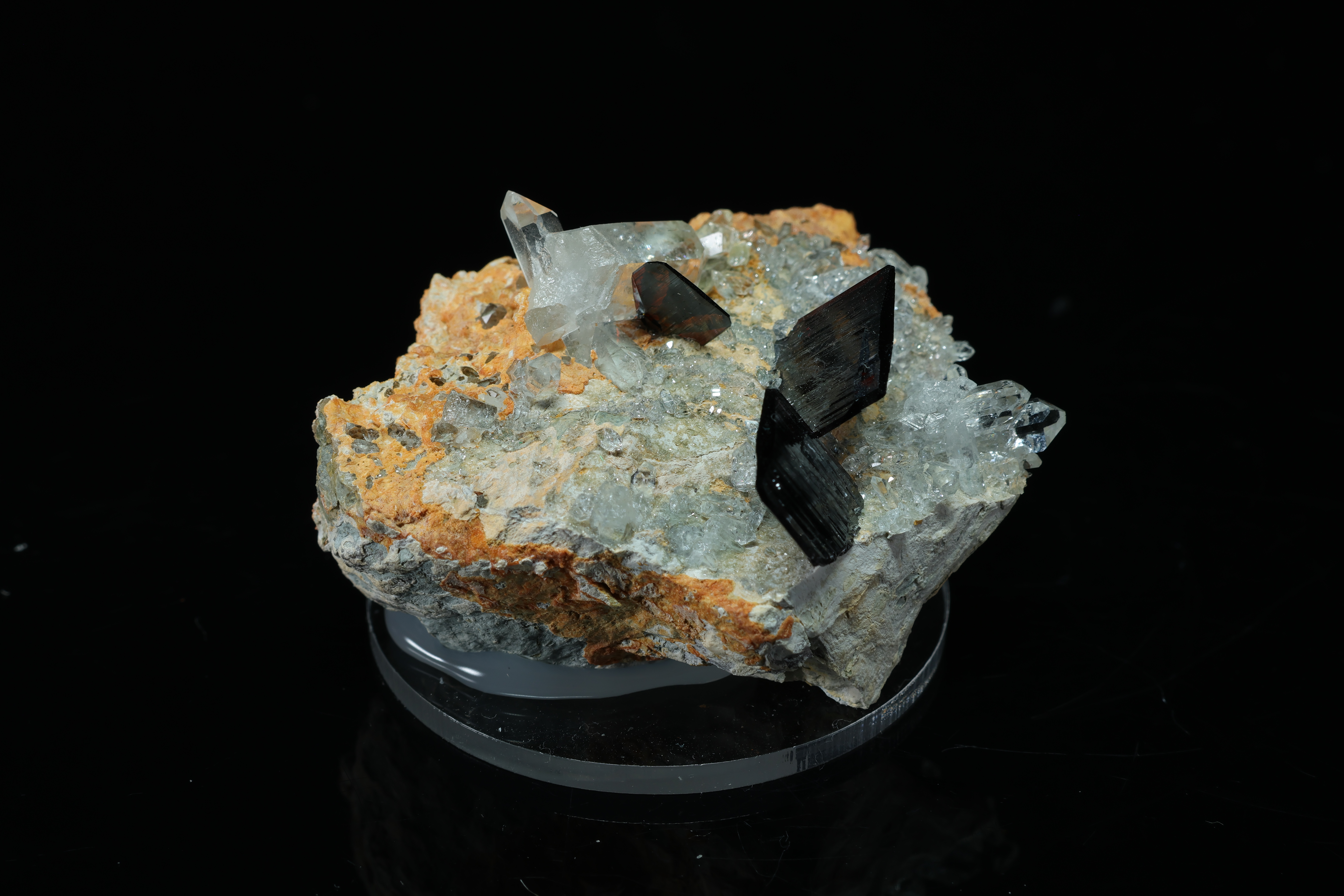
The specimen features dark brown, flattened crystals set on a lighter matrix composed of colorless quartz crystals. The main crystal is distinguished by its pronounced luster and sharp geometry with visible sculpting on the flat faces. In the vicinity of the dark brookite forms, a slender, transparent quartz crystal stands out clearly. Main features: pronounced color contrast of dark brookite with transparent quartz; strong luster of the crystal faces; stable matrix; ex coll K. Urbanik. Condition: Very good.
Price: 161 EUR (699 PLN)
Availability: In stock
Location: Kharan, Baluchistan, Pakistan
Size: 60 x 46 x 28 mm
Weight: 68.4 g
Chemical formula: TiO₂
Crystal system: orthorhombic
Mohs hardness: 5,5-6
Mineral group: Hematite Group
Rarity: Rare
Characteristics Brookite is a titanium oxide mineral, one of three naturally occurring polymorphs of TiO₂, alongside rutile and anatase. Typical brookite specimens are often tabular, flattened crystals, which can also be acicular or prismatic. Crystal surfaces may be striated. The color of brookite ranges from brown, through yellowish-brown, reddish-brown, to dark brown or black. In transmitted light, it can appear yellowish-brown to dark brown. Physical Properties The Mohs hardness of brookite is 5.5-6, making it a moderately hard mineral. It has a specific gravity of approximately 4.08 g/cm³. Brookite's luster is metallic to adamantine, which gives it a distinctive appearance. This mineral can be transparent, translucent, or opaque. Colors and Varieties Brookite occurs in shades of brown, yellow, red, and black. There are no widely known commercial or color varieties, but the intensity and hue of the color can vary depending on impurities and formation conditions. History and Name Brookite was described in 1825. Its name comes from Henry James Brooke (1771-1857), an English crystallographer and mineralogist, who contributed to its identification and description. Uses Due to its rarity and often attractive crystal habit, brookite is primarily a collector's mineral. It has no significant industrial applications, unlike rutile, which is an important source of titanium.
Identification Brookite can be identified by its characteristic, often tabular or platy crystal habit, which frequently exhibits striations. An important diagnostic feature is its strong, metallic to adamantine luster and color, which is usually within the brown and black spectrum. The streak of brookite is white to grayish-white or yellowish-white. Distinguishing from similar minerals Brookite is sometimes confused with other titanium minerals, such as rutile and anatase, with which it is polymorphic. It differs from rutile by its crystallographic system (rutile is tetragonal, brookite is orthorhombic) and often a different crystal habit. Anatase also has a different crystallographic system (tetragonal) and often forms bipyramidal shapes. From other dark minerals with metallic luster, brookite can be distinguished based on hardness, streak, and specific crystal forms. Crystal forms Brookite crystals are typically tabular, platy, often flattened parallel to one of the faces. They can also occur in prismatic or acicular forms. It often forms radial or massive aggregates.
Genesis Brookite forms in low-temperature, hydrothermal alpine veins, often in fissures of metamorphic rocks such as crystalline schists and gneisses. It can also occur as an accessory mineral in some igneous rocks, especially pegmatites, and in alluvial sediments as a heavy mineral. Mineral associations Brookite often co-occurs with quartz, adularia, chlorite, anatase, rutile, ilmenite, and hematite. In some deposits, it can also be found with titanite and garnets. Localities Known brookite localities include the Alpine region (e.g., Switzerland, Italy), where beautiful, well-formed crystals occur. Other important localities are Brazil (Minas Gerais), Pakistan (Gilgit-Baltistan), Russia (Urals), and the United States (Arkansas).
Quality criteria The most prized brookite specimens are those with well-formed, large, and distinct crystals with intense color and strong luster. Transparent crystals, especially those with beautiful color and without visible inclusions, are particularly sought after. The aesthetics of the specimen, including its form and how it is set on the matrix, are also important. Popular localities The most prized brookite specimens come from the Alps, especially Switzerland (e.g., Valais) and Italy (e.g., Val d'Ala). Other popular sources include Brazil, Pakistan, and Arkansas in the USA, which provide specimens of diverse forms and colors.
See mineralogical reference for Brookite in the Knowledge Base →