Brookite
Chemical formula: Ti<sup>4+</sup>O<sub>2</sub>
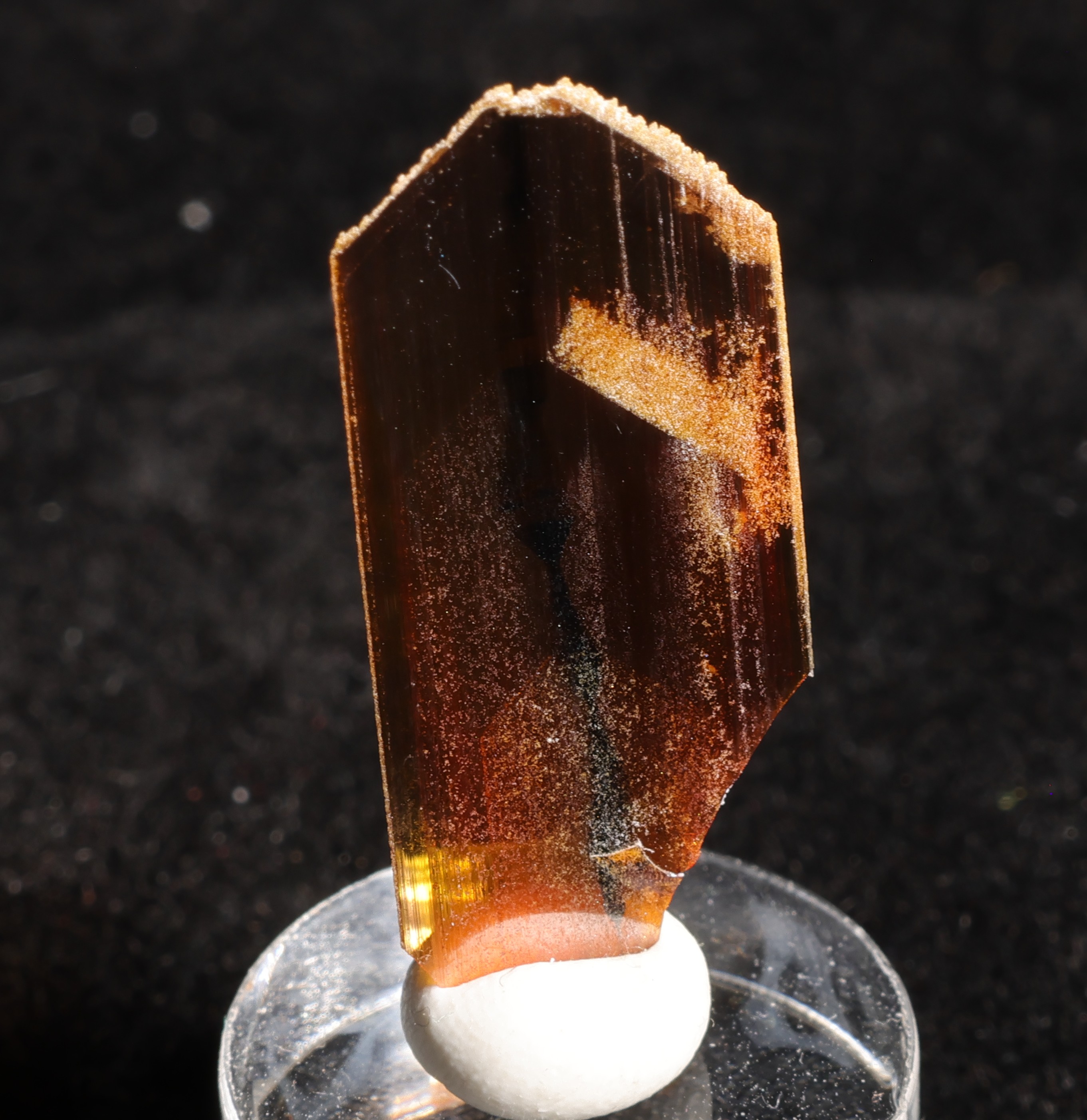
Brookite is a rare titanium oxide mineral, polymorphic with rutile and anatase, distinguished by its characteristic, often tabular crystals and strong luster.
Properties
- Mohs hardness
- 5.5-6
- Luster
- Metallic, Adamantine
- Streak
- White to greyish white or yellowish white
- Density
- 4.08
- Cleavage
- on {120}, in traces on {001}
- Fracture
- Brak danych
- Transparency
- Transparent,Translucent,Opaque
- Crystal system
- Orthorhombic
Diagnostic features
## Identification Brookite can be identified by its characteristic, often tabular or platy crystal habit, which frequently exhibits striations. An important diagnostic feature is its strong, metallic to adamantine luster and color, which is usually within the brown and black spectrum. The streak of brookite is white to grayish-white or yellowish-white. ## Distinguishing from similar minerals Brookite is sometimes confused with other titanium minerals, such as rutile and anatase, with which it is polymorphic. It differs from rutile by its crystallographic system (rutile is tetragonal, brookite is orthorhombic) and often a different crystal habit. Anatase also has a different crystallographic system (tetragonal) and often forms bipyramidal shapes. From other dark minerals with metallic luster, brookite can be distinguished based on hardness, streak, and specific crystal forms. ## Crystal forms Brookite crystals are typically tabular, platy, often flattened parallel to one of the faces. They can also occur in prismatic or acicular forms. It often forms radial or massive aggregates.
Geological environment
## Genesis Brookite forms in low-temperature, hydrothermal alpine veins, often in fissures of metamorphic rocks such as crystalline schists and gneisses. It can also occur as an accessory mineral in some igneous rocks, especially pegmatites, and in alluvial sediments as a heavy mineral. ## Mineral associations Brookite often co-occurs with quartz, adularia, chlorite, anatase, rutile, ilmenite, and hematite. In some deposits, it can also be found with titanite and garnets. ## Localities Known brookite localities include the Alpine region (e.g., Switzerland, Italy), where beautiful, well-formed crystals occur. Other important localities are Brazil (Minas Gerais), Pakistan (Gilgit-Baltistan), Russia (Urals), and the United States (Arkansas).
Rarity
Common
For collectors
## Quality criteria The most prized brookite specimens are those with well-formed, large, and distinct crystals with intense color and strong luster. Transparent crystals, especially those with beautiful color and without visible inclusions, are particularly sought after. The aesthetics of the specimen, including its form and how it is set on the matrix, are also important. ## Popular localities The most prized brookite specimens come from the Alps, especially Switzerland (e.g., Valais) and Italy (e.g., Val d'Ala). Other popular sources include Brazil, Pakistan, and Arkansas in the USA, which provide specimens of diverse forms and colors.
Care and storage
## Cleaning Brookite is a relatively hard mineral, but gentle cleaning is recommended. A soft brush and lukewarm water with a small amount of mild soap can be used. After washing, rinse the specimen thoroughly with distilled water and dry with a soft cloth. ## What to avoid Avoid using strong chemicals, acids, and bases, which can damage the mineral's surface. Brookite is sensitive to sudden temperature changes, which can lead to cracks. Prolonged exposure to direct sunlight may affect the color intensity of some specimens. Store away from excessive humidity. ## Storage Brookite specimens are best stored in enclosed display cases or boxes to protect them from dust and mechanical damage. For delicate crystals, it is advisable to place them on a soft pad or in a separate compartment to prevent abrasion.