SKU: B_34_0032
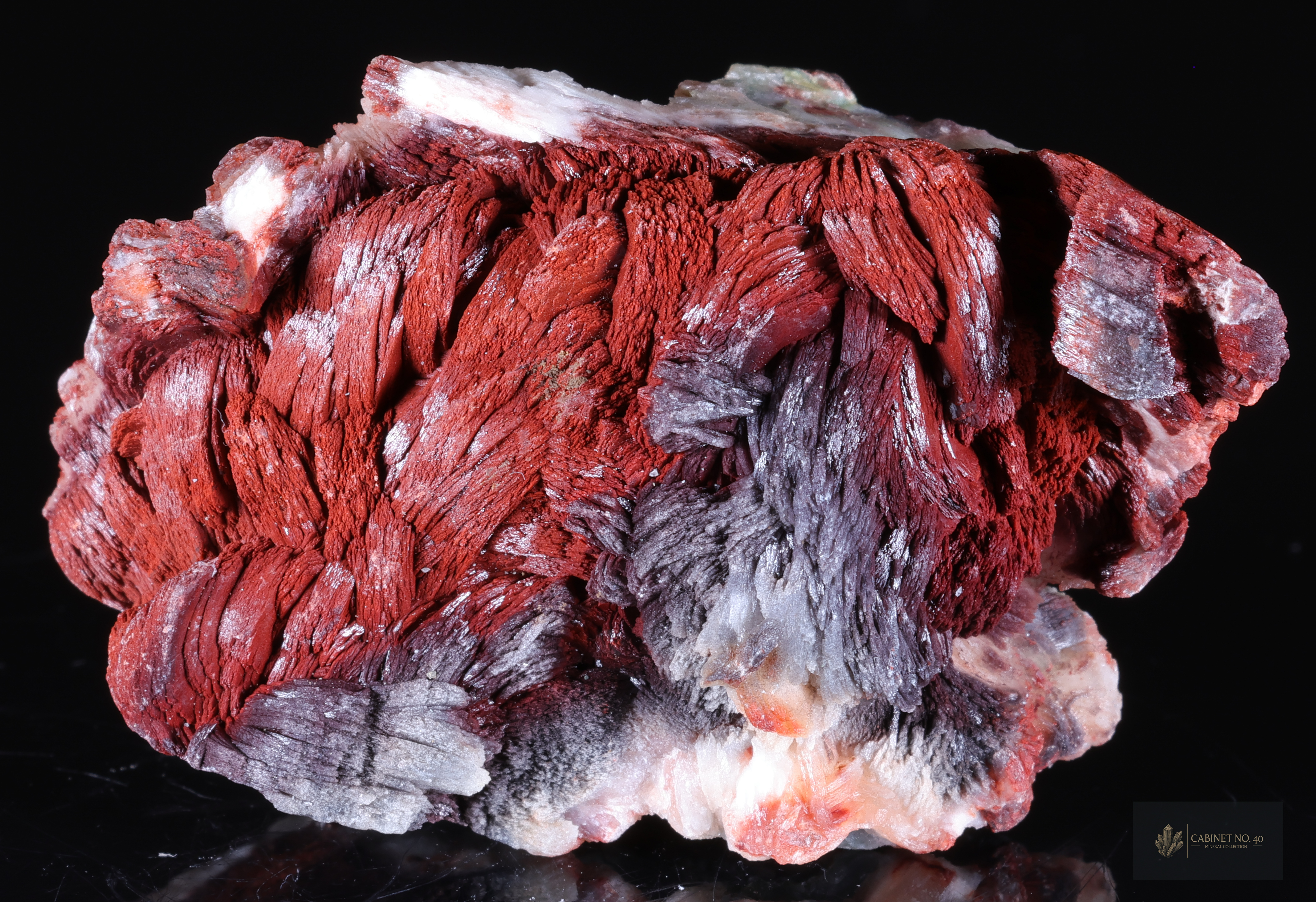
Collector's specimen, showcasing stilbite in two contrasting color varieties. The upper parts of the crystals are intensely red, while at their base, there is a rarely encountered black stilbite. Main features: Rare combination of red and black stilbite, strong contrast. Condition: Very good - the terminations are sharp and shiny, with no visible mechanical damage.
Price: 16 EUR (69 PLN)
Availability: In stock
Location: Aurangabad, Maharashtra, India
Size: 49 x 29 x 23 mm
Weight: 24.1 g
Chemical formula: NaCa₂Al₅Si₁₃O₃₆·₁₄H₂O
Crystal system: Monoclinic
Mohs hardness: 3.5–4.0
Characteristics Stilbite is a mineral belonging to the zeolite group, which are framework silicates. Typical stilbite specimens form radiating, sheaf-like, or fan-shaped crystal aggregates, often resembling sheaves of grain. The crystals are usually elongated, tabular, and their surfaces can be striated. The color of stilbite is variable, ranging from white, colorless, yellowish, orange, pink, to reddish-brown. This mineral often occurs in vugs and rock fissures, forming aesthetic shapes. Physical Properties Stilbite has a Mohs hardness of 3.5-4. Its luster is vitreous, often with a distinct pearly sheen on cleavage surfaces. This mineral is transparent to translucent. The density of stilbite ranges from 2.1-2.2 g/cm³. Colors and Varieties Stilbite occurs in a wide range of colors, with white, colorless, yellow, orange, and pink shades being the most common. Reddish-brown specimens are observed less frequently. The color depends on the presence of impurities, e.g., iron. No formal varieties of stilbite are distinguished, but color differences are often used to describe individual specimens. History and Name The name stilbite comes from the Greek word "stilbe," meaning luster, which refers to the characteristic pearly luster of the mineral. It was first described in 1797 by Jean-Claude Delamétherie. Uses Stilbite, like other zeolites, is used in industry as an adsorbent, catalyst, and in ion exchange processes. Due to its aesthetic forms and colors, it is a valued collector's mineral.
Identification Stilbite can be identified by its characteristic radiating or sheaf-like crystal aggregates, often with a pearly luster on cleavage surfaces. The color is usually white, yellowish, orange, or pink. Low hardness (3.5-4 on the Mohs scale) is also a diagnostic feature. Distinguishing from Similar Minerals Stilbite can be confused with other zeolites, such as heulandite. It differs from heulandite in its crystal structure and often a more distinct pearly luster. From other minerals with a similar habit, e.g., gypsum, it is distinguished by its hardness and reaction to acid (no reaction in the case of stilbite). Crystal Forms Stilbite most commonly forms tabular, elongated crystals that arrange themselves into radiating, sheaf-like, fan-shaped, or spherical aggregates. It also often forms druses and coatings in rock fissures. Crystals can be striated parallel to their elongation.
Genesis Stilbite forms mainly in low-temperature, hydrothermal conditions, often as a secondary mineral in gas vesicles and fissures in volcanic rocks, such as basalts, andesites, and rhyolites. It can also occur in hydrothermal veins and in some metamorphic and sedimentary rocks, where it is a product of diagenesis. Mineral Associations Stilbite often co-occurs with other zeolites, such as heulandite, chabazite, laumontite, analcime, as well as with calcite, apophyllite, quartz, and prehnite. Localities Known stilbite localities are found worldwide. The most important include India (Deccan Traps, especially around Mumbai and Nashik, famous for large and well-formed crystals), Iceland, Faroe Islands, Scotland, Northern Ireland, Canada (Nova Scotia), USA (Oregon, Washington), Australia, and Brazil.
Quality Criteria The most prized stilbite specimens are characterized by well-formed, large, and complete crystal aggregates with an intense, uniform color (especially pink, orange, or reddish). The transparency of the crystals and a distinct pearly luster are also important. Specimens embedded in an aesthetic matrix are particularly desirable. Popular Localities The most sought-after stilbite specimens come from India, especially from the Deccan Traps region, where they occur in large sizes and beautiful forms. Other valued localities include Iceland and the Faroe Islands.
See mineralogical reference for Stilbite in the Knowledge Base →