Stilbite
Chemical formula: M₆-₇[Al₈-₉Si₂₇-₂₈O₇₂]·nH₂O
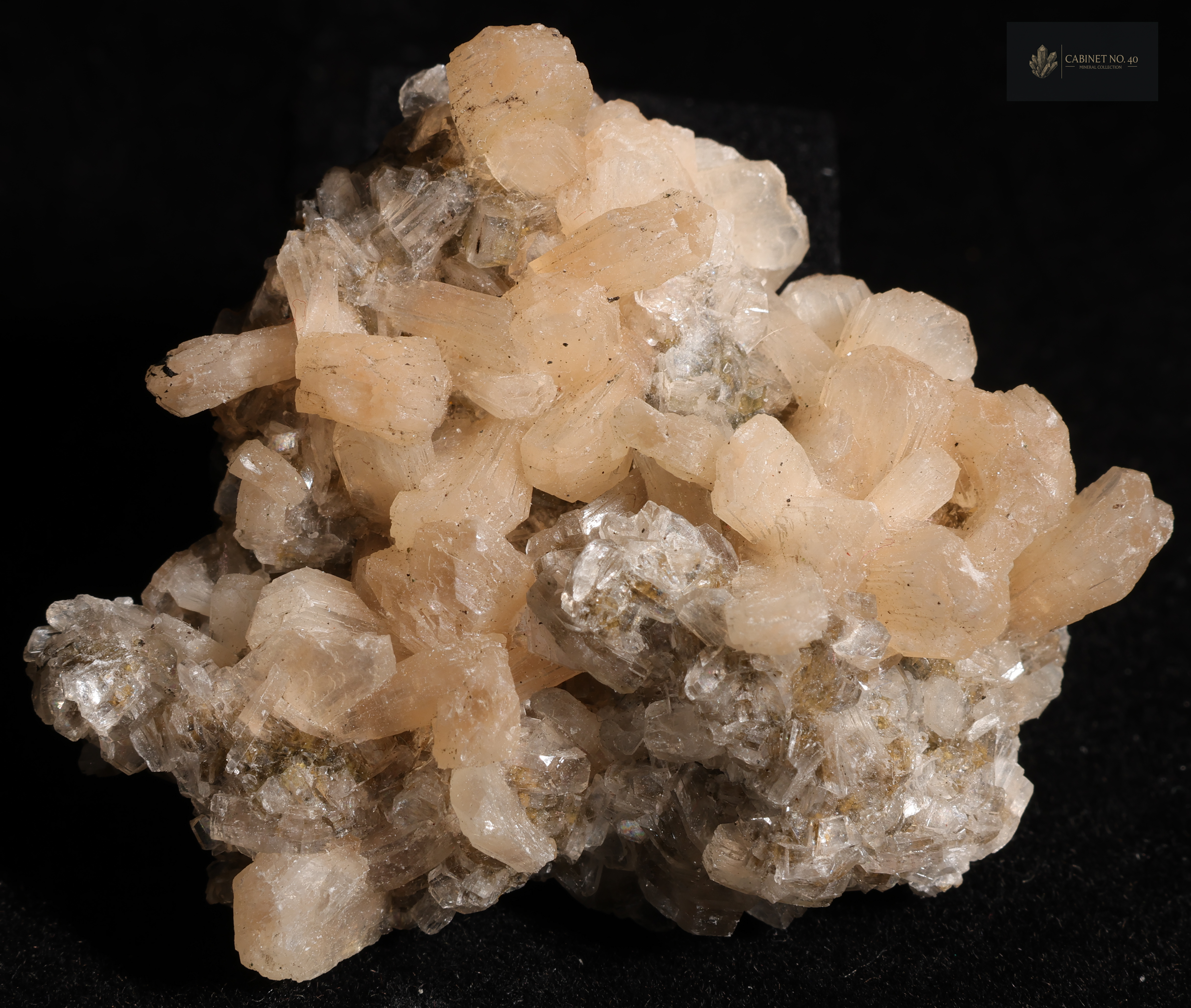
Stilbite is a mineral from the zeolite group, characterized by radiating or sheaf-like crystal aggregates, often with a pearly luster.
Properties
- Mohs hardness
- 3.5-4
- Luster
- Vitreous, Pearly on cleavage
- Streak
- White
- Density
- 2.1-2.2
- Cleavage
- Perfect on {010}
- Fracture
- Uneven
- Transparency
- Transparent to Translucent
- Crystal system
- Monoclinic
Diagnostic features
## Identification Stilbite can be identified by its characteristic radiating or sheaf-like crystal aggregates, often with a pearly luster on cleavage surfaces. The color is usually white, yellowish, orange, or pink. Low hardness (3.5-4 on the Mohs scale) is also a diagnostic feature. ## Distinguishing from Similar Minerals Stilbite can be confused with other zeolites, such as heulandite. It differs from heulandite in its crystal structure and often a more distinct pearly luster. From other minerals with a similar habit, e.g., gypsum, it is distinguished by its hardness and reaction to acid (no reaction in the case of stilbite). ## Crystal Forms Stilbite most commonly forms tabular, elongated crystals that arrange themselves into radiating, sheaf-like, fan-shaped, or spherical aggregates. It also often forms druses and coatings in rock fissures. Crystals can be striated parallel to their elongation.
Geological environment
## Genesis Stilbite forms mainly in low-temperature, hydrothermal conditions, often as a secondary mineral in gas vesicles and fissures in volcanic rocks, such as basalts, andesites, and rhyolites. It can also occur in hydrothermal veins and in some metamorphic and sedimentary rocks, where it is a product of diagenesis. ## Mineral Associations Stilbite often co-occurs with other zeolites, such as heulandite, chabazite, laumontite, analcime, as well as with calcite, apophyllite, quartz, and prehnite. ## Localities Known stilbite localities are found worldwide. The most important include India (Deccan Traps, especially around Mumbai and Nashik, famous for large and well-formed crystals), Iceland, Faroe Islands, Scotland, Northern Ireland, Canada (Nova Scotia), USA (Oregon, Washington), Australia, and Brazil.
Rarity
Not very common
For collectors
## Quality Criteria The most prized stilbite specimens are characterized by well-formed, large, and complete crystal aggregates with an intense, uniform color (especially pink, orange, or reddish). The transparency of the crystals and a distinct pearly luster are also important. Specimens embedded in an aesthetic matrix are particularly desirable. ## Popular Localities The most sought-after stilbite specimens come from India, especially from the Deccan Traps region, where they occur in large sizes and beautiful forms. Other valued localities include Iceland and the Faroe Islands.
Care and storage
## Cleaning Stilbite is a relatively soft mineral, so it should be cleaned gently. It is best to use a soft brush or paintbrush to remove dust. For heavier soiling, lukewarm distilled water and mild soap can be used, followed by thorough rinsing and drying. Avoid vigorous scrubbing. ## What to Avoid Avoid using aggressive chemicals, acids, and bases, which can damage the mineral's surface. Stilbite is sensitive to high temperatures, which can cause dehydration and loss of luster. Prolonged exposure to direct sunlight can also lead to color fading. Due to its porous structure, stilbite can absorb contaminants, so it should be protected from dust and dirt. ## Storage Stilbite specimens are best stored in enclosed display cases or boxes to protect them from dust and temperature changes. It is advisable to place them away from direct sunlight and heat sources. Due to its relative softness, avoid contact with harder minerals that could scratch stilbite.