SKU: B_26_0022
Brucite on the matrix in an intense yellow-green color, with a distinct character. A collector's specimen for those seeking larger, aesthetic forms of brucite in good color.
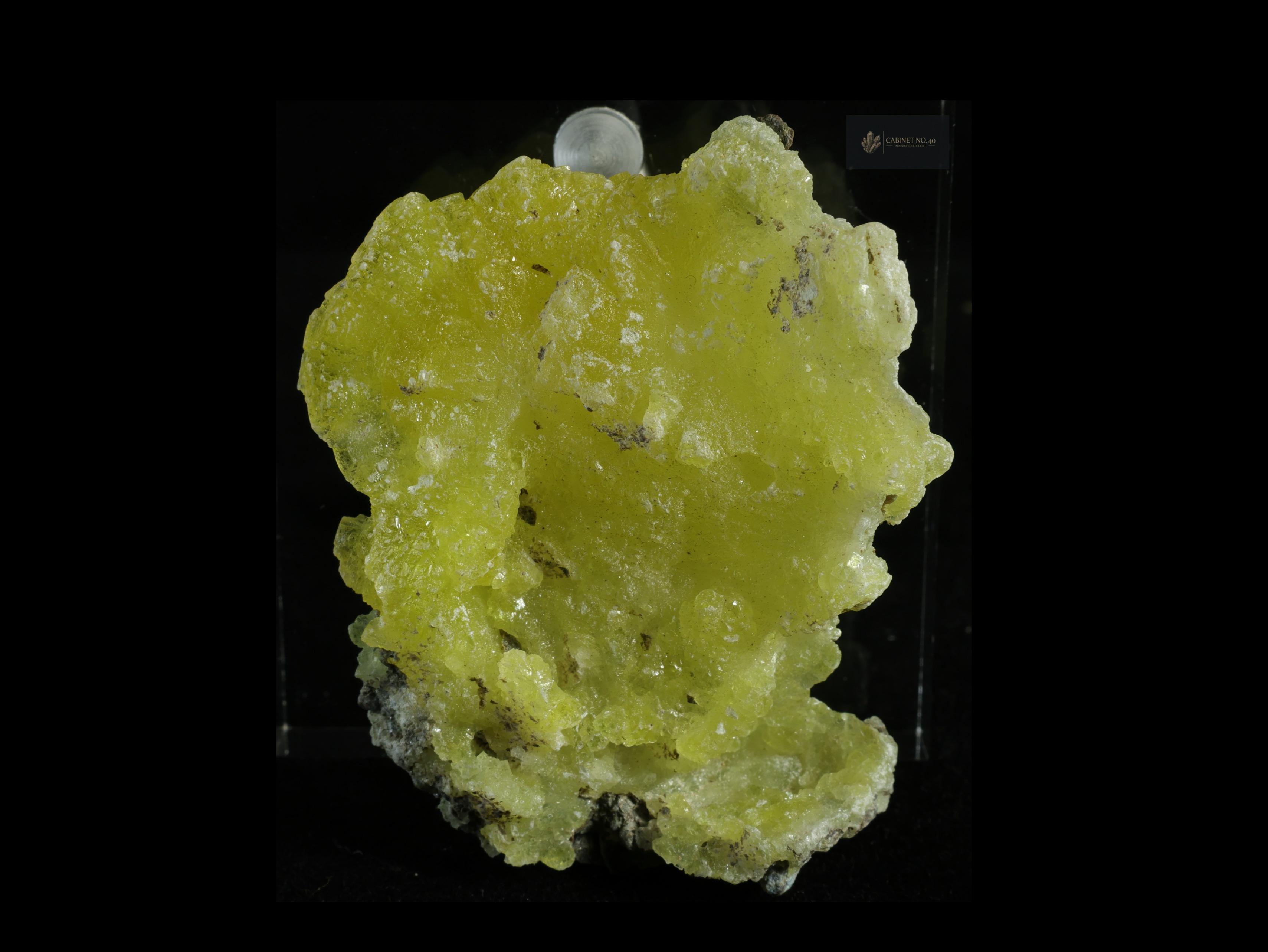
Price: 43 EUR (189 PLN)
Availability: In stock
Location: Baluchistan, Pakistan
Size: 41 x 52 x 20 mm
Weight: 25.1 g
Chemical formula: Mg(OH)₂
Crystal system: Trigonal
Mohs hardness: 2.5
Rarity: Rare
Characteristics Brucite is a magnesium hydroxide that typically occurs as lamellar, platy, or fibrous aggregates, less commonly as well-formed crystals. Brucite specimens are often soft and flexible, and their surface can have a characteristic pearly luster, especially on cleavage planes. This mineral can be transparent to translucent, giving it a delicate appearance. Physical Properties The hardness of brucite on the Mohs scale is 2.5-3, making it a relatively soft mineral. It possesses perfect cleavage in one direction, which is typical for lamellar minerals. The density of brucite is approximately 2.39 g/cm³. The streak of brucite is white. This mineral exhibits vitreous, pearly, and sometimes waxy luster. Colors and Varieties Brucite most commonly occurs in white, pale green, grayish, or bluish colors. Varieties containing manganese impurities can take on honey-yellow, reddish-brown, and even dark brown hues. The color of brucite is often delicate and pastel. History and Name Brucite was described in 1824 and named after the American mineralogist Archibald Bruce, who was the first to study this mineral. This name commemorates his contribution to mineralogy and the discovery of new mineral species. Uses Brucite has limited industrial applications. It is used as a raw material for the production of magnesium oxide, which finds application in the refractory, cement industries, and as a fertilizer additive. High-quality and aesthetically pleasing specimens are sought after by collectors.
Identification Brucite can be identified by its softness, pearly or vitreous luster, and lamellar or fibrous habit. Perfect cleavage in one direction is also characteristic. It often occurs in leafy or fibrous aggregates. Distinguishing from Similar Minerals Brucite is sometimes confused with talc, but talc is even softer and feels greasy to the touch. It can also resemble gypsum, but gypsum is slightly harder and has different cleavage. Colored varieties of brucite may resemble serpentine, but brucite is much softer and has a different structure. Crystal Forms Brucite most commonly forms lamellar or tabular crystals, often with a hexagonal outline. It also occurs as fibrous aggregates, known as nemalite, and in radial, platy, or granular aggregates.
Genesis Brucite forms under low-temperature hydrothermal conditions, often in veins and fractures in serpentinite rocks and dolomitic marbles. It is also a secondary mineral, forming as a result of the alteration of magnesite and dolomite. Mineral Associations Brucite often co-occurs with minerals such as magnesite, dolomite, serpentine, calcite, aragonite, talc, and chromite. Localities Known brucite localities include the USA (New York, Pennsylvania), Canada (Quebec), Russia (Urals), Italy (Lombardy), Austria (Tyrol), and Pakistan (Balochistan), where beautiful, pale green specimens are found.
Quality Criteria The most prized brucite specimens are those with well-formed, transparent or translucent crystals, especially those with intense and rare colors, such as honey-yellow or green. Large, aesthetic lamellar or fibrous aggregates are also highly sought after. The purity of the mineral and the absence of mechanical damage are also important. Popular Localities Particularly valued brucite specimens come from Pakistan, especially from the Balochistan region, where beautiful, pale green crystals are found. Other important localities include New York in the USA, where white and bluish specimens occur, and Quebec in Canada.
See mineralogical reference for Brucite in the Knowledge Base →