Brucite
Chemical formula: Mg(OH)<sub>2</sub>
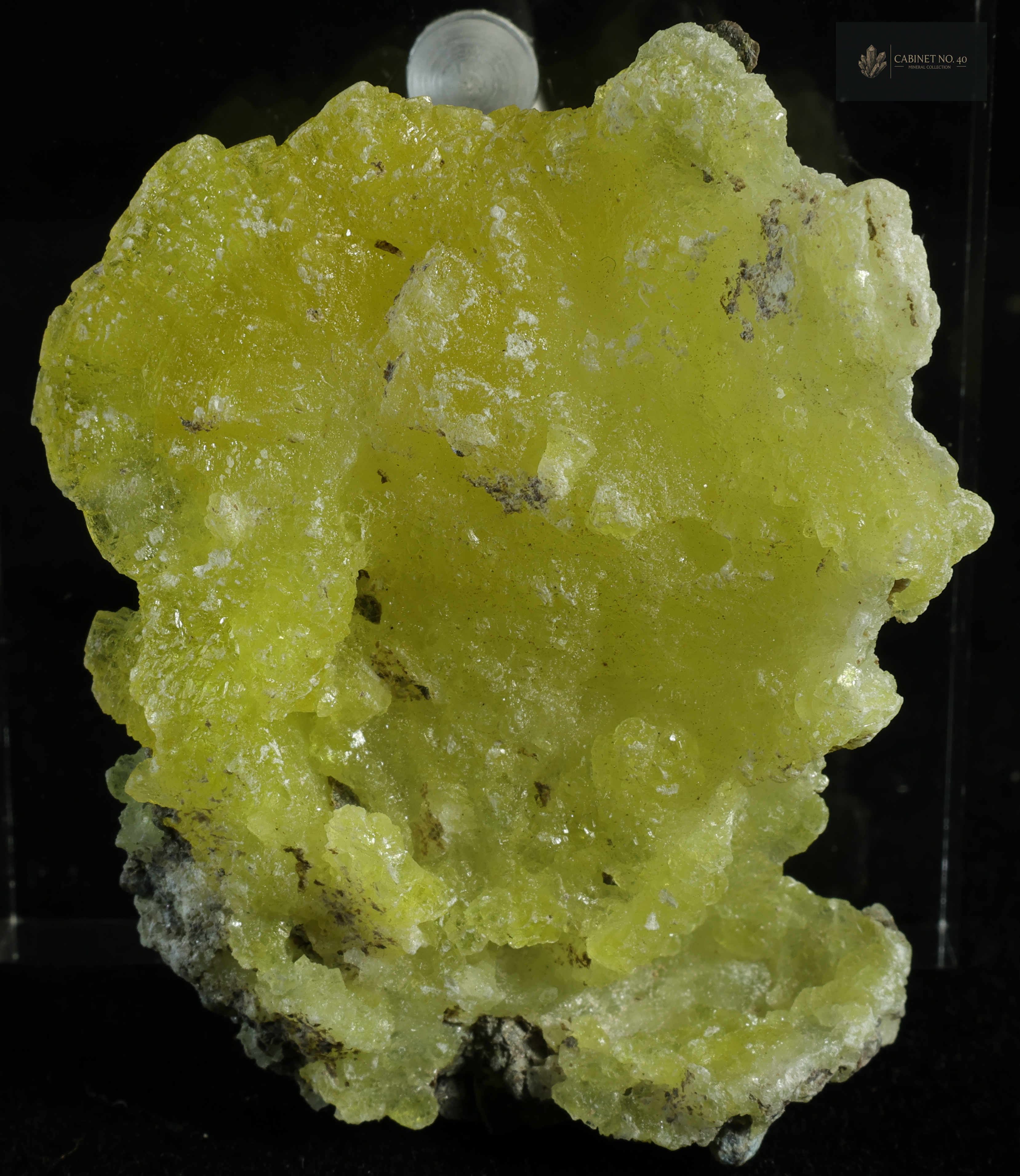
Brucite is a mineral from the magnesium hydroxide group, characterized by its softness and pearly luster, often forming lamellar or fibrous aggregates.
Properties
- Mohs hardness
- 2.5-3
- Luster
- Szklisty, perłowy, woskowy
- Streak
- White
- Density
- 2.39
- Cleavage
- On {0001}
- Transparency
- Transparent,Translucent
- Crystal system
- Trigonal
Diagnostic features
## Identification Brucite can be identified by its softness, pearly or vitreous luster, and lamellar or fibrous habit. Perfect cleavage in one direction is also characteristic. It often occurs in leafy or fibrous aggregates. ## Distinguishing from Similar Minerals Brucite is sometimes confused with talc, but talc is even softer and feels greasy to the touch. It can also resemble gypsum, but gypsum is slightly harder and has different cleavage. Colored varieties of brucite may resemble serpentine, but brucite is much softer and has a different structure. ## Crystal Forms Brucite most commonly forms lamellar or tabular crystals, often with a hexagonal outline. It also occurs as fibrous aggregates, known as nemalite, and in radial, platy, or granular aggregates.
Geological environment
## Genesis Brucite forms under low-temperature hydrothermal conditions, often in veins and fractures in serpentinite rocks and dolomitic marbles. It is also a secondary mineral, forming as a result of the alteration of magnesite and dolomite. ## Mineral Associations Brucite often co-occurs with minerals such as magnesite, dolomite, serpentine, calcite, aragonite, talc, and chromite. ## Localities Known brucite localities include the USA (New York, Pennsylvania), Canada (Quebec), Russia (Urals), Italy (Lombardy), Austria (Tyrol), and Pakistan (Balochistan), where beautiful, pale green specimens are found.
Rarity
Common
For collectors
## Quality Criteria The most prized brucite specimens are those with well-formed, transparent or translucent crystals, especially those with intense and rare colors, such as honey-yellow or green. Large, aesthetic lamellar or fibrous aggregates are also highly sought after. The purity of the mineral and the absence of mechanical damage are also important. ## Popular Localities Particularly valued brucite specimens come from Pakistan, especially from the Balochistan region, where beautiful, pale green crystals are found. Other important localities include New York in the USA, where white and bluish specimens occur, and Quebec in Canada.
Care and storage
## Cleaning Brucite is a soft mineral, so it should be handled with care. For cleaning, it is best to use a soft brush or a delicate brush to gently remove dust. For heavier dirt, lukewarm distilled water can be used, avoiding strong rubbing. ## What to Avoid Brucite should be kept away from acids, which can dissolve it. High temperatures and sudden temperature changes can cause damage. Prolonged exposure to direct sunlight can lead to color fading, especially in colored varieties. Due to its softness, brucite is susceptible to scratches, so it should be protected from contact with harder minerals. ## Storage Brucite is best stored in enclosed display cases or boxes lined with soft material to protect it from dust and mechanical damage. Maintaining stable temperature and humidity is advisable. Specimens should be displayed in areas where they will not be exposed to direct sunlight.