SKU: S_00069
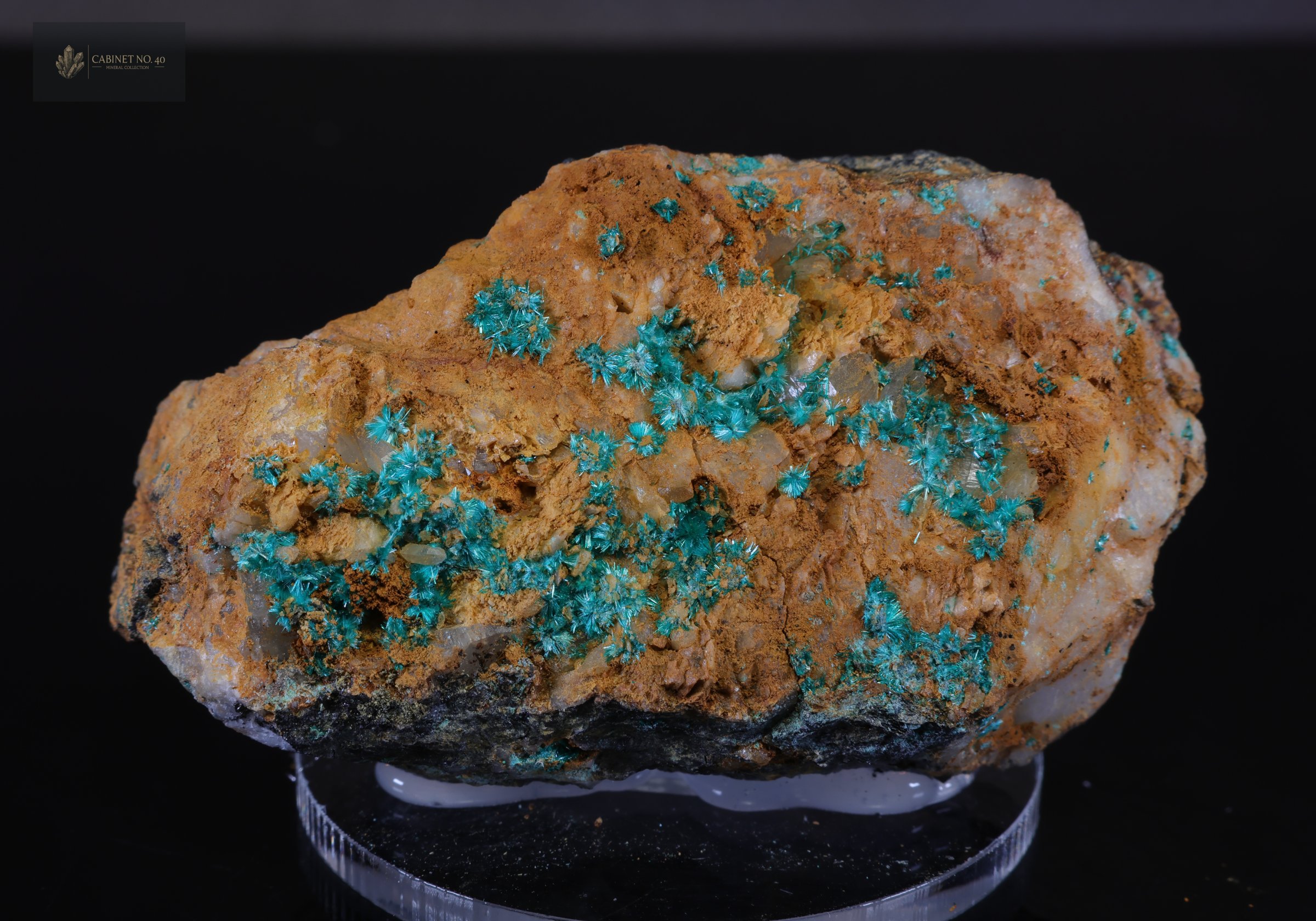
Aesthetic specimen of brochantite from a classic Spanish location. The mineral forms green crystalline clusters with a needle-like habit. Crystals are set against a contrasting matrix. Main Features: classic location; high contrast with the matrix. Condition: Very Good - crystals intact in the central parts of the matrix.
Price: 39 EUR (169 PLN)
Availability: In stock
Location: El Feliz Mine, Villaricos, Almería, Andalusia, Spain
Size: 55 x 30 x 15 mm
Weight: 47 g
Chemical formula: Cu₄SO₄(OH)₆
Crystal system: Monoclinic
Mohs hardness: 3.5–4.0
Characteristics Brochantite is a copper sulfate that crystallizes in the monoclinic system. It usually occurs as small, acicular or columnar crystals, often forming radial aggregates, fibrous masses, or crusts. Its color ranges from light green, through emerald green, to dark green, sometimes with a bluish tint. Brochantite crystals are transparent to translucent, and their luster is vitreous or pearly, especially on cleavage surfaces. Physical Properties The Mohs hardness of brochantite is 3.5-4, making it a relatively soft mineral. The specific gravity is approximately 3.97 g/cm³. This mineral exhibits perfect cleavage along the {100} plane. The streak of brochantite is light green. Colors and Varieties Brochantite occurs in shades of green, from light green to emerald green, sometimes with a hint of blue. Color is one of its most characteristic features. No specific commercial varieties are distinguished. History and Name The mineral was described in 1824 and named in honor of the French geologist and mineralogist, André Jean François Marie Brochant de Villiers, who was a professor of geology at the École des Mines in Paris and inspector general of mines. Uses Brochantite is a collector's mineral. Due to its rarity and small crystal size, it has no industrial significance as a copper ore, although its presence may indicate the occurrence of other, more abundant copper minerals.
Identification Brochantite can be identified by its characteristic, intensely green color, often emerald, and acicular or columnar crystal habit. It usually occurs in radial aggregates or as crusts. A light green streak is also a diagnostic feature. Distinguishing from similar minerals Brochantite is sometimes confused with malachite, atacamite, dioptase, or emerald. It is distinguished from malachite by its lack of reaction with hydrochloric acid (malachite effervesces), and from atacamite by a different streak color (atacamite has a green streak, but its color is often darker and more olive). Dioptase has significantly higher hardness and a more intense, bluish-green color. Emerald is much harder and has a different crystallographic system. Crystal forms Brochantite most often forms elongated, acicular or columnar crystals, which can be single or form radial aggregates, fibrous masses, and also crusts.
Genesis Brochantite is a secondary mineral, forming in the oxidation zones of copper deposits, in dry and arid climates. It forms as a result of the reaction of sulfate solutions with copper minerals, such as chalcopyrite or bornite. Mineral associations It often co-occurs with other secondary copper minerals, such as malachite, azurite, chrysocolla, cuprite, as well as with quartz and hematite. Localities Known brochantite localities include Chile (Chuquicamata), USA (Arizona, especially the Bisbee mine), Russia (Urals), Namibia (Tsumeb), Great Britain (Cornwall), and Australia.
Quality criteria The most prized brochantite specimens are those that exhibit well-formed, distinct, and large crystals of an intense, emerald-green color. Radial aggregates or druses with numerous, shiny crystals are particularly sought after. The aesthetic appeal of the specimen, contrast with the matrix, and absence of mechanical damage are also important. Popular localities The most valued specimens come from Chile (Chuquicamata), USA (Arizona), and Namibia (Tsumeb), where crystals of exceptional size and color intensity are found.
See mineralogical reference for Brochantite in the Knowledge Base →